Game-Maker: Sandbox Edition
DOS engine port and visual editors
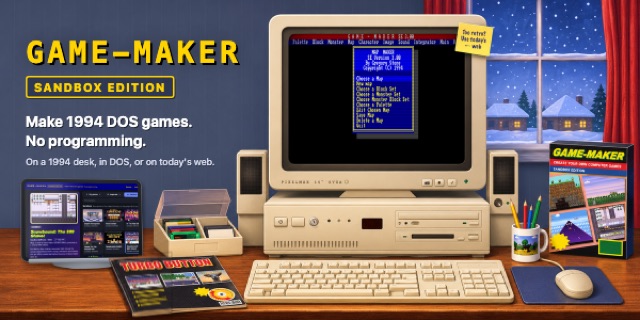
RSD Game-Maker 3.0 reimplemented and extended in TypeScript: original DOS file formats, browser editors, OPL2 audio, offline play, automated level checks, and an interactive 1994 desktop.
Live demo Source npm packages Video
Executive summary
Why it exists
RSD Game-Maker 3.0 was a 1991-1995 game construction kit, and its source was released under the MIT License in 2014. I shoveled Fort Ashby driveways in the winter of 1992 to buy it. This fork makes and plays DOS-style games in a web browser, with no programming, and keeps the original DOS files intact.
Outcome
A live, playable site with offline play and desktop exports. My November 2026 posts describe the project's growth, including a parallel-AI-agent workflow and the 3.2.0 release.
My role
Maintainer of the fork. Much of the recent code was written by AI agents under my direction, as my blog posts describe.
Technical overview
How it works
A port, not a PC emulator: Game-Maker and its PLAYGAME player are re-implemented in TypeScript from the released C source. Games are read and written byte for byte in the original formats, so a game made here still runs in DOS Game-Maker and DOSBox. There are three ways in: a 1994 desk with a simulated PC, the DOS screen alone, and a point-and-click web editor. A Level check plays each scene on the real engine, draws a heat map, marks places a player can get stuck, and offers fixes; a bot can record a walkthrough. The engine, archive tools, and builders are reusable npm packages. Original games are written entirely in code.
Hard parts
Matching the original exactly. The same code must make the same bytes: a check builds each game twice into separate folders and fails if any file differs, and another reads every original file, writes it back, and compares. Refactors must not change a generated byte.
Stack
Posts about it
- — Directing the Night Shift: a Pi that plays, a Pocket Player, and site 3.2.0
- — THE CHEZ: running the engine from npm in a separate project
- — Game-Maker OS wakes up on a Pi Zero
- — Pocket Players, pixel diplomas, and a growing Game-Maker Sandbox
- — How RSD Game-Maker Grew Beyond the Screen
- — Rebuilding RSD Game-Maker with Parallel AI Agents