Falken-9 model research report
Project overview · C64 game · Initial detailed study
The engineering question
Across Palace-9, Crystal-9 and Falken-9, the engineering question is:
Can a learned attention-and-expert network execute on a C64, play correctly, and be small enough to investigate exhaustively?
A specialized tic-tac-toe solver can be the better choice for speed or code size without answering that question about a learned network. This experiment asks whether learned attention and routed experts can execute as a correct C64 game and remain small enough to inspect systematically. Execution and gameplay checks are documented in the game guide; the following studies investigate the frozen model's computation.
Here, exhaustive checks cover declared finite board domains and explicitly bounded experiments, not a complete interpretation of every internal mechanism. Each study states what it enumerates and what remains unestablished.
The answer so far
The frozen model has causally relevant, distributed and position-sensitive components, but the studies have not established a dedicated win, block, fork or fork-prevention neuron/expert. Stored weights do not change with a board; activations, attention probabilities, routing/gates and their downstream contributions do. A failed search for a clean detector is not proof that the network contains no strategic information.
The same 5,195-byte F9J2 model was used throughout:
fe180f8a931f9d92d8aa39da337bc819d0dbe4e6d971edcba00324fbc18a91c1.
The studies run host-side exact-integer interventions and observational audits, comparing their baselines
to saved actual-target evidence. They are not new C64 performance benchmarks,
training runs or gameplay changes.
Model layout: the original weight and connection views
These two complementary inspectors show the accepted frozen model before the behavioral studies. They are documentation views, not different models.
Decoded weights and tensor workflow
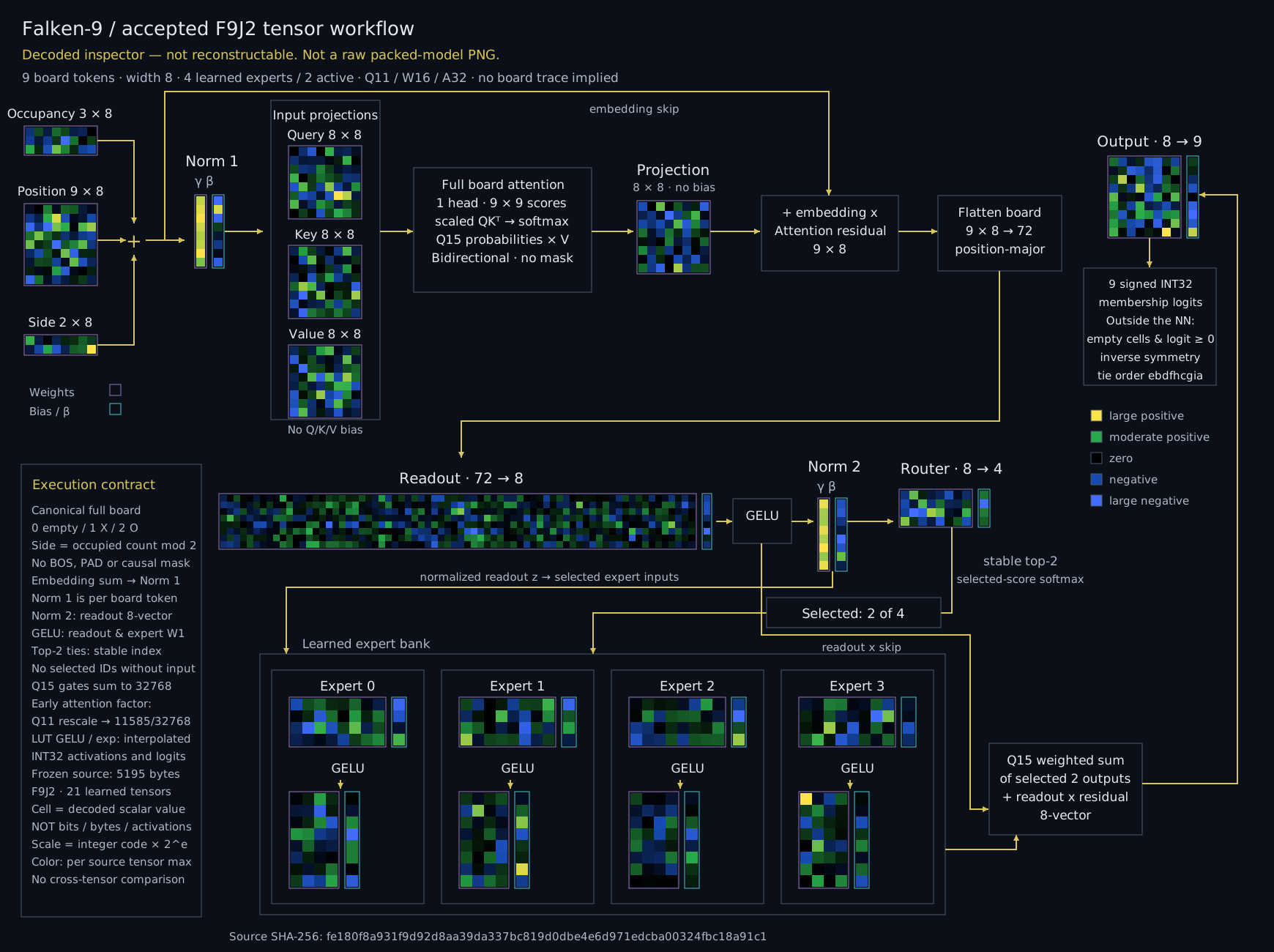
The original weight-map image, preserved byte-for-byte. Each cell represents one decoded scalar parameter, not a bit or byte. Colors normalize per tensor; all four expert banks are displayed, while only two selected experts execute per inference. Static weights are not board-dependent activations.
Workflow guide · Zoomable original SVG
Execution graph and residual connections
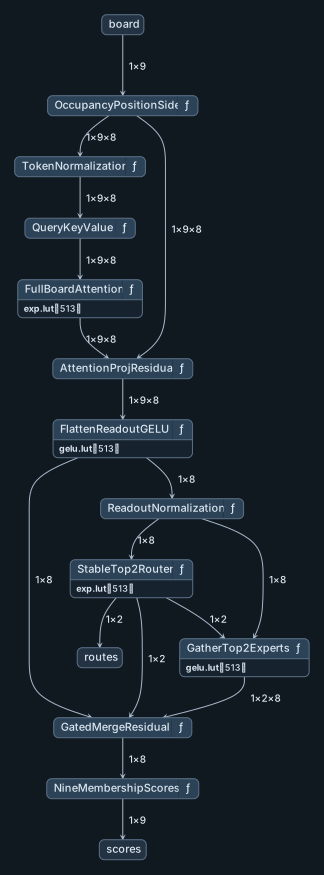
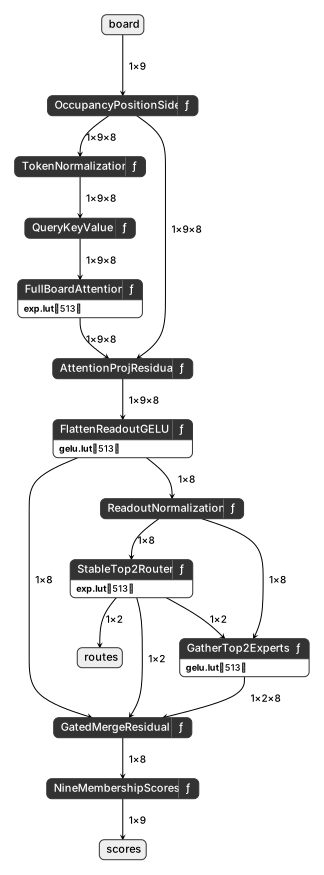
The original native Netron graph layout, with presentation colors adapted for this dark report. All node labels, tensor dimensions, paths and residual branches are unchanged. The PNG is browser-rendered from the recolored SVG; it is not labeled as a new native Netron export or new inference validation.
Original unmodified PNG · Original unmodified SVG · Inspection guide · Image provenance

Suggested reading routes
- See the computation: start with one actual forward pass, then return to the intervention studies.
- Understand the guarantees: compare wrapper symmetry, individual parameter intervals and joint safety.
- Understand the game: follow self-play coverage and its sampler qualification, then random-opponent versus worst-case outcomes.
Reading the figures
- Squares: research arrays generally use zero-based
0 1 2 / 3 4 5 / 6 7 8; the C64 shows human labels1 2 3 / 4 5 6 / 7 8 9. Check each figure's legend before comparing coordinates. A raw board and its canonical orientation can assign different numbers to the same physical mark. - Experts and units: E0–E3 are actual expert IDs, not route-slot numbers. An expert hidden unit is a measured activation coordinate, not a named tactic. Normally unselected expert values are unobserved unless explicitly evaluated as extra offline counterfactual work.
- Static versus dynamic: a stored code/scale is a parameter. Activations, attention, routes/gates and contributions depend on the input board. A bright cell is not automatically evidence that the model recognized a strategy.
- Sets versus moves: a legal square with score ≥0 belongs to the approved set. Score magnitude is not calibrated confidence or preference. The wrapper restores the full set to raw coordinates before applying its fixed move order. Thus an unchanged canonical chosen move can hide an incorrect raw decision.
- Colors: follow the local legend. In study009, green fills mean legal set membership and the contrasting outlines mean the chosen move—not the largest score.
- Evidence: a changed internal value, an output failure, a local restoration and a selective causal mechanism are different claims. Controls and surviving counterexamples are part of the explanation. Click embedded figures for SVGs.
Report index
| Study | Question and measured result | Full report | Annotated figures |
|---|---|---|---|
| 002 | Which activations/parameters associate with tactics, and does removing them affect moves? E1.h0 removal breaks a particular winning fork, but controls reject a dedicated-fork-neuron claim. | Original detailed report | Circuit map, board examples, symmetry map |
| 003 | Do effects vary with dose, donor, or combinations? 128 interventions show contextual necessity, donor non-interchangeability and cancellation. Removing E1.h0 and E1.h1 together rescues 8 canonical positions that fail under at least one individual lesion. | Preserved report | Necessity/dose, patch/restoration |
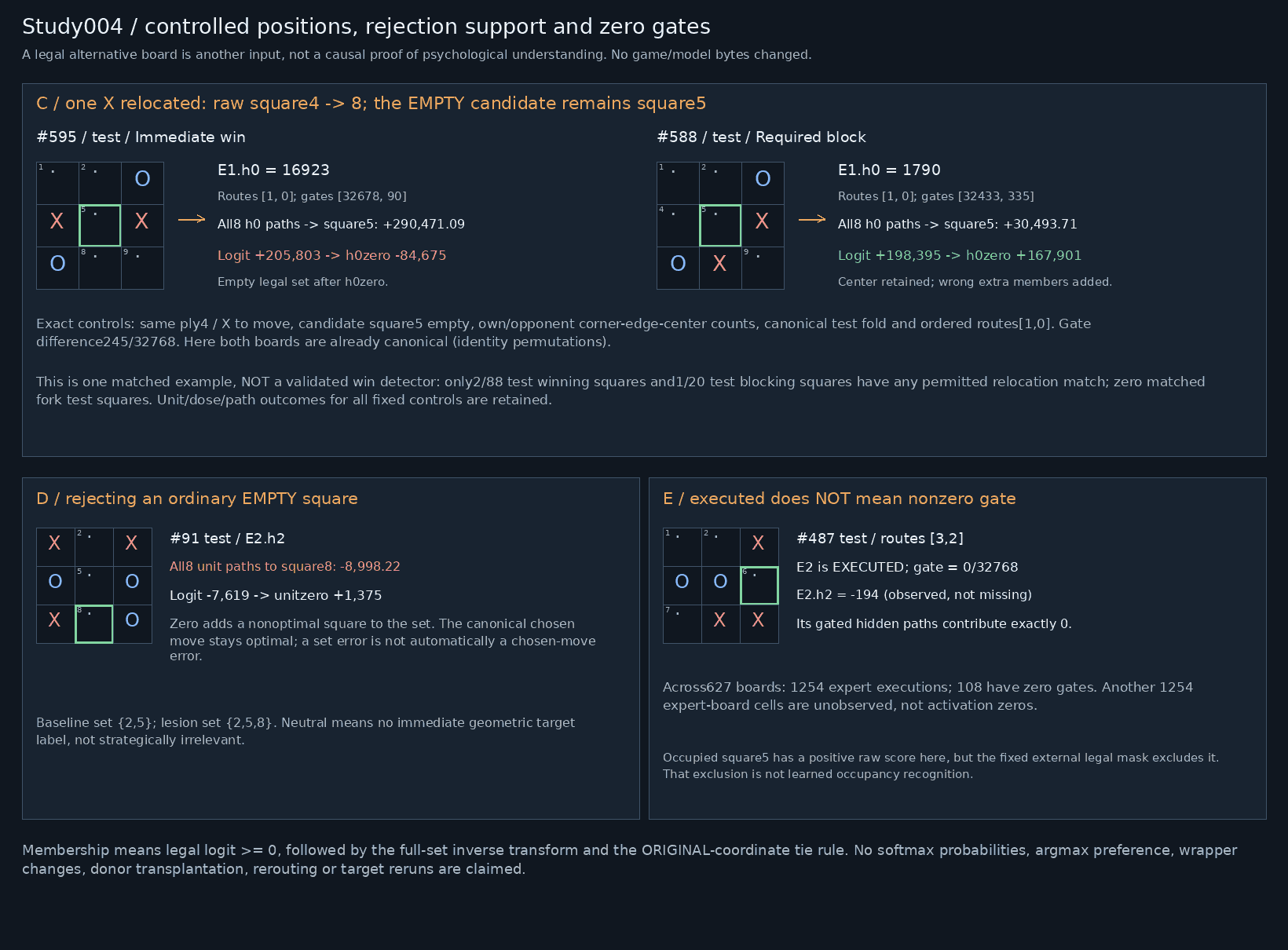
| 004 | How do actual weights support individual candidate squares? 22 interventions / 66 legal relocation contrasts accompany exact reconstruction of all 5,643 canonical scores, with rounding residuals explicit. One E2.h2→lane5 path supports a fork square on one board and opposes a fork square on another. | Preserved report | Square paths, position contrasts |
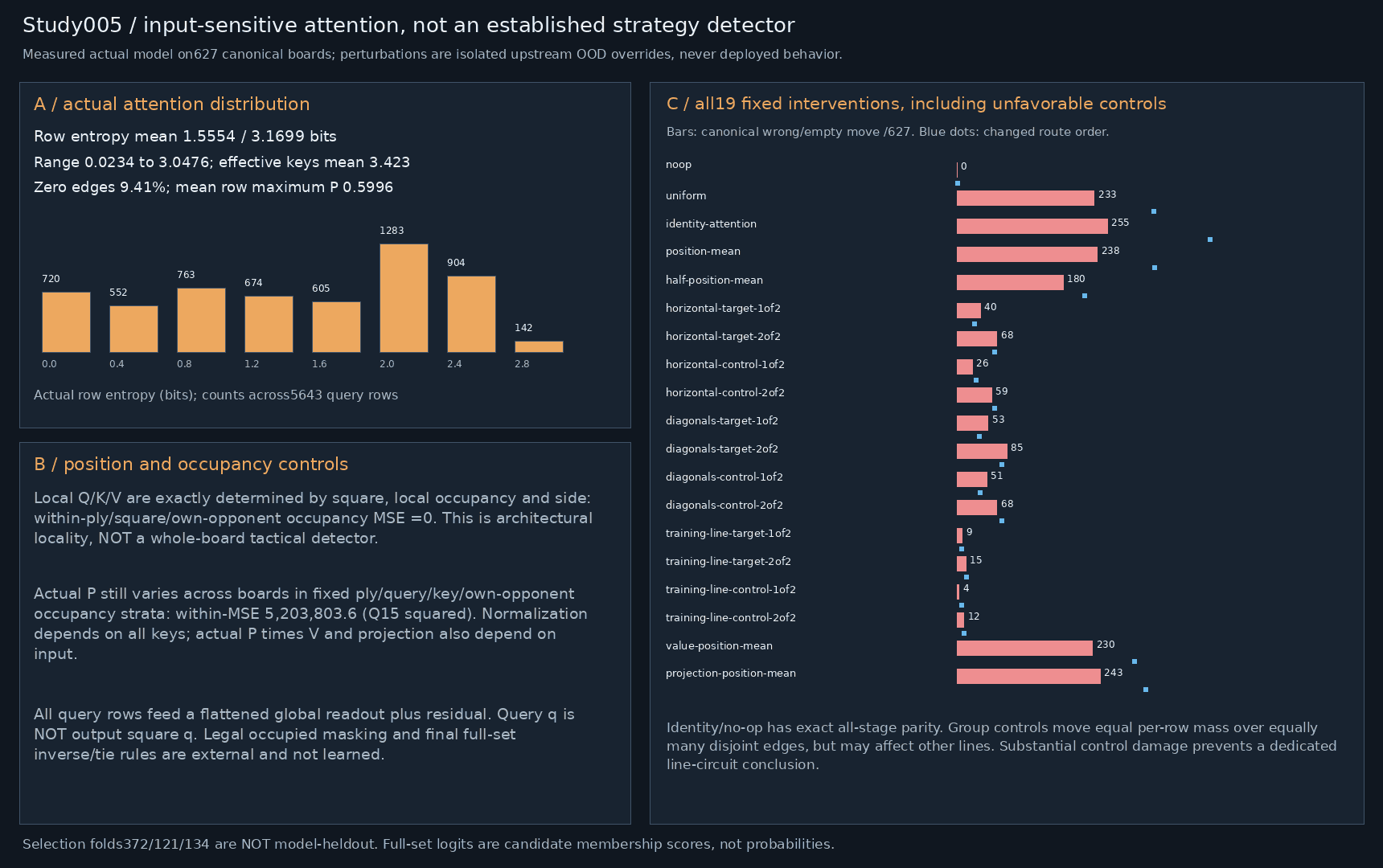
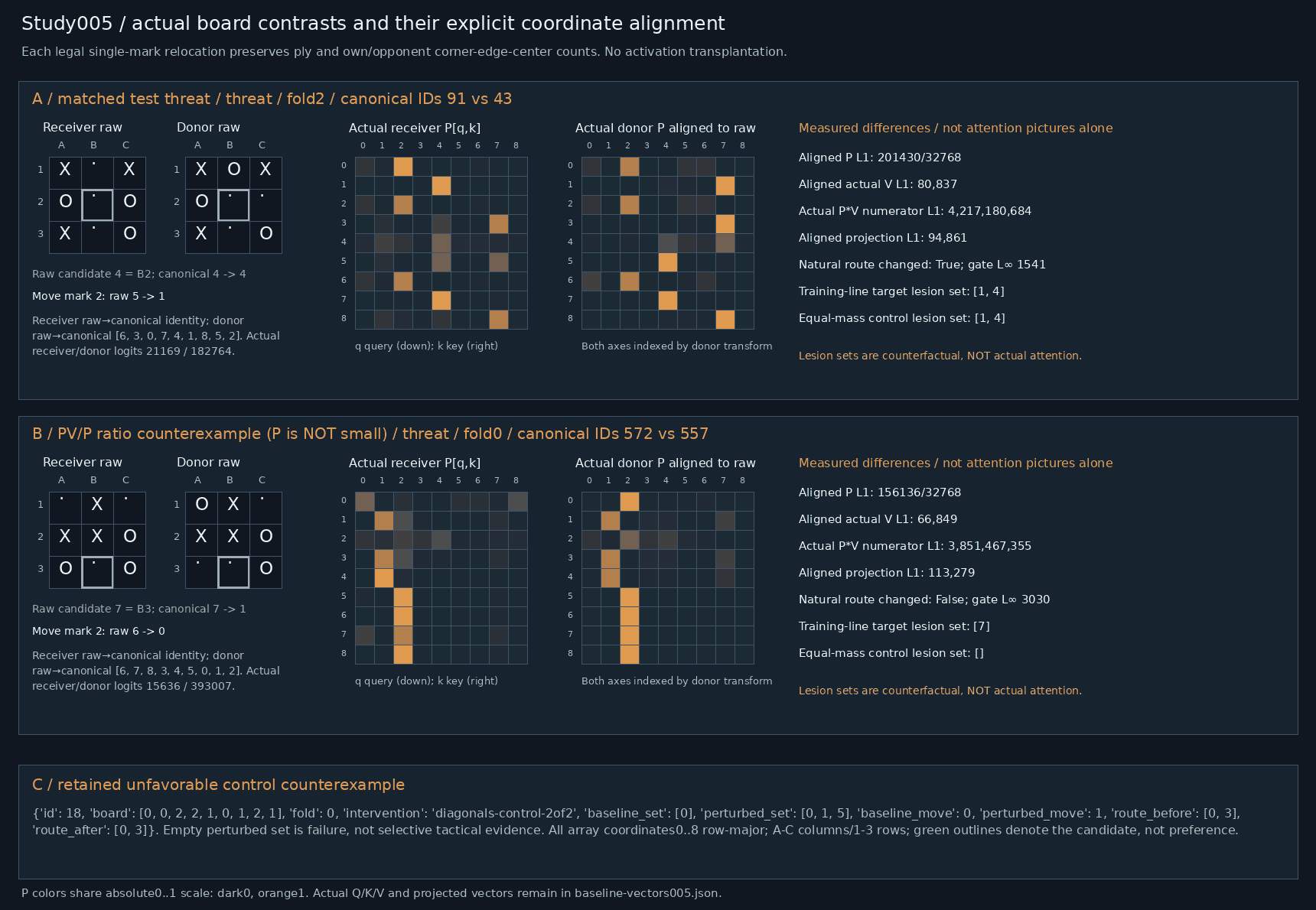
| 005 | Is attention only positional, or does it reflect board context/geometry? 19 interventions / 544 aligned legal relocation contrasts show input-sensitive attention and downstream effects, but not a selective line detector. Position-mean attention causes 238/627 canonical selected-move failures; a selected-line lesion causes 15, versus 12 equal-size/equal-moved-mass control failures. | Preserved report | Attention overview, contrasts |
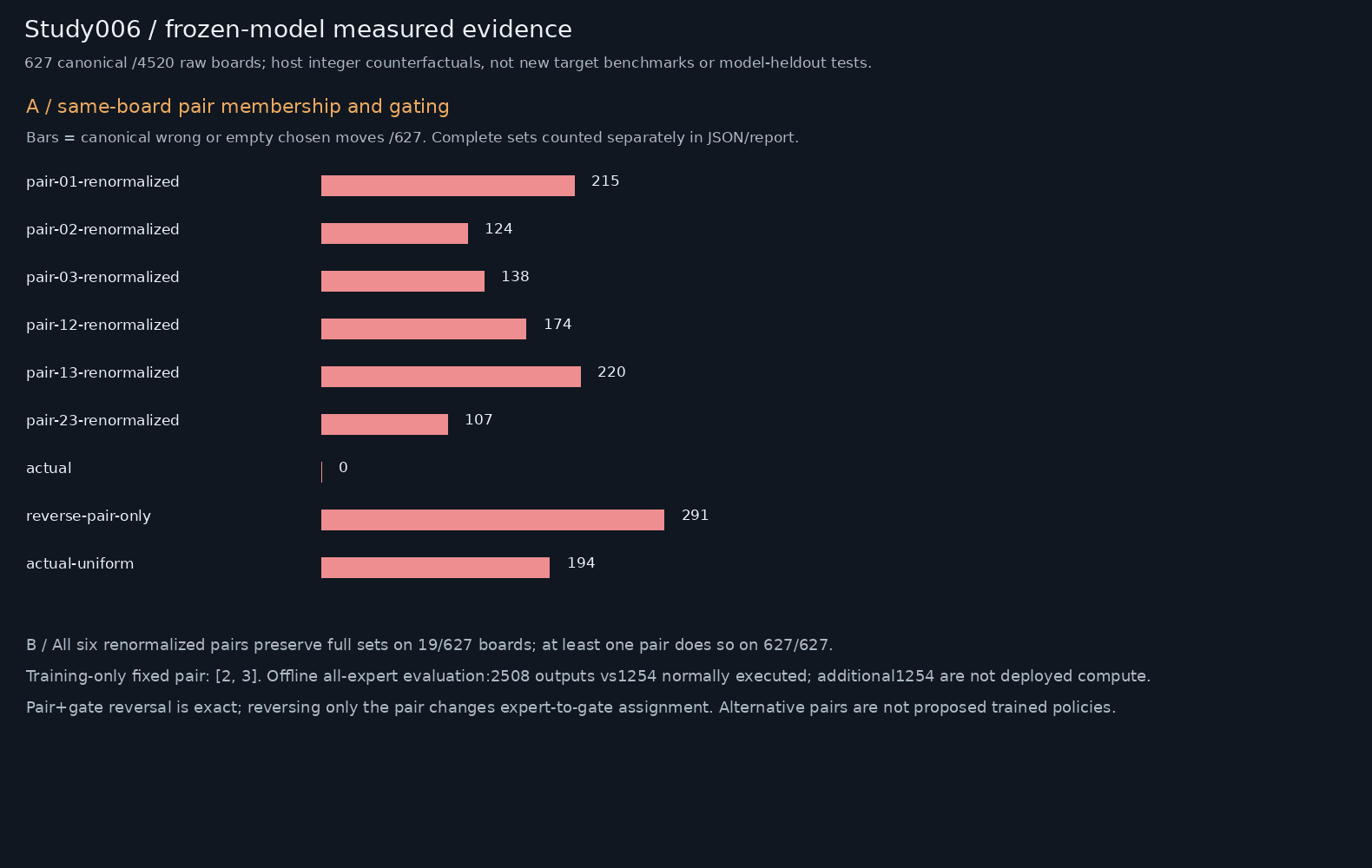
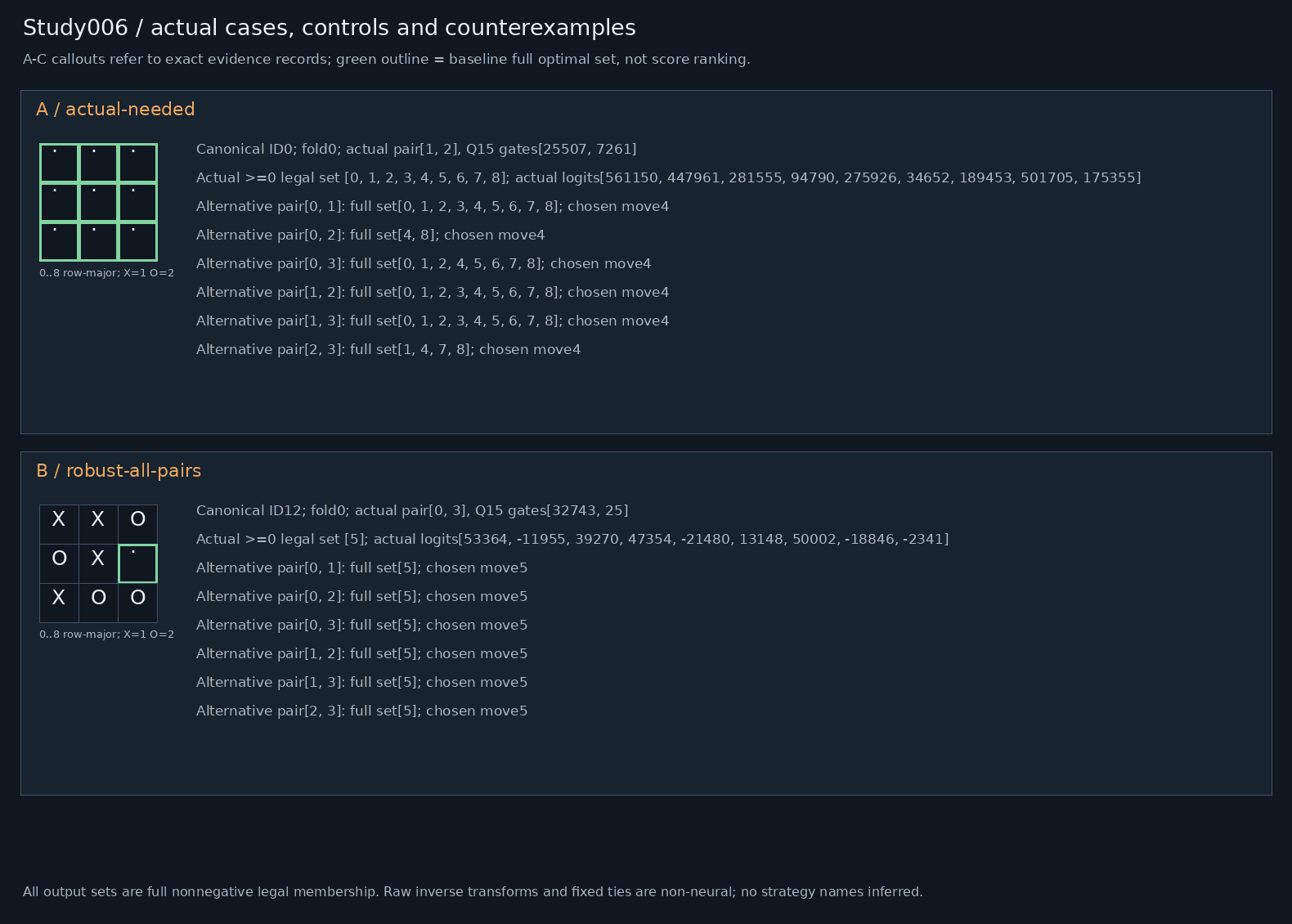
| 006 | Do learned expert choices and gates matter? Actual routing has 0/627 failures; uniform gates cause 194/627, and swapping expert-to-gate assignment causes 291/627. Matched tactical controls do not establish a named specialist. | Router report | Overview, cases |
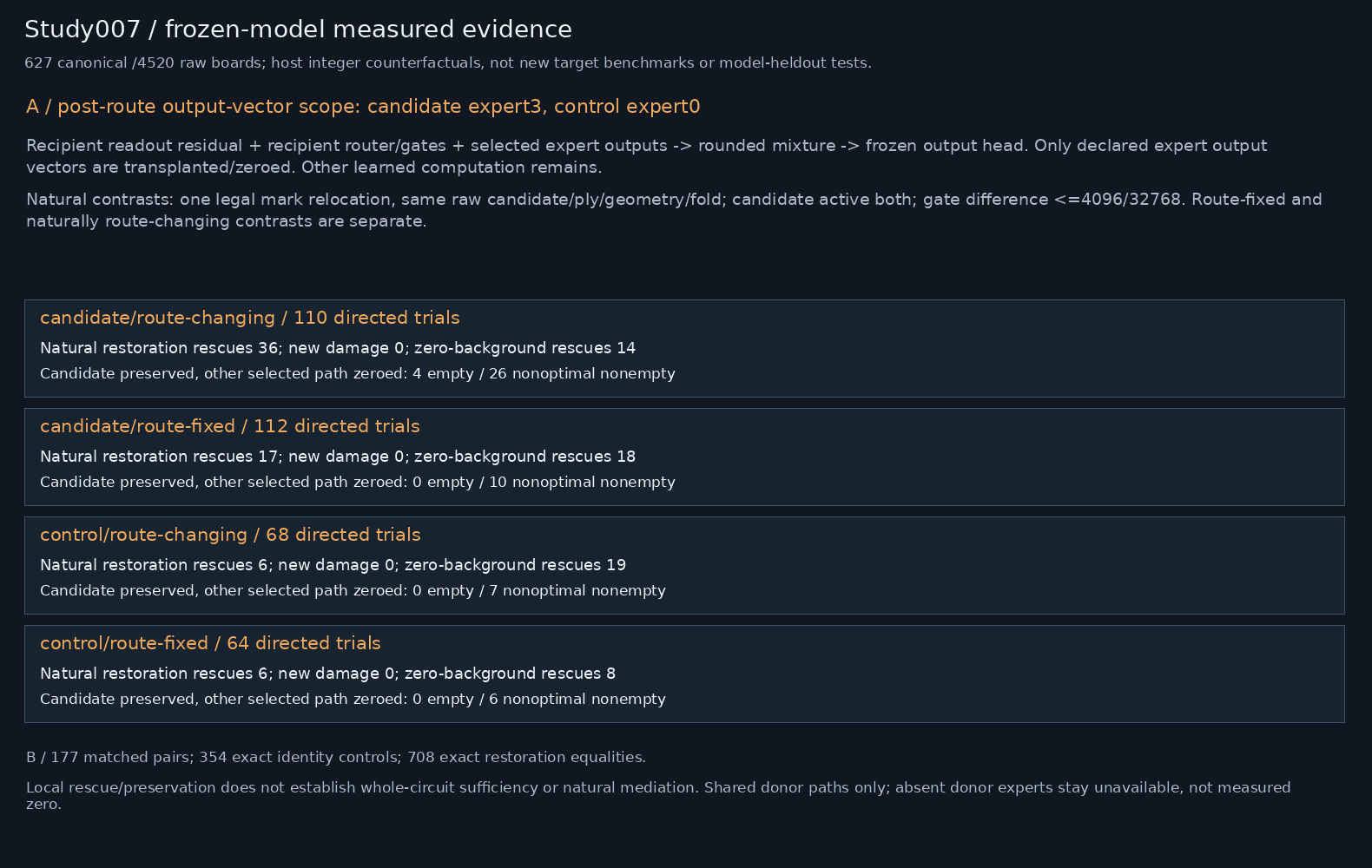
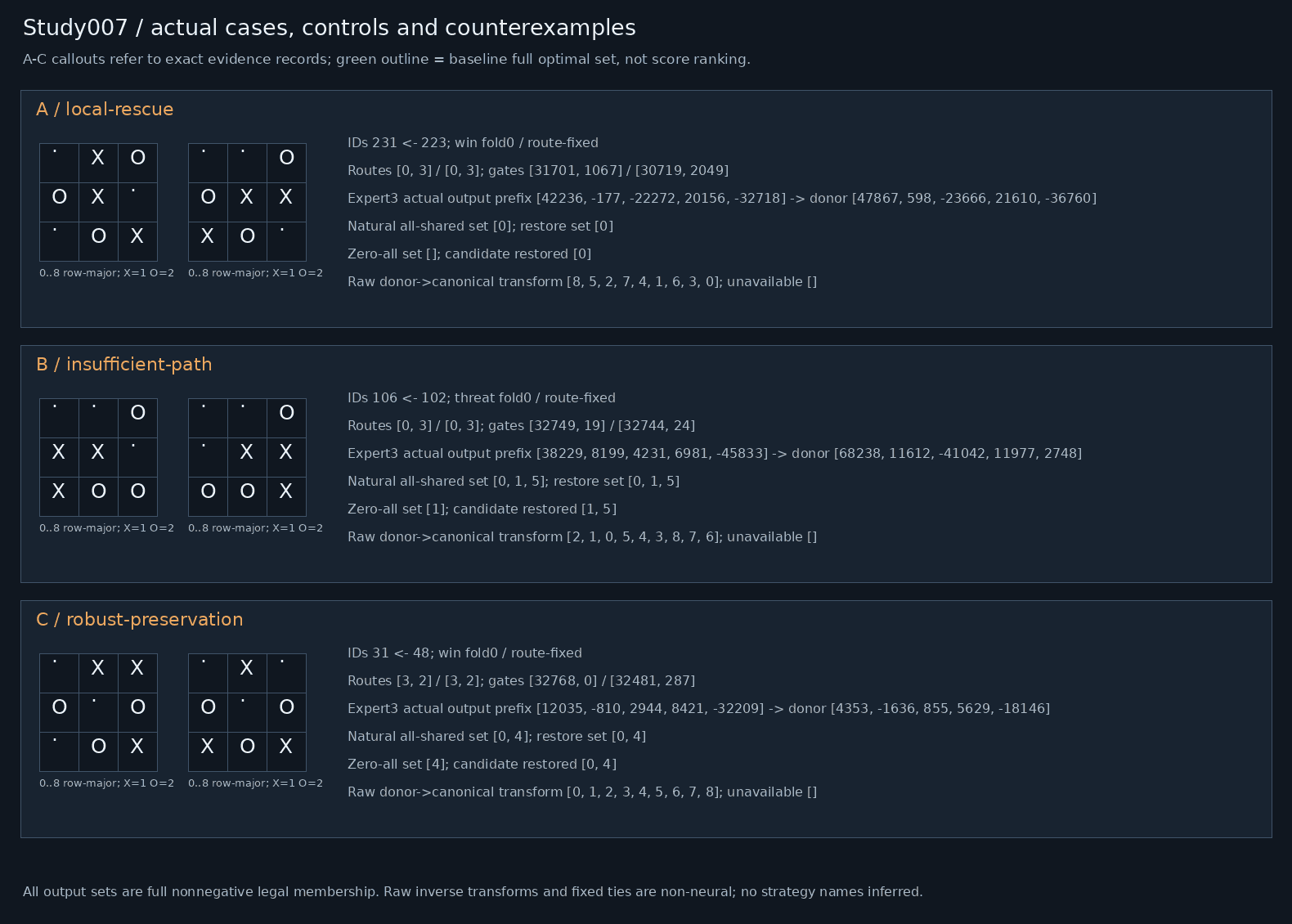
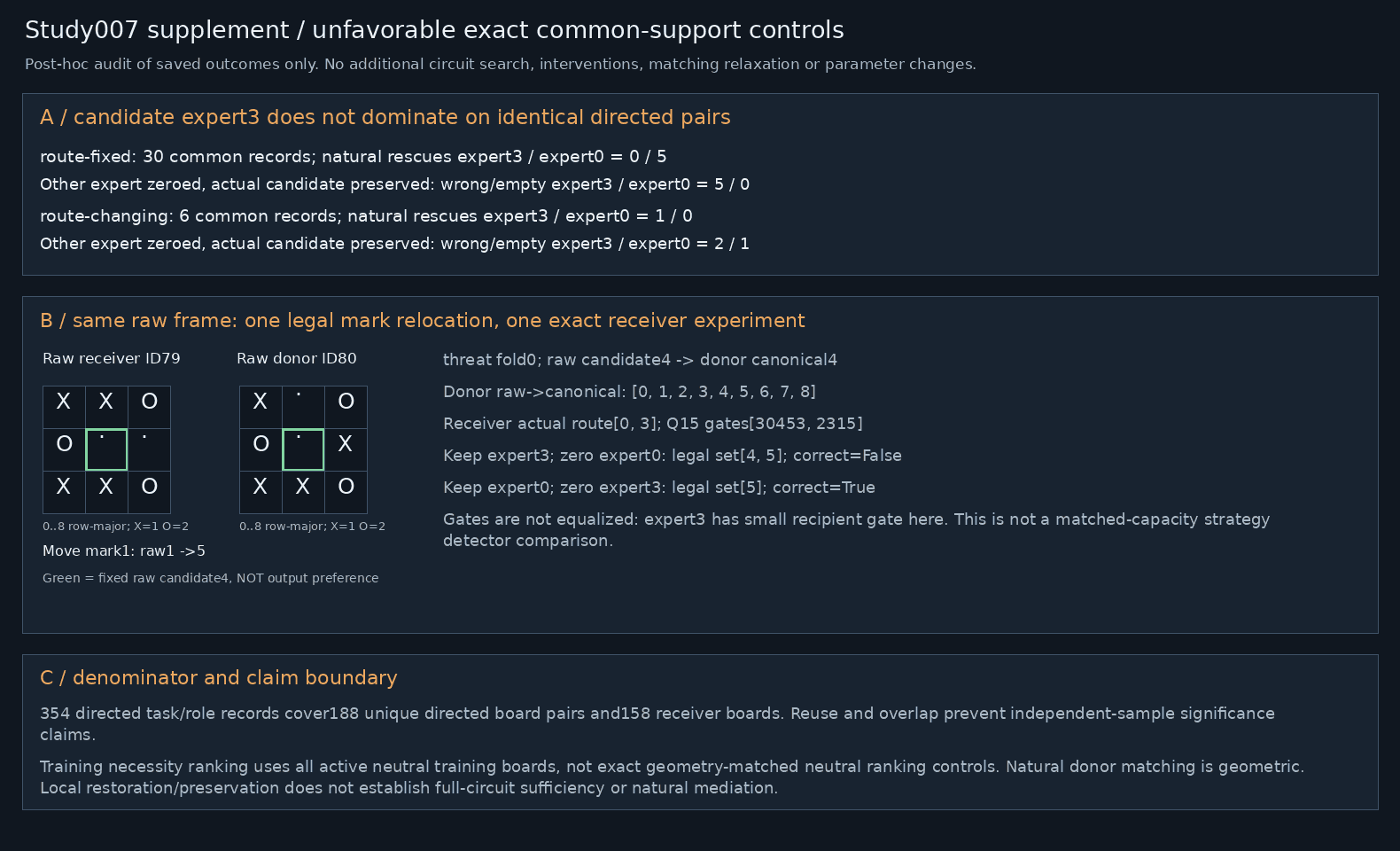
| 007 | Is a candidate expert-output path sufficient? 354 bidirectional trials show local rescue but preservation failures. On 30 identical route-fixed control records, preserving candidate E3 fails 5 times versus 0 for control E0. | Pathway report, common-support clarification | Overview, cases, exact controls |
| 008 | Are decisions fragile to small stored-code changes? 76 one-code perturbations across 38 coordinates change no legal full sets or chosen moves on all 627 canonical boards. Four occupied-square sign-flip observations are masked out. | Integer robustness report | Overview, actual boundary/masked-flip cases |
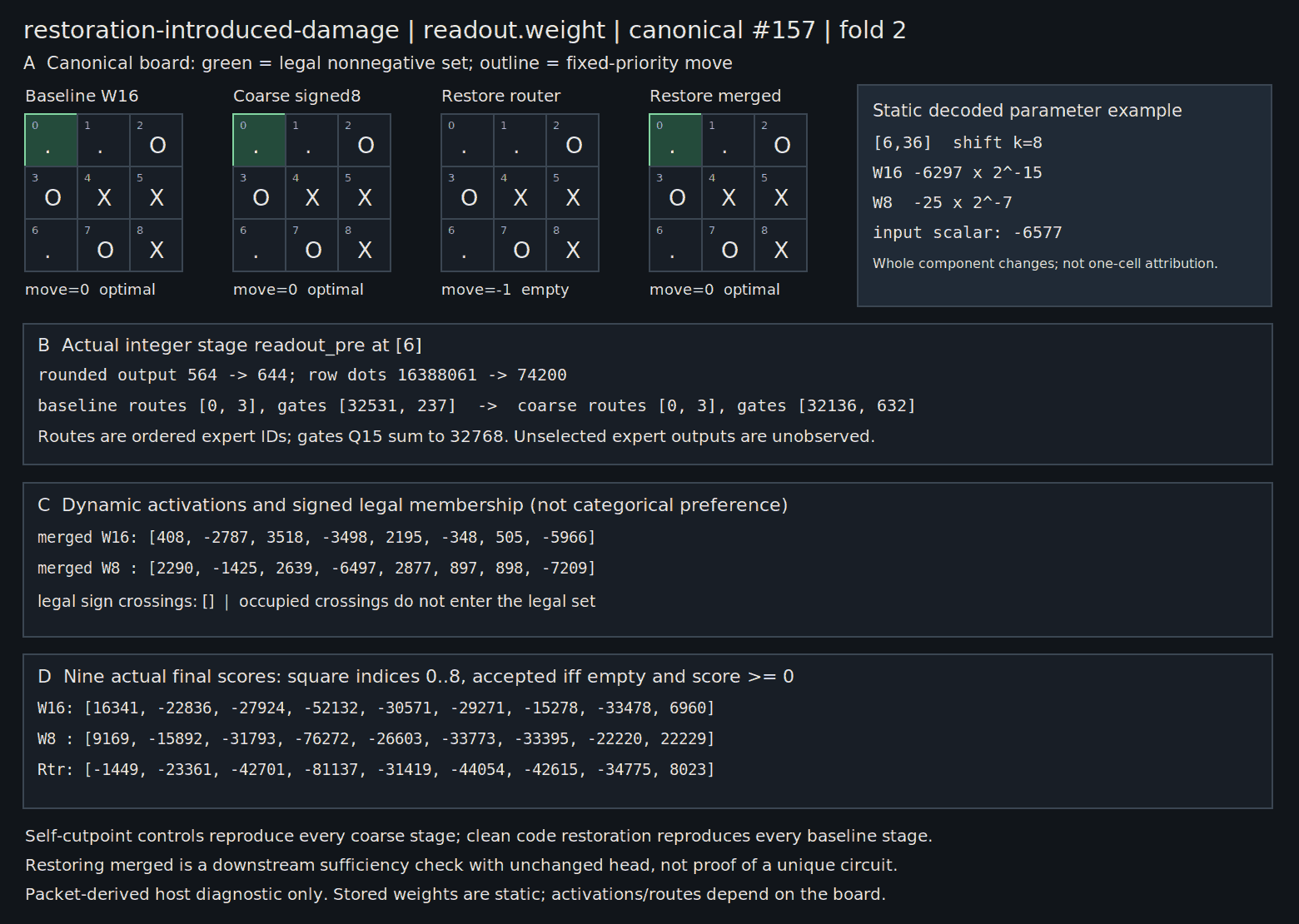
| 009 | Can componentwise coarser precision fail even though the one-code panel was benign? 24 specifications / four component scopes produce canonical set changes for query/value/router/readout of 1/3/1/24. Readout produces 91 raw chosen-move failures; restoring router scores rescues some but introduces others. | Coarse-precision report | Overview, value mechanism, restoration damage, raw alignment, surviving example |
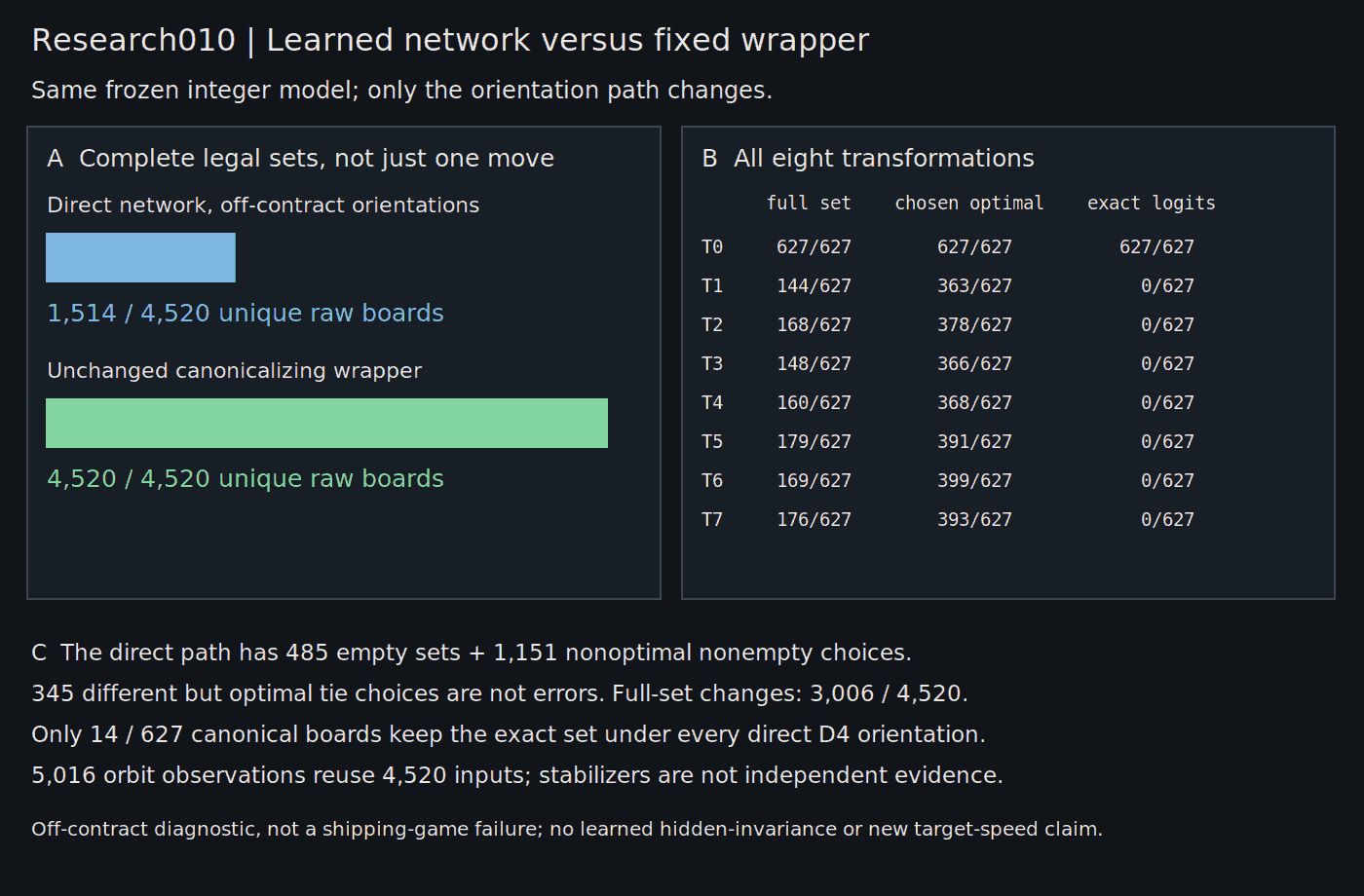
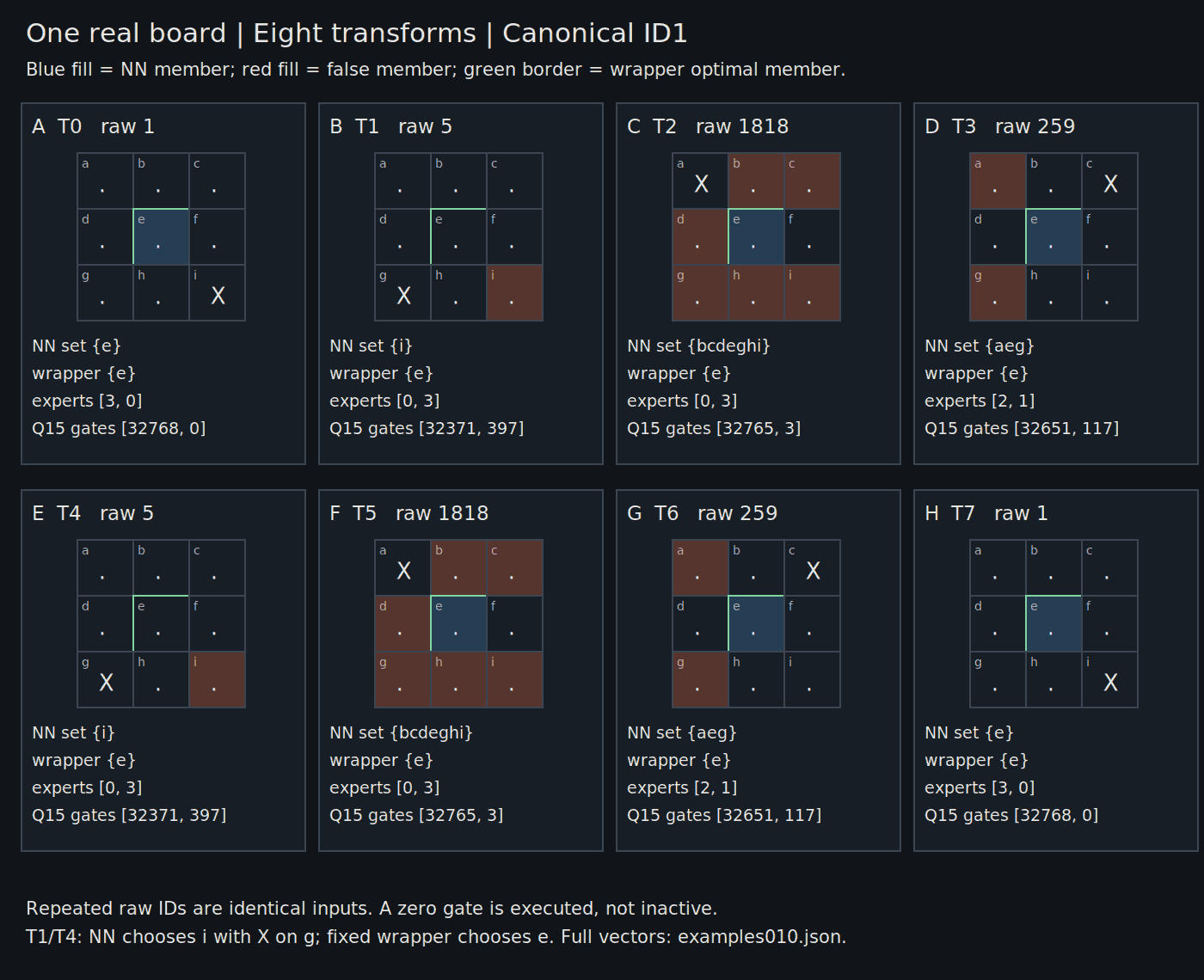
| 010 | What symmetry comes from learned computation versus fixed canonicalization? Direct off-contract inputs give 1514/4520 exact sets, versus 4520/4520 through the accepted wrapper. | Symmetry report | Comparison, eight orientations |
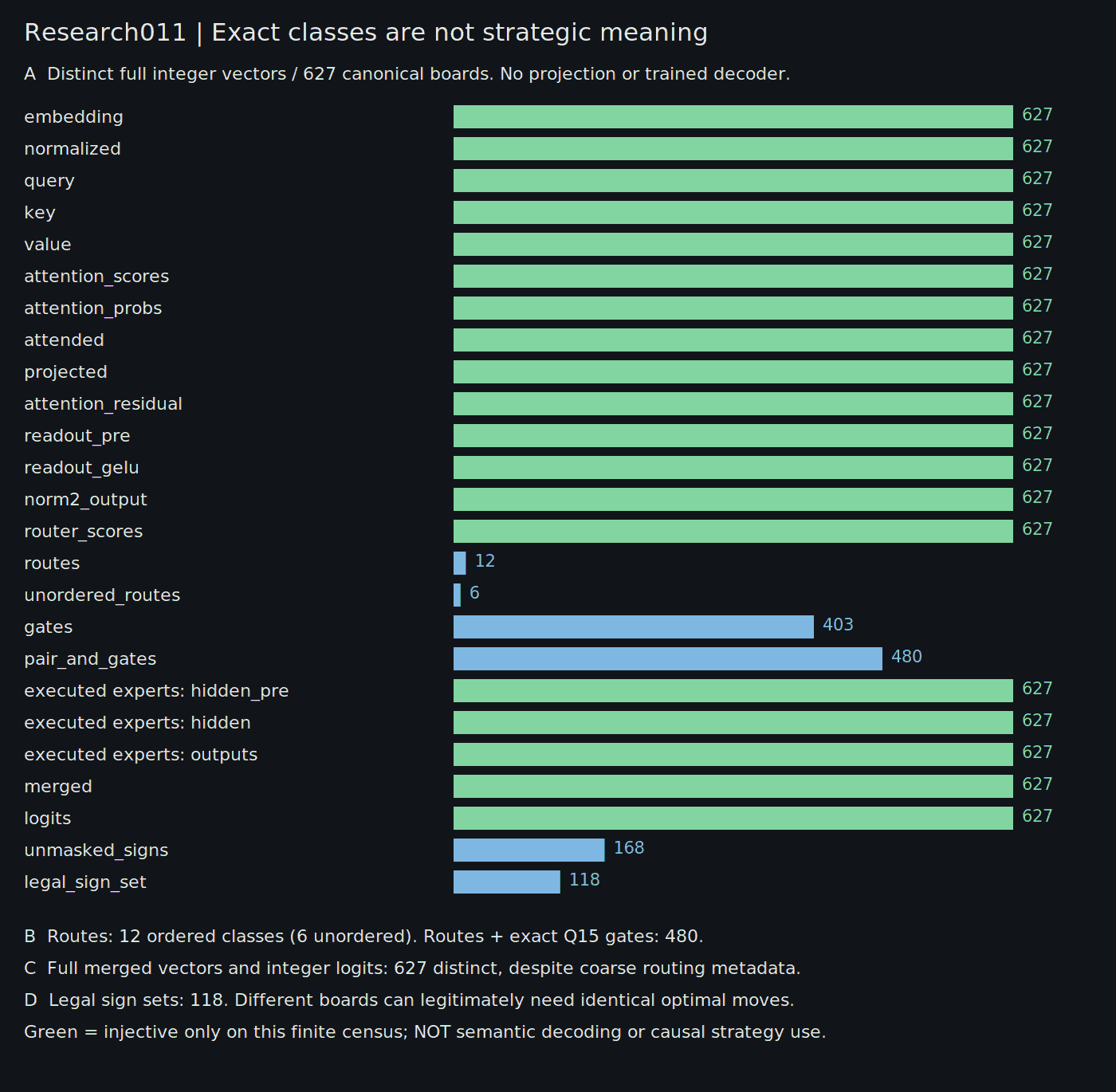
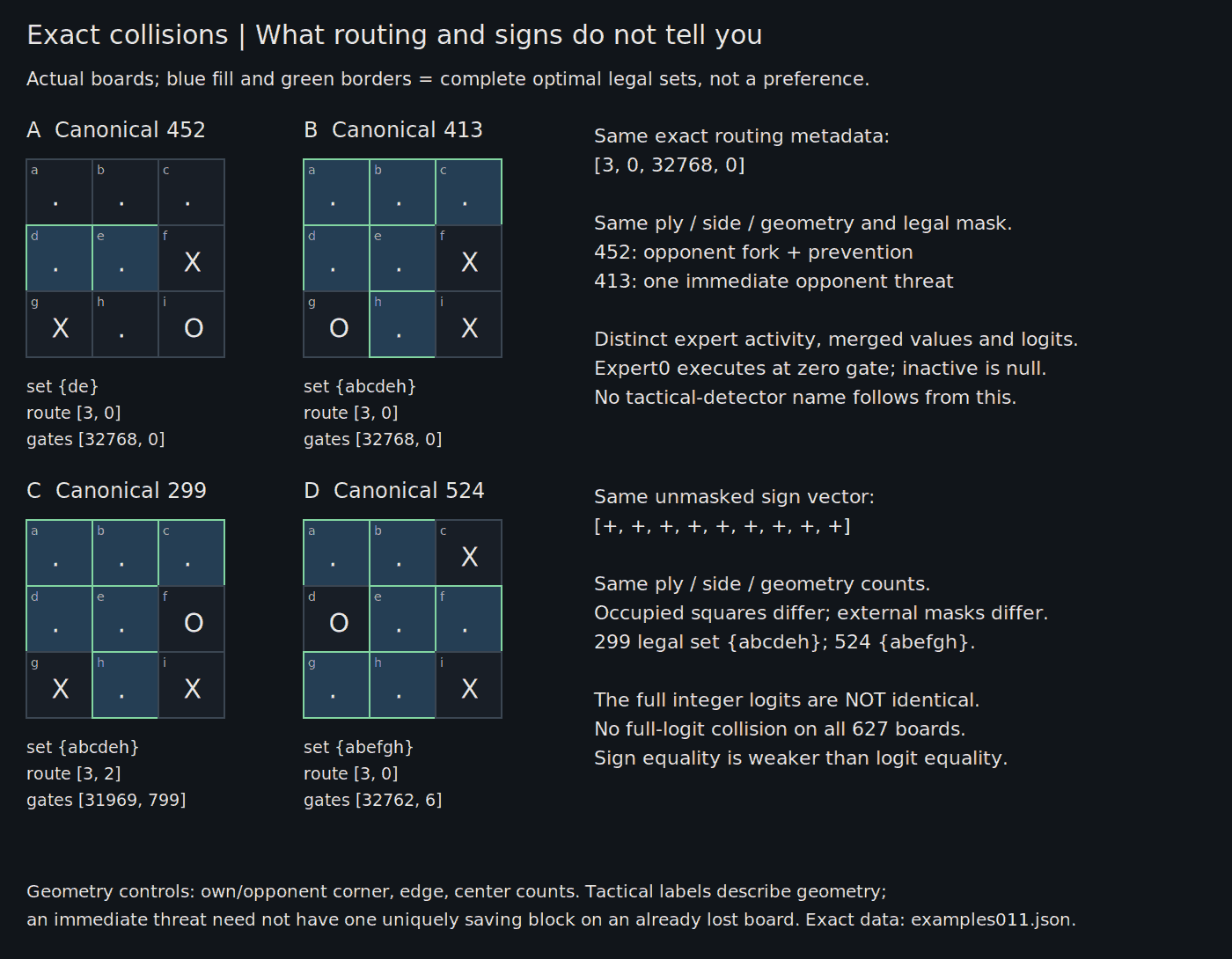
| 011 | Which exact distinctions survive each stage? Merged/logit vectors distinguish 627 boards; ordered routes have 12 classes and route+gates 480. Uniqueness is not semantic decoding. | Collision report | Stage census, controlled counterexamples |
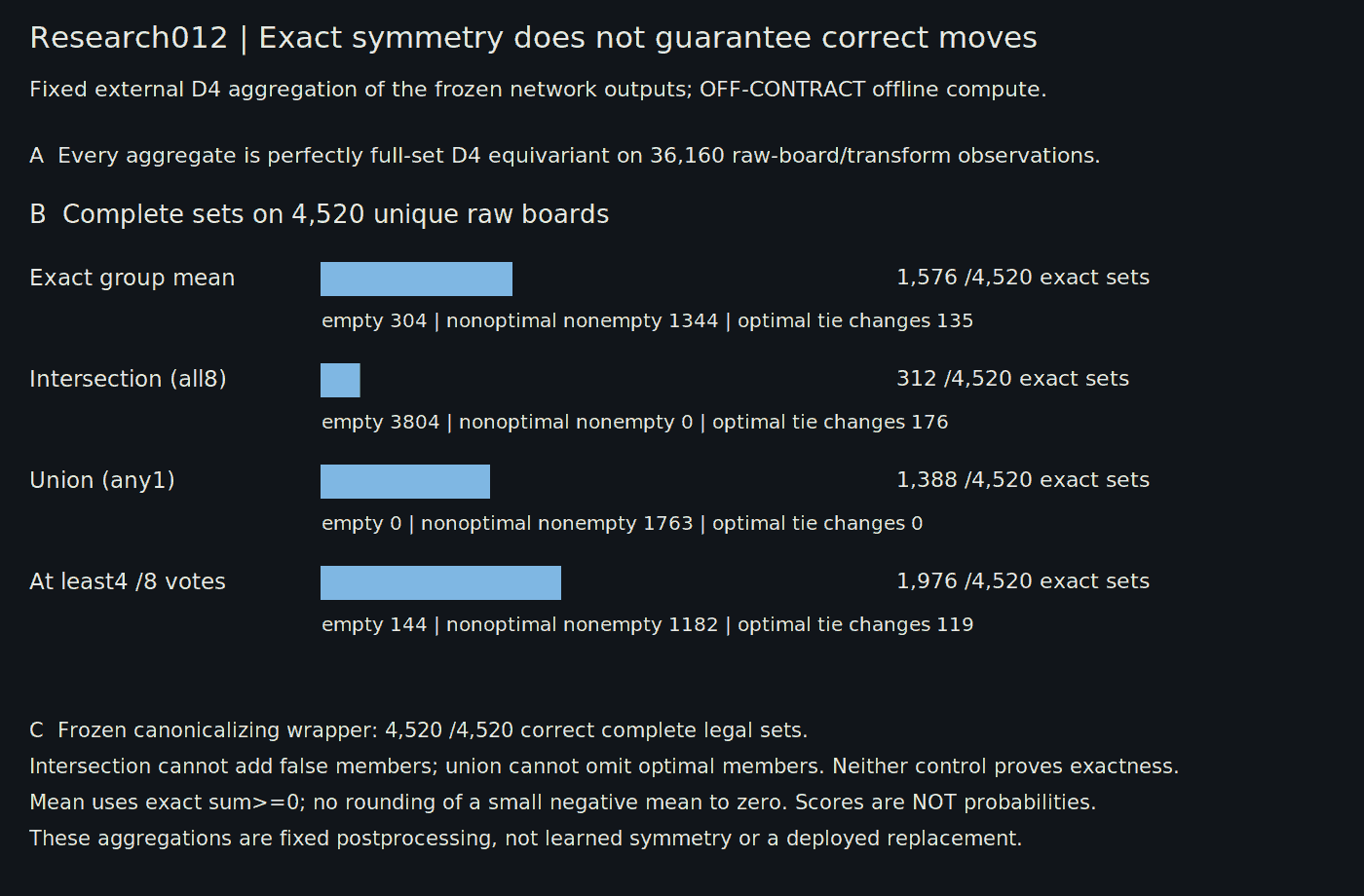
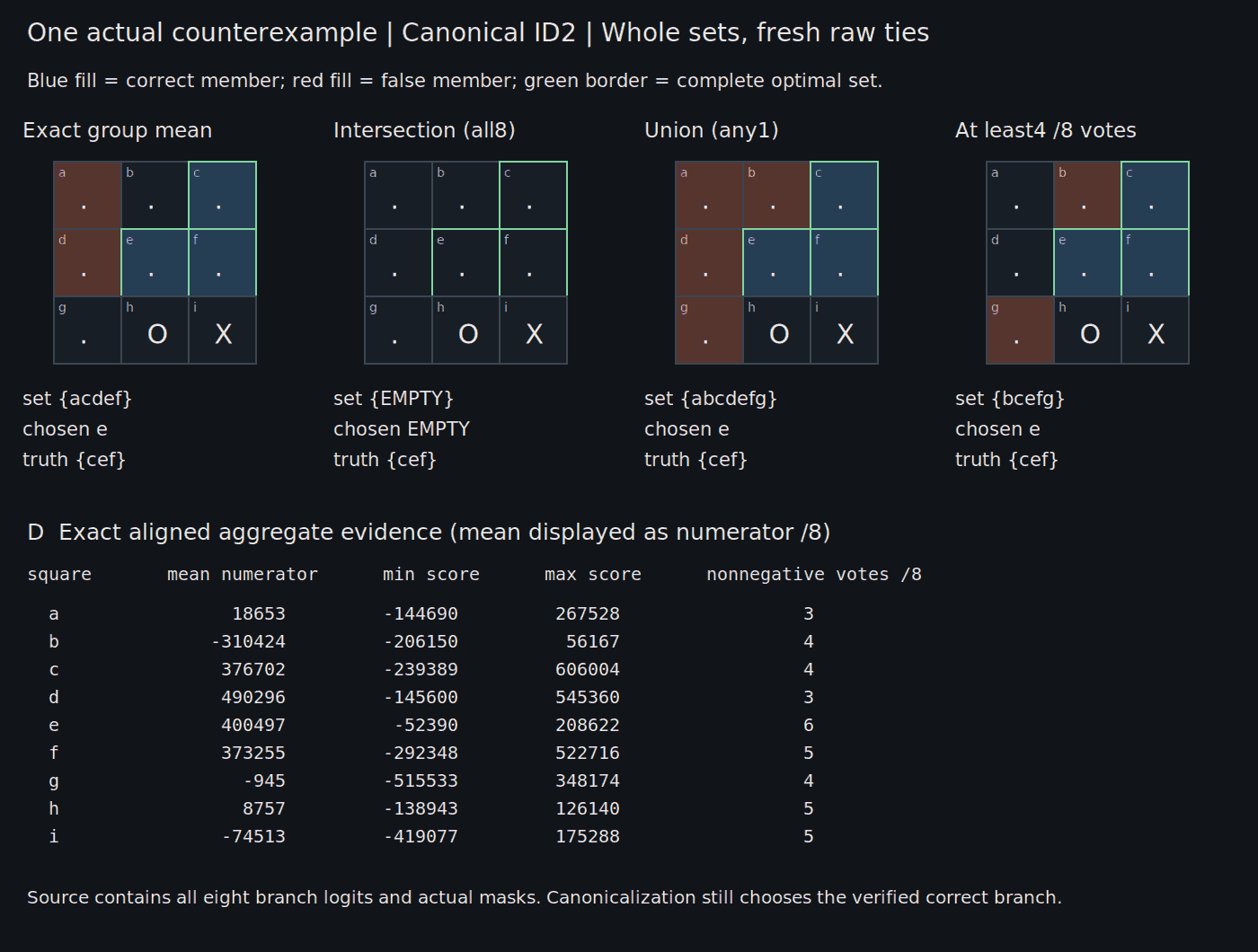
| 012 | Does imposed symmetry repair correctness? Four fixed aggregates are perfectly full-set equivariant but have only 1576/312/1388/1976 exact sets out of 4520. | Aggregation report | Outcomes, actual counterexample |
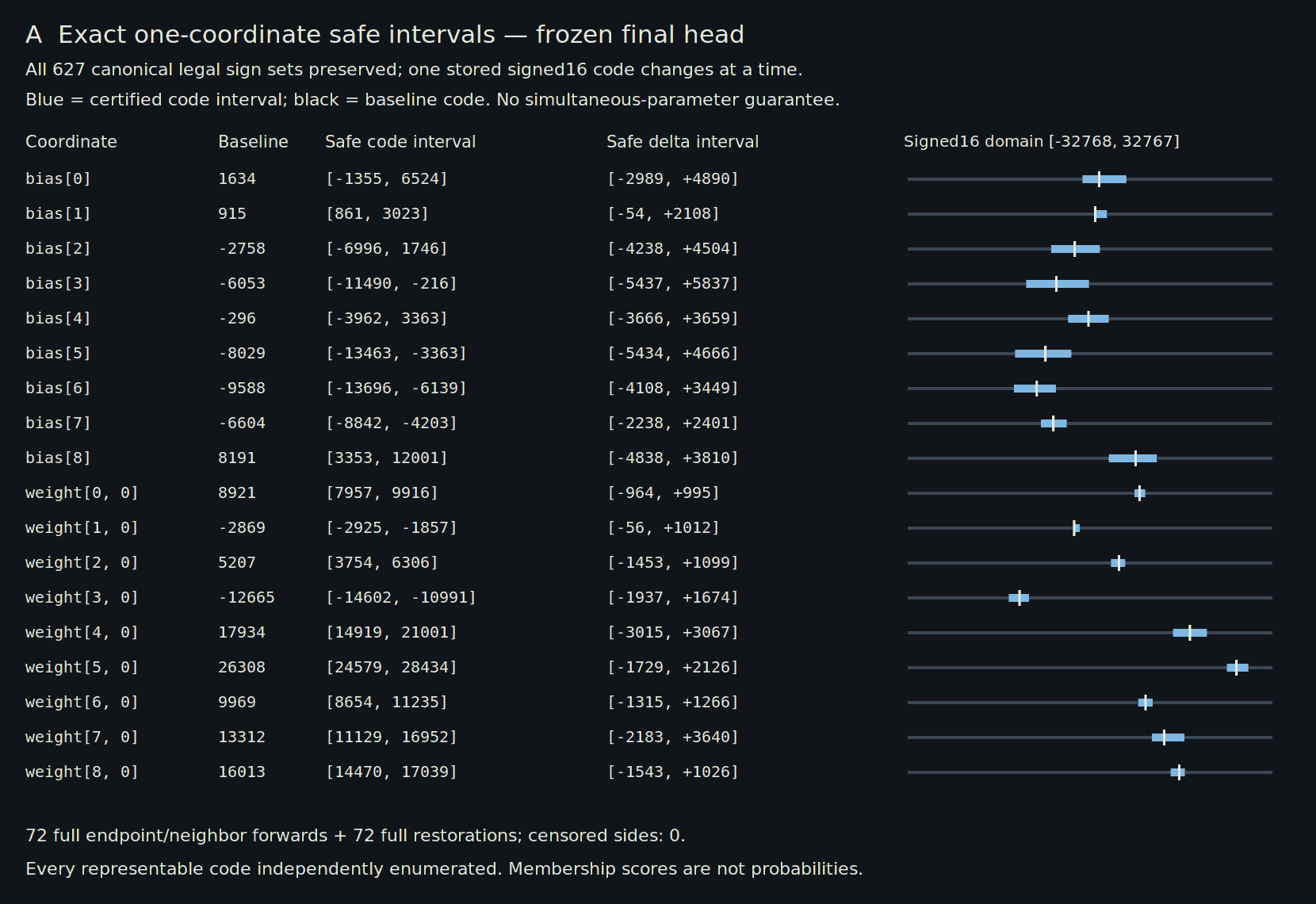
| 013 | How far can a stored head coordinate change before any legal membership flips? 18 exact maximal intervals, with full endpoint/neighbor/restoration forwards and exhaustive signed16 checks. One-at-a-time only. | Coordinate certificate report | Exact intervals, limiting boards |
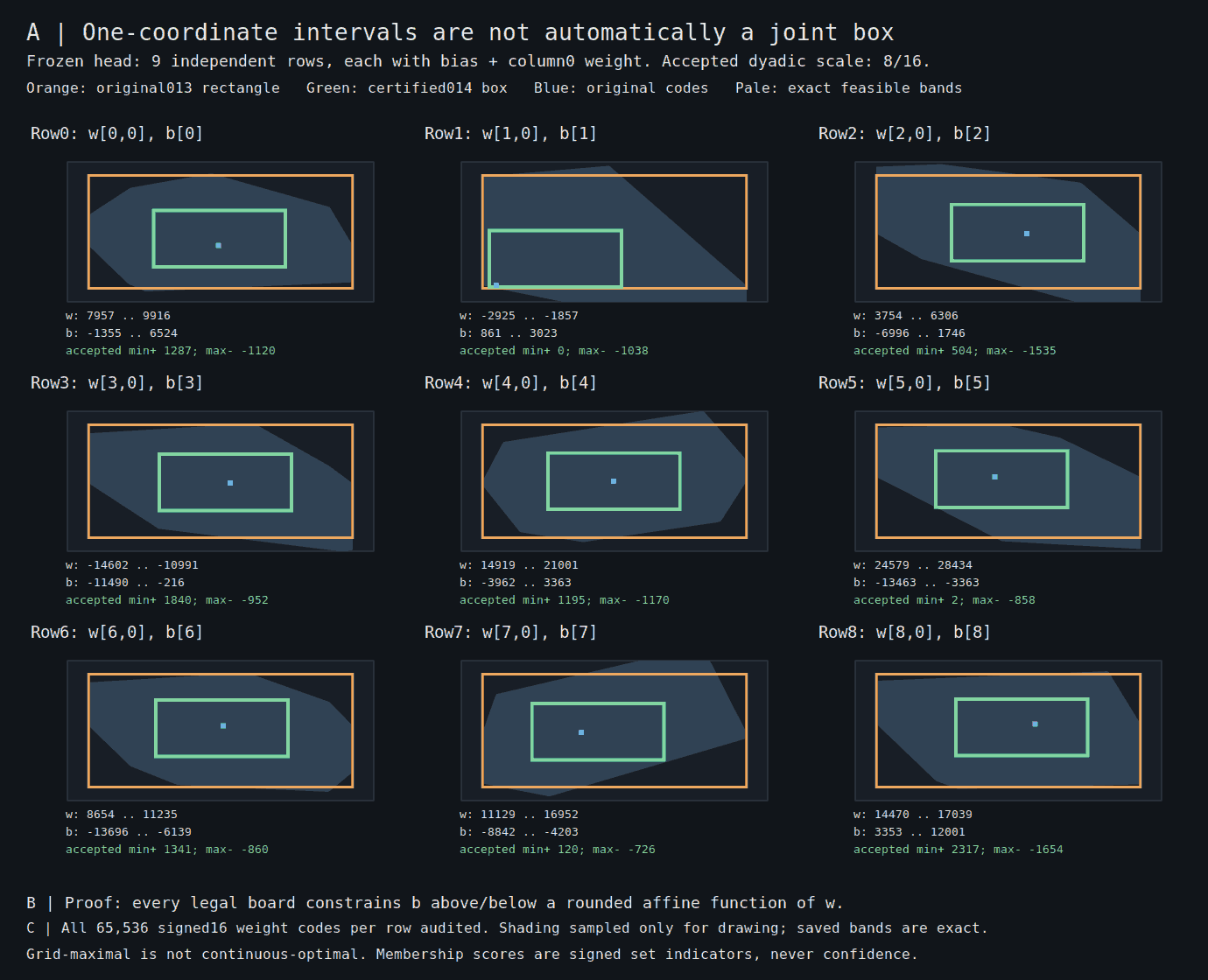
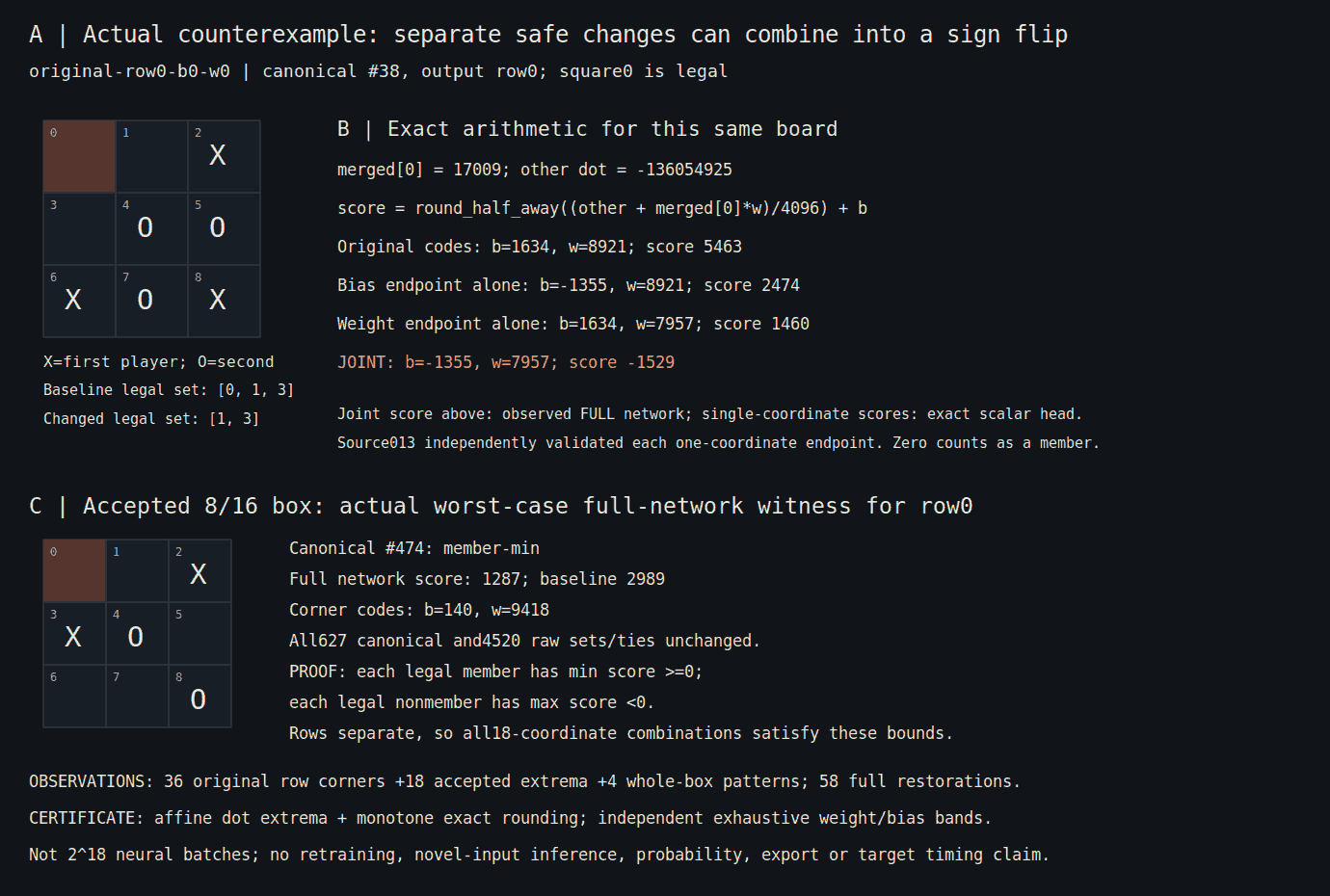
| 014 | Do individually safe coordinate ranges compose? 31/36 original row corners fail. A smaller 8/16 grid-scale box certifies every combination of the 18 selected parameters on the audited domain. | Joint certificate report | Feasible bands, actual joint failure |
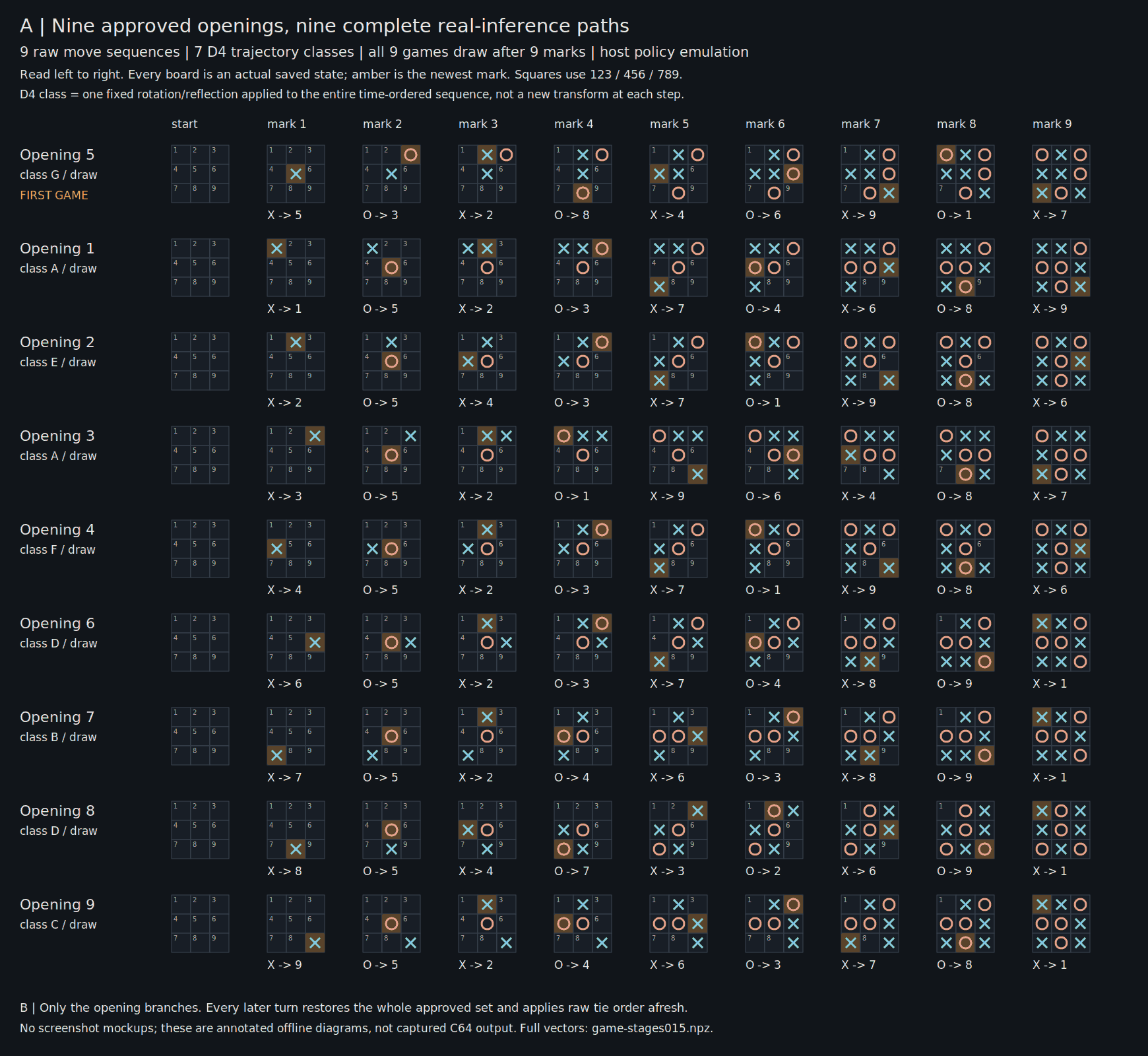
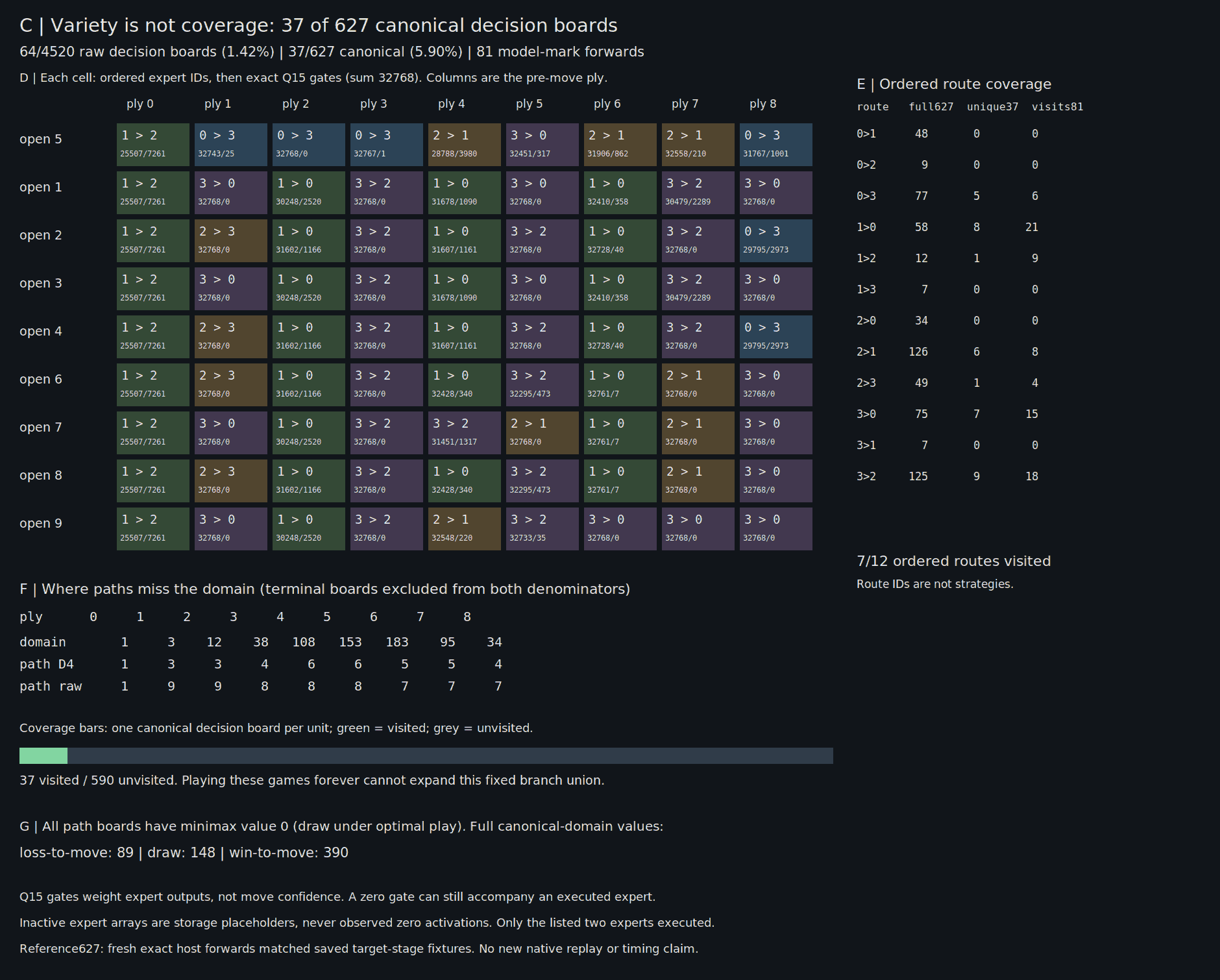
| 015 | How much does continuous self-play explore? 9 raw games / 7 trajectory symmetry classes, all draws; only 37/627 canonical boards. Fixed-seed sampler frequencies are nonuniform in source-bound host analysis. | Self-play coverage report | Complete games, routes/coverage, sampler |
| 016 | Does worst-case safety imply the same wins against mistakes? Three fixed ties remain loss-free from empty in both roles, but O random-opponent win probabilities differ: 848/945, 704/945, 814/945. | Opponent-policy report | Exact outcomes, whole-policy branch example |

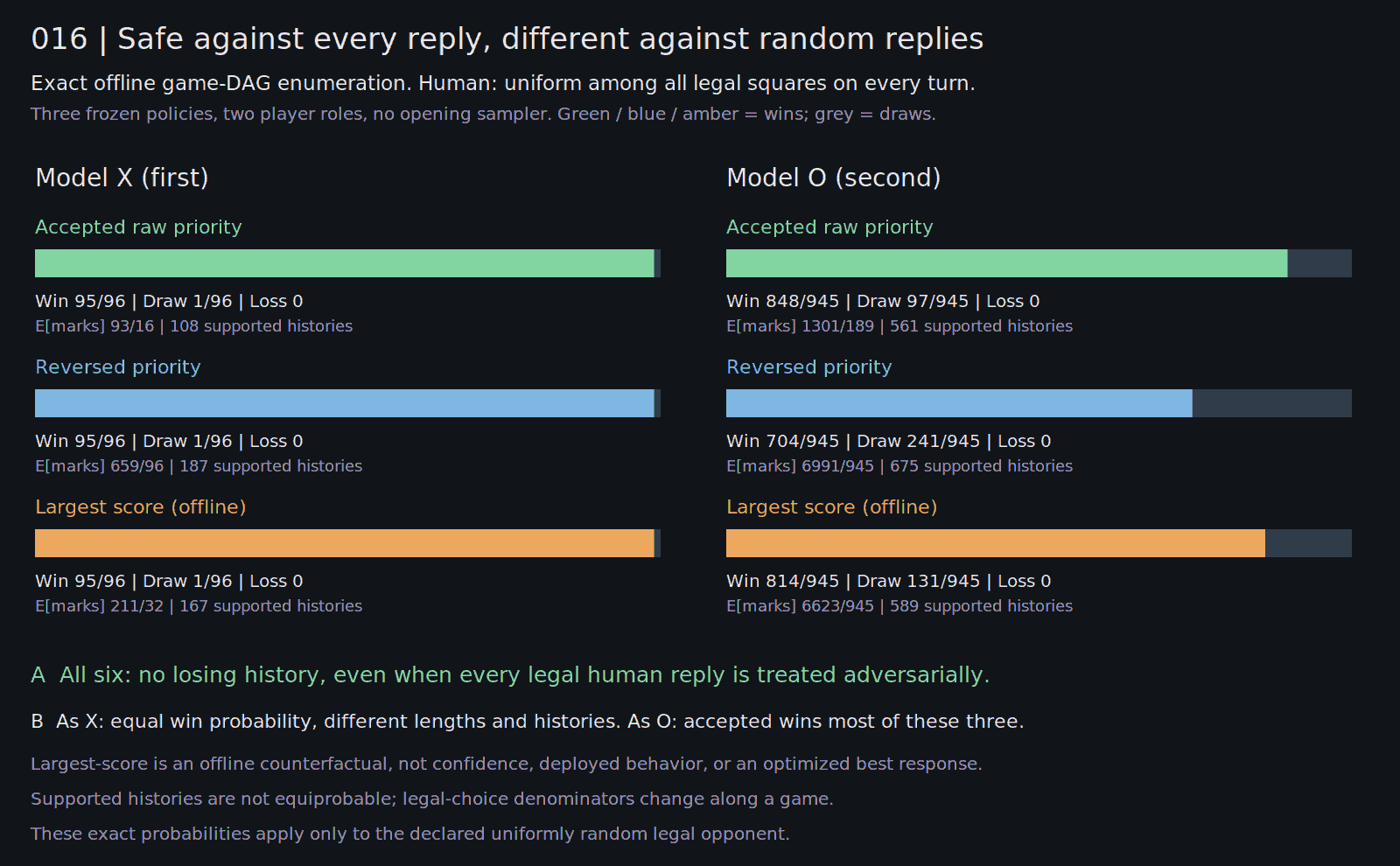
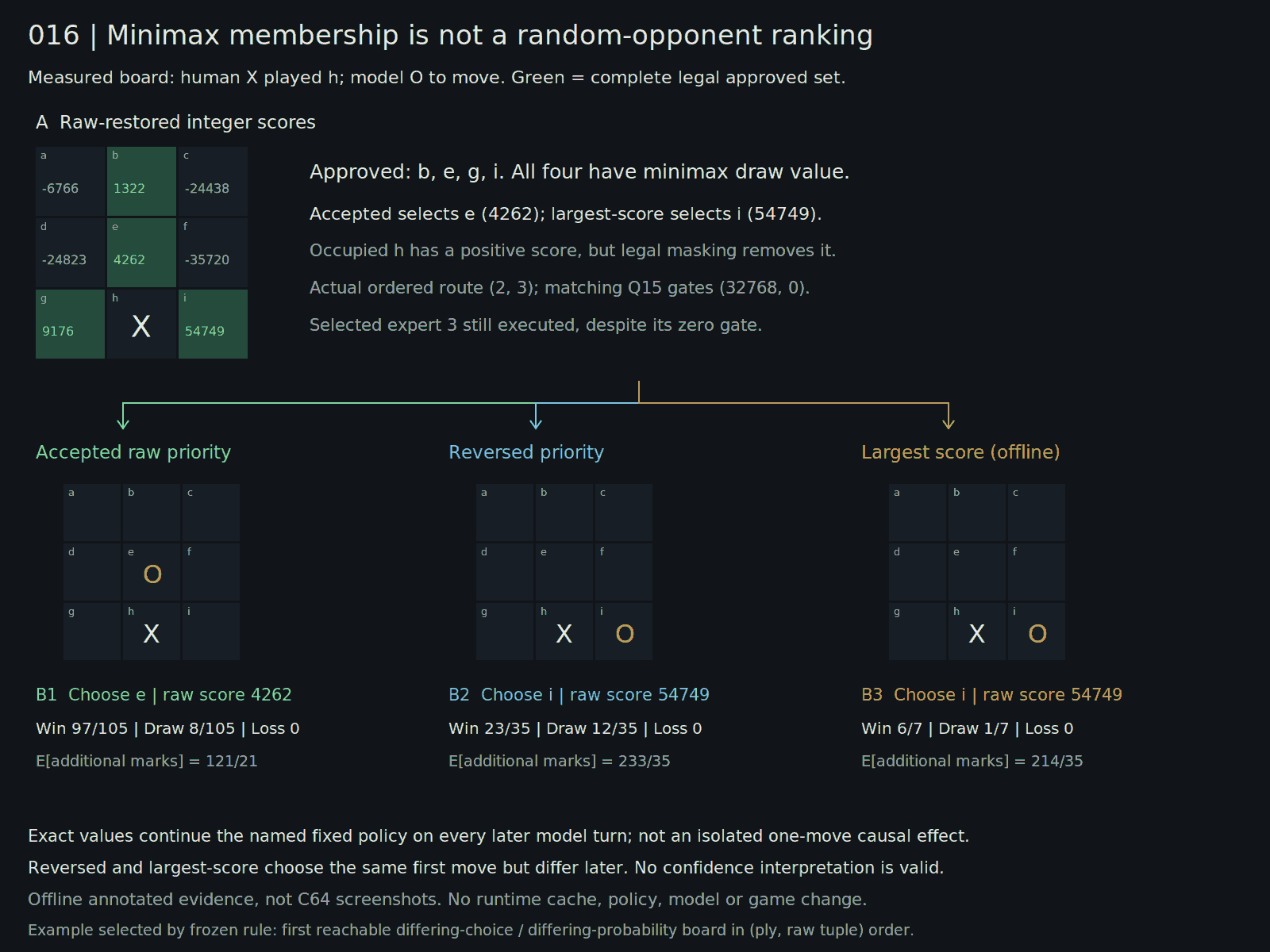
All new figure directories also contain the corresponding SVGs for zooming. Counts are those of each declared design, not independent discoveries or mutually exclusive samples. The report index is a synthesis; the original reports remain byte-identical historical records.
Measured examples and figures
Local necessity is not a job title
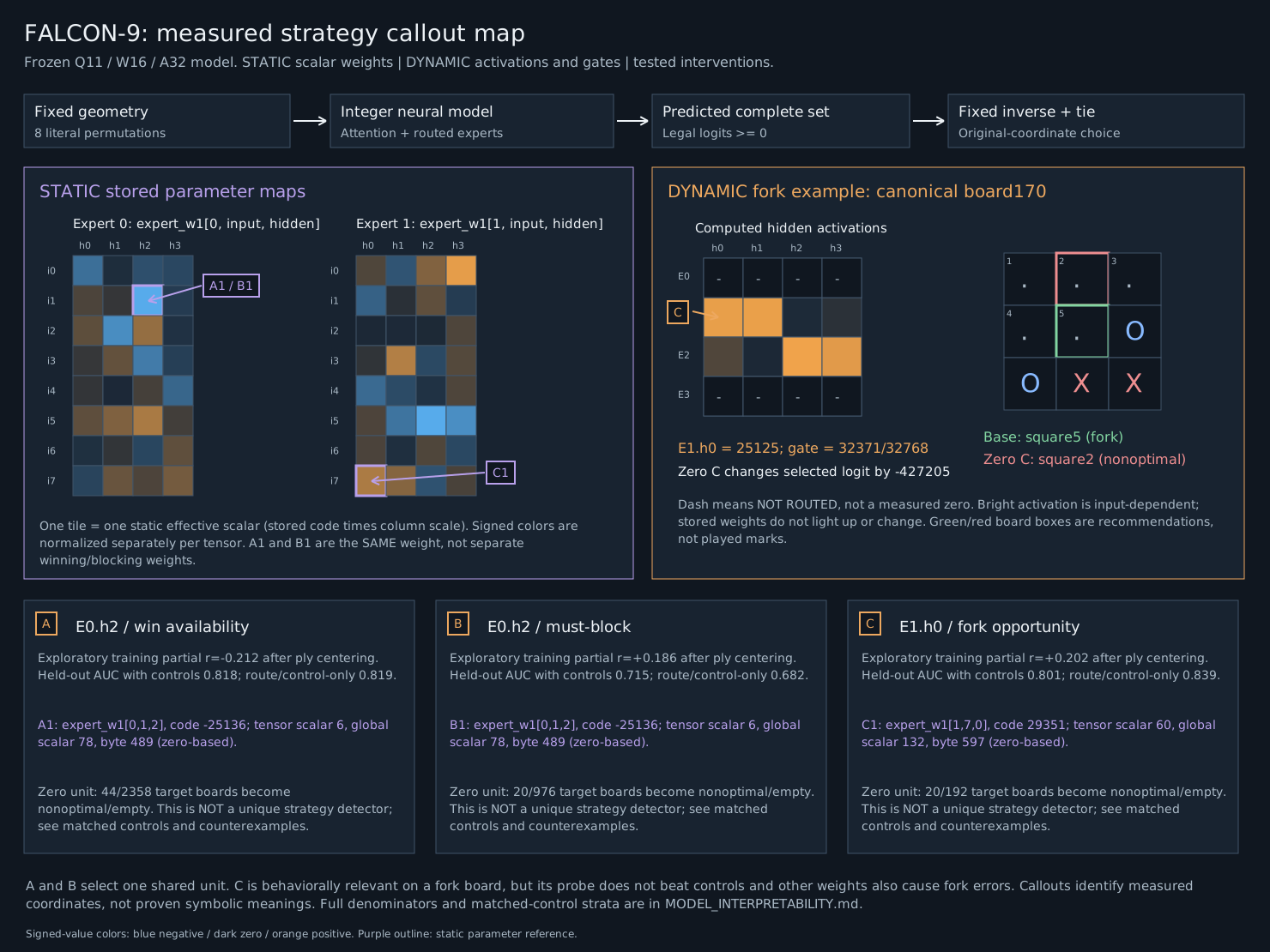
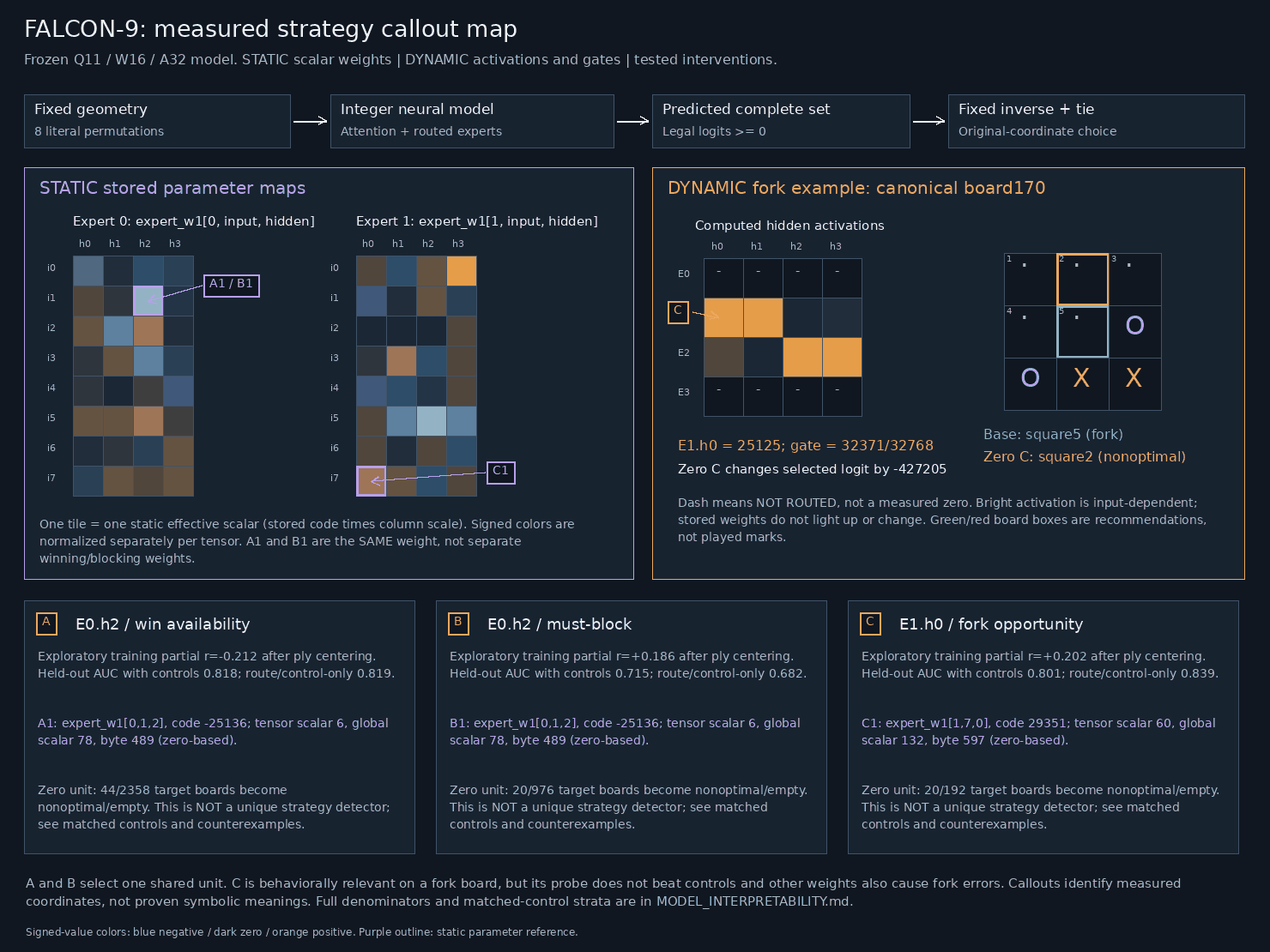
Study002: annotated parameter/activity map. Stored weights are static; observed activations and routing depend on the board. Click the image for the SVG.
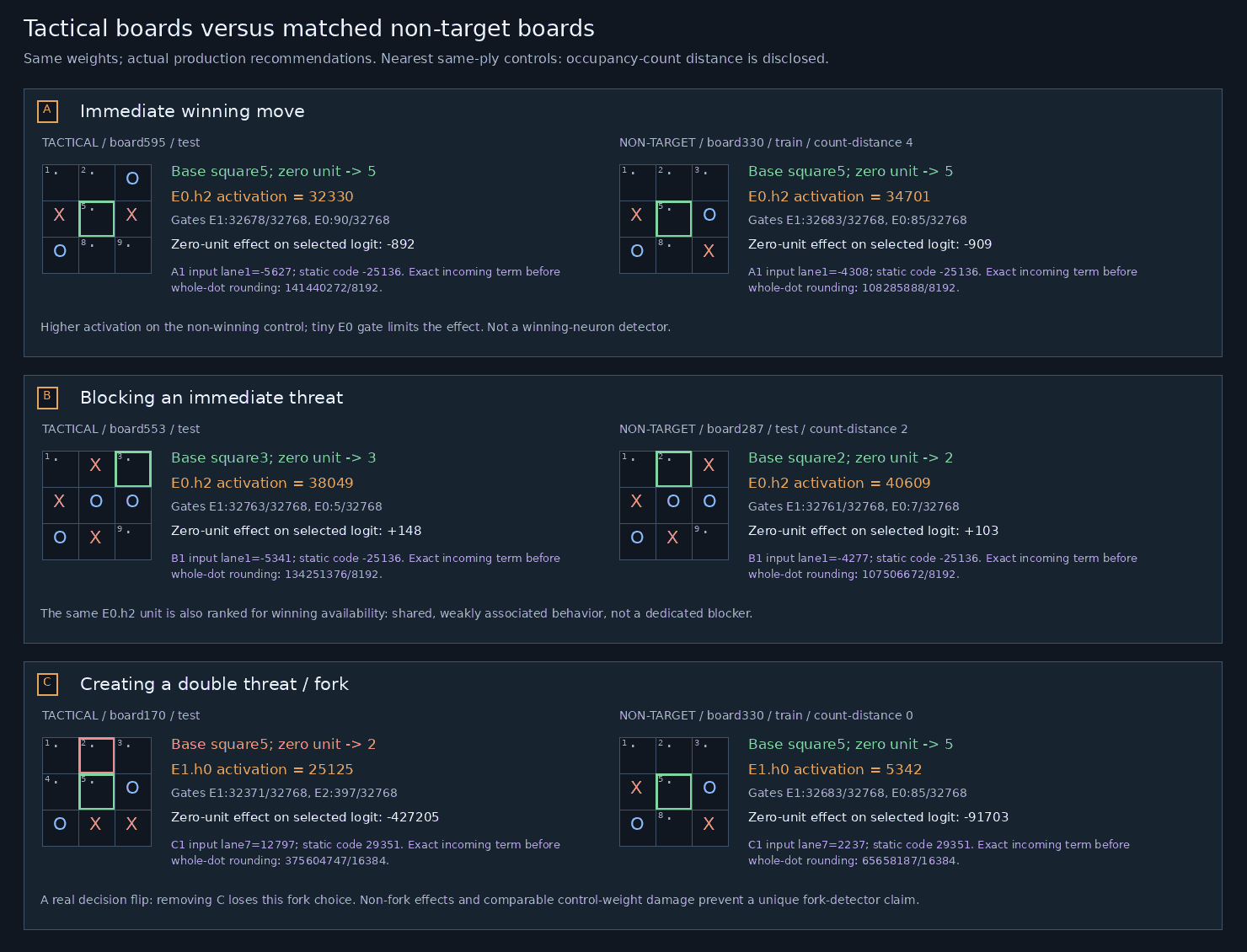
On canonical board 170, X to play:
. . .
. . O
O X X
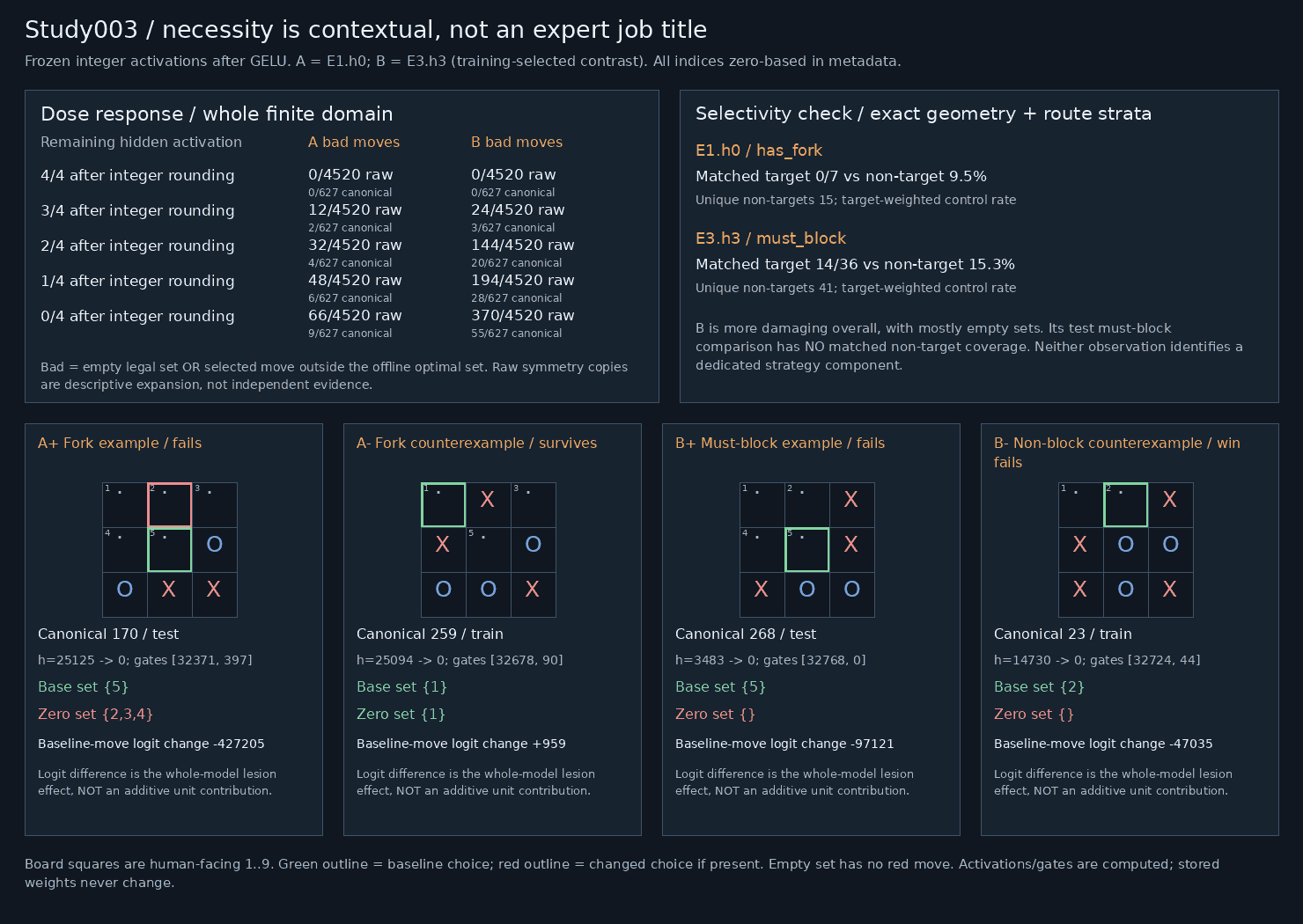
The baseline selects center (square 5), a winning fork. Removing the E1.h0 activation changes the chosen move to square 2, which loses under best play. Other fork boards survive the same removal, and other tactical categories are also affected. This establishes an effect in context, not an exclusive fork function. Study003 adds graded doses and matched counterexamples rather than renaming the unit.
E3.h3 damage includes blocking failures, but also immediate-win failures and many empty approved sets. Empty-set damage cannot be presented as selectively forgetting to block. Similarly, a different equally optimal chosen move is not a mistake; reports separate set changes, empty sets, nonoptimal selections and optimal tie changes.
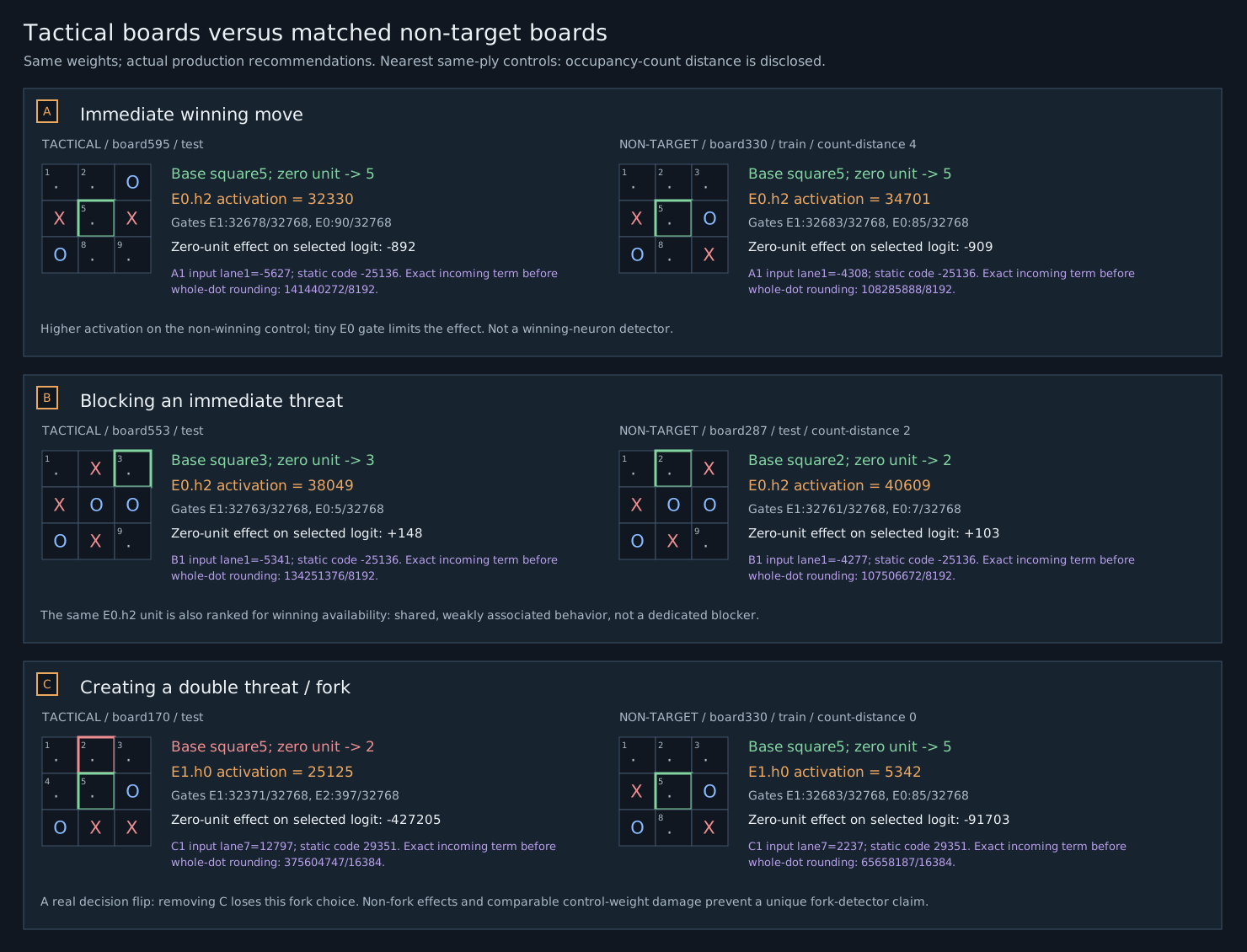
Concrete tactical effects and counterexamples must be read together; the fork failure does not establish an exclusive fork neuron.
Doses, donors and combinations
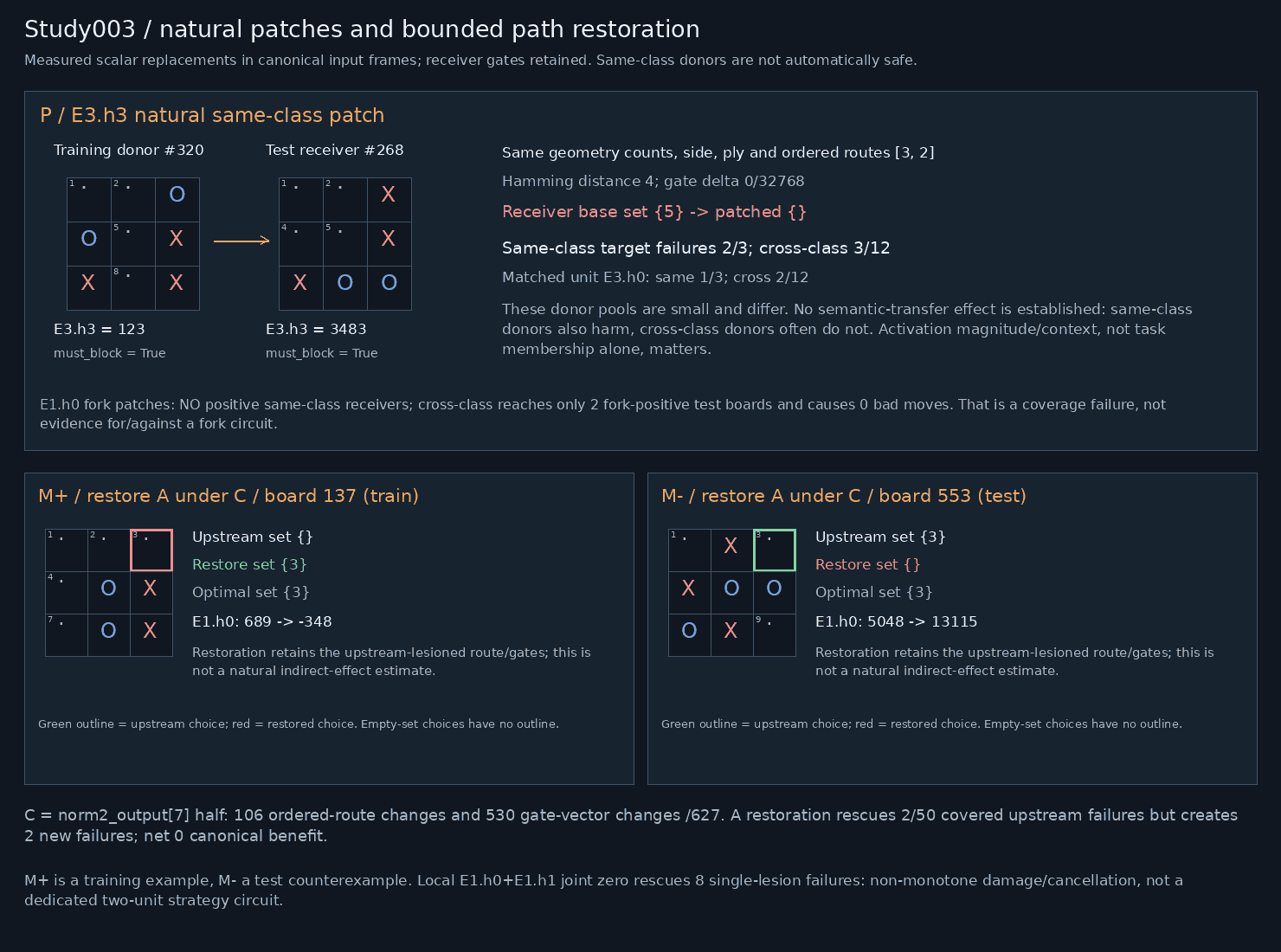
Study003 tests 128 interventions, including graded doses, natural donor patches, pairs and upstream/restoration contrasts. A same-class donor activation need not be interchangeable with a receiver's activation. Combined E1.h0/E1.h1 removal rescues eight canonical positions that fail under at least one single lesion; this cancellation is evidence against a simple additive necessity story, not proof of a dedicated two-unit strategy circuit.
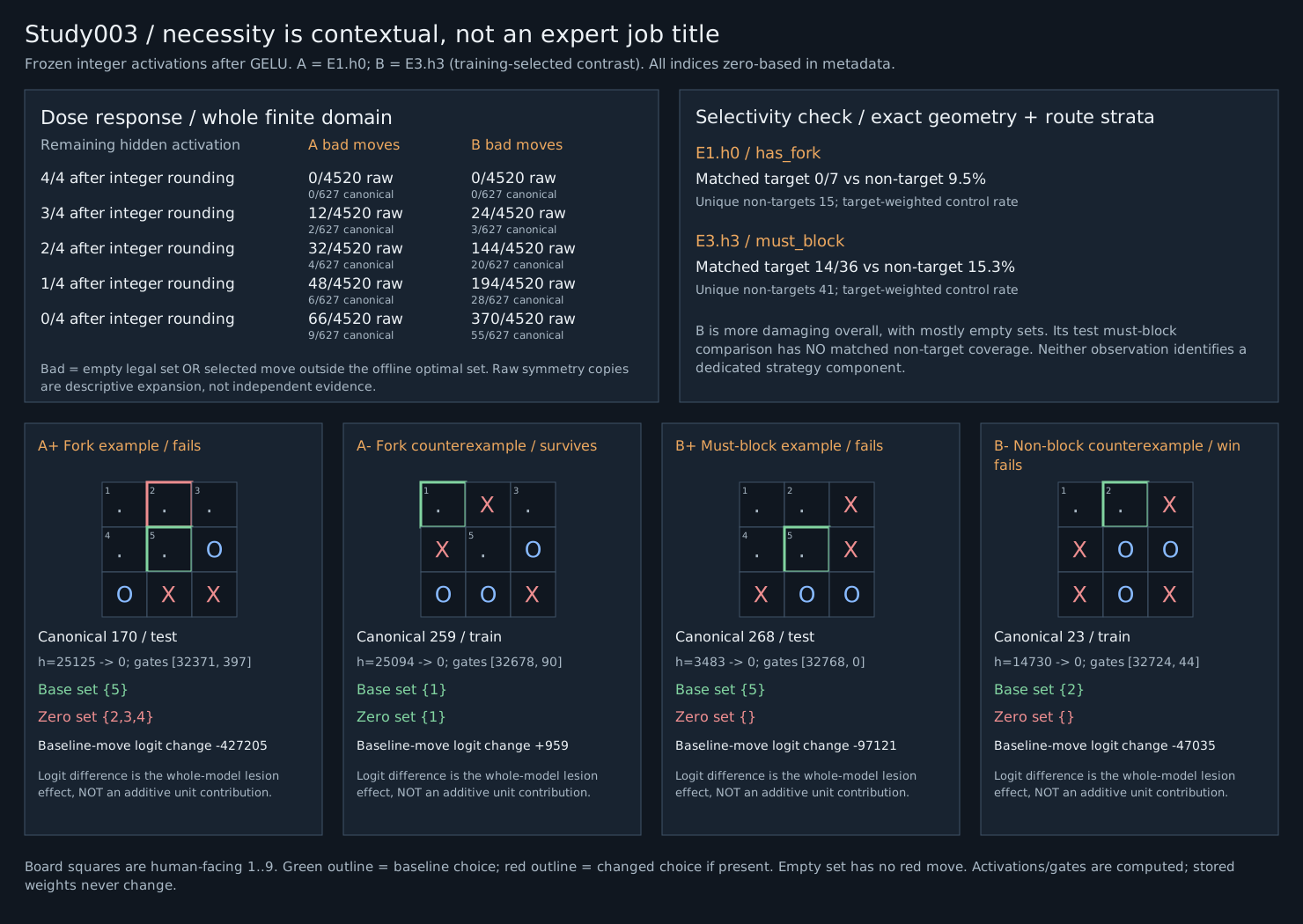
Graded damage and surviving tactical counterexamples, with the declared canonical/raw denominators. Whole-domain effects are not selective strategy confirmation.
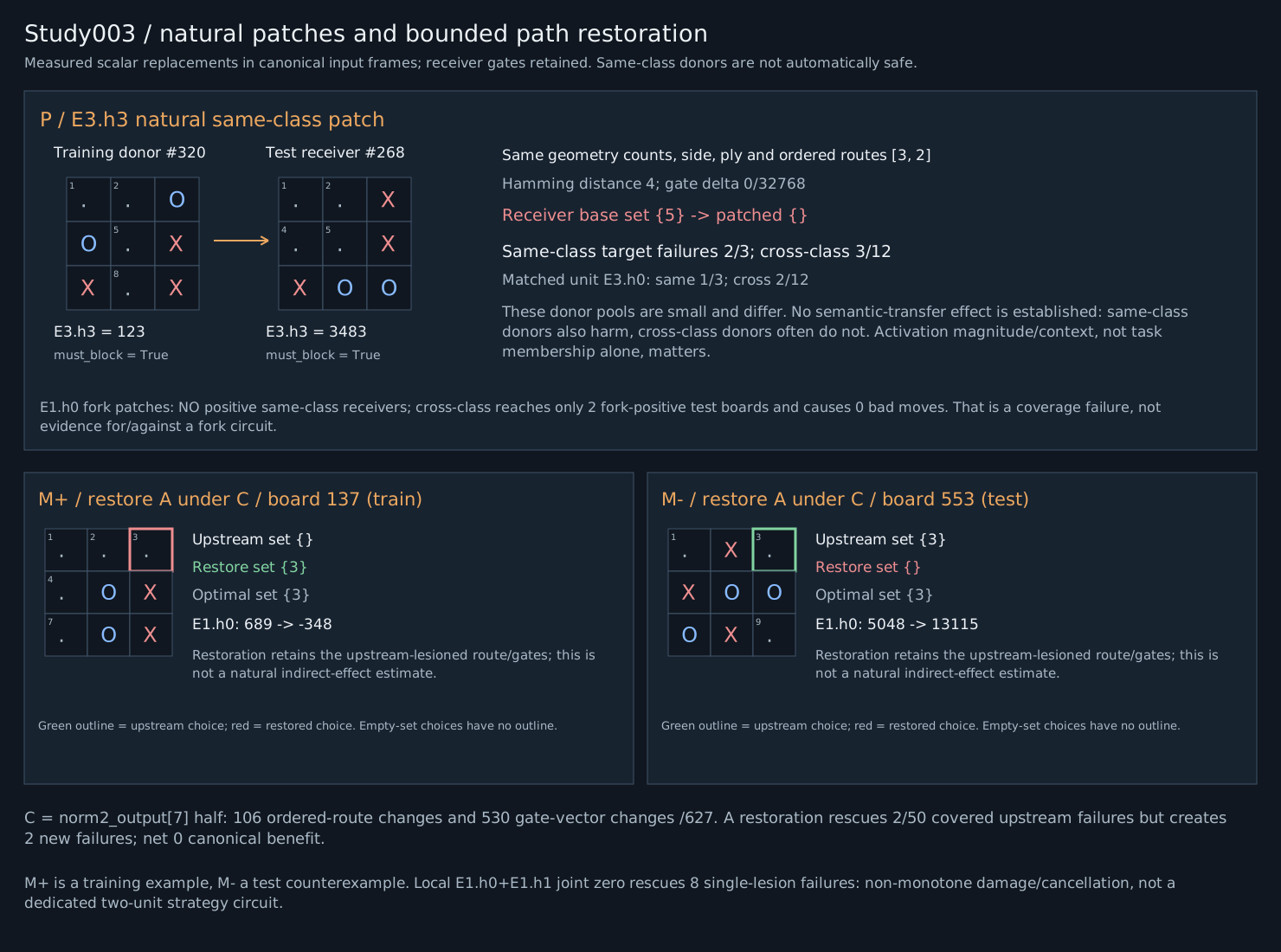
Donor, pair and restoration results include unfavorable controls and newly introduced damage. Restoration is not automatically evidence of mediation.
One stored connection can help opposite-looking outcomes
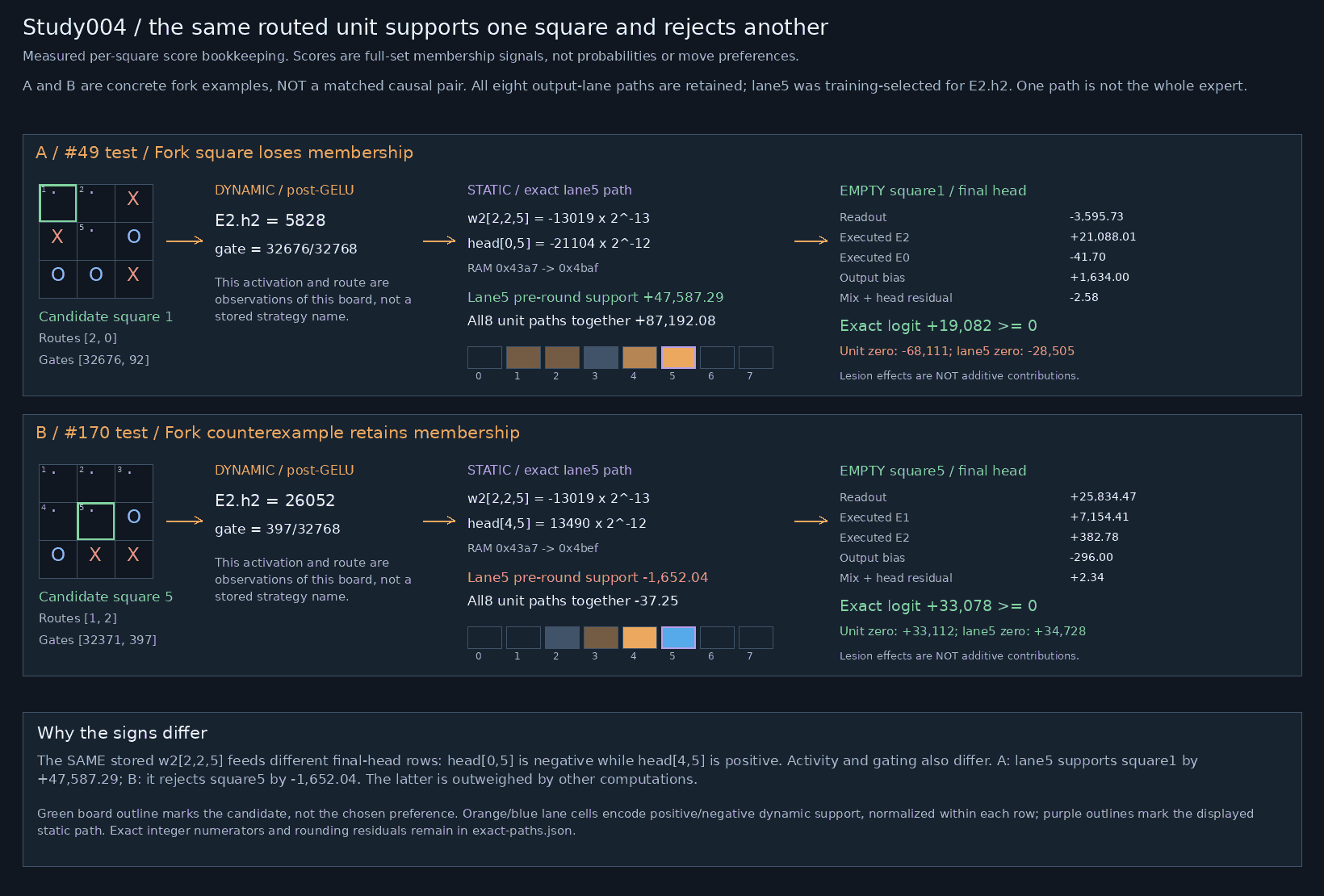
Study004 follows E2.h2 through output lane 5 and the final head. Its pre-round contribution is +47,587.29 to fork square 1 on canonical board 49, but −1,652.04 to fork square 5 on canonical board 170. Different signed final-head rows account for the reversal. These are path bookkeeping values, not probabilities, uniquely assigned causal shares or sums of independent lesion effects. Shared integer-rounding residuals remain separate.
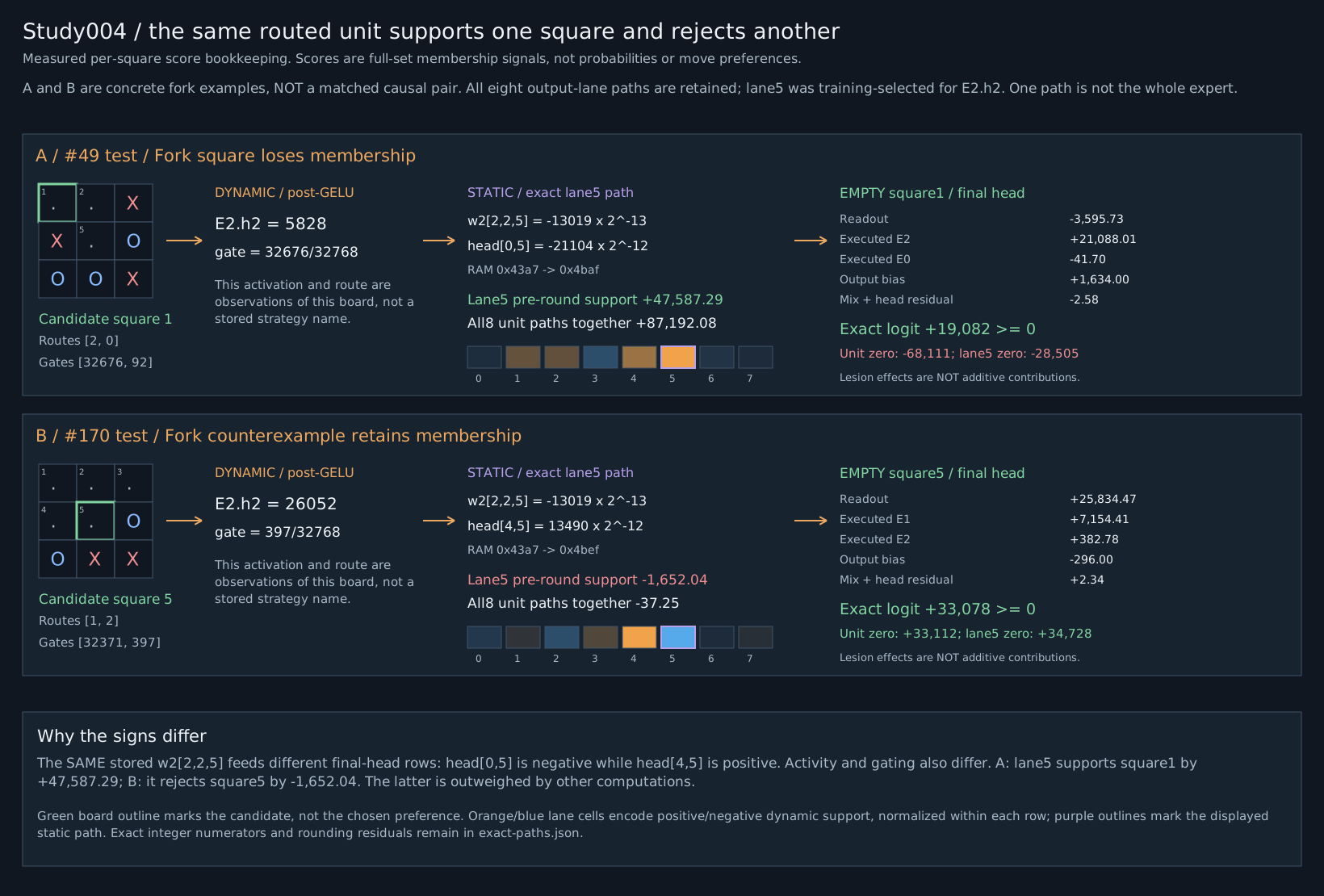
The same stored connection has opposite-signed pre-round support through different final-head rows. These are actual measured paths, not probabilities or uniquely allocated causal shares.
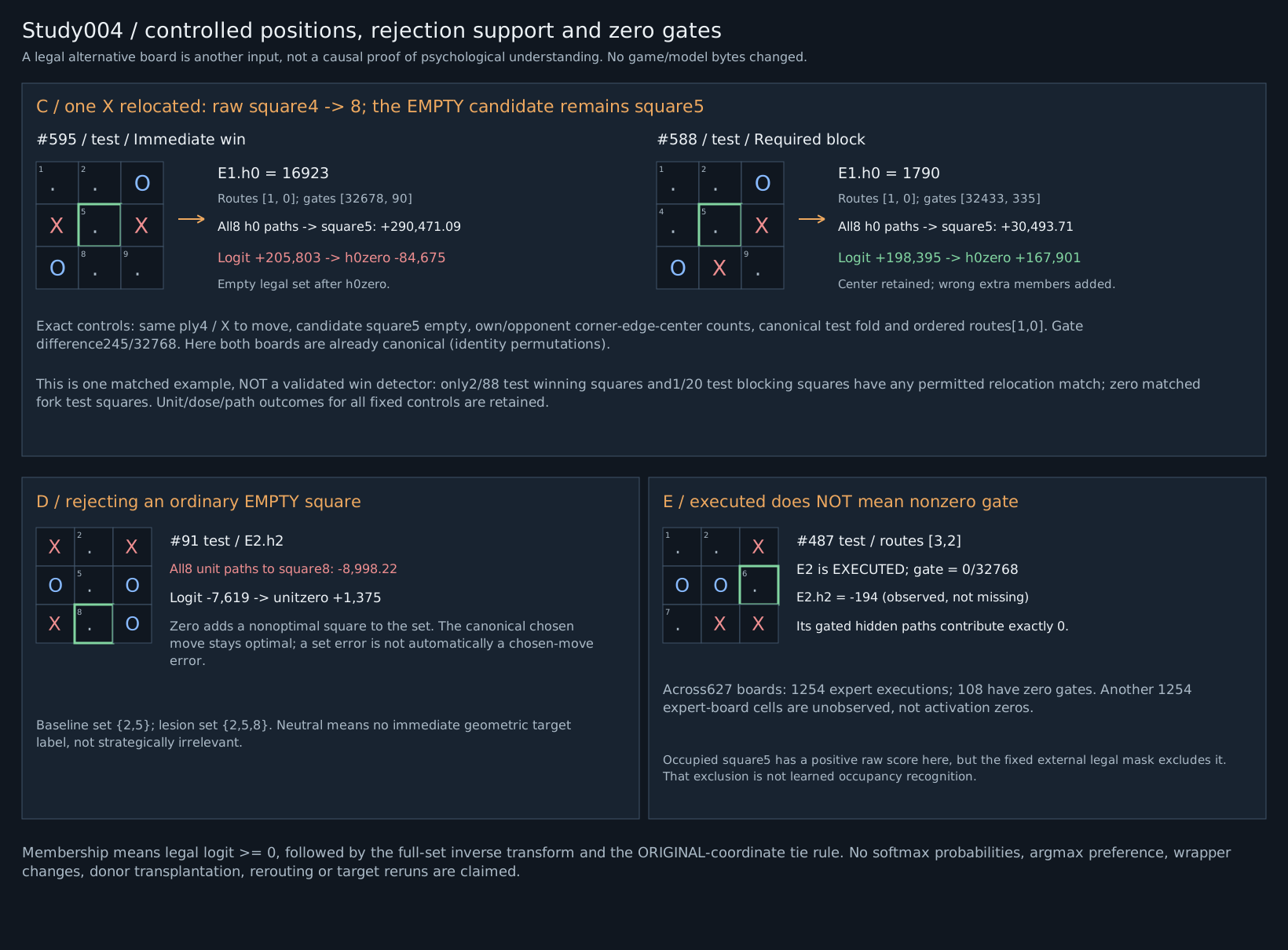
Legal relocation controls keep declared geometry/candidate alignment explicit. An executed zero-gate expert is distinct from an unexecuted, unobserved expert.
Attention is contextual, but that does not identify a strategy detector
Local embedding/Q/K/V values are fixed by square, occupancy and side. A pair's QK score can stay fixed while its attention probability changes because other keys alter the normalization. The weighted values and projection then depend on the whole board. Query row is not chosen output square: all rows feed the flattened global readout and later learned computation.
Attention is heterogeneous, not uniformly broad. Replacing it with a positional mean damages decisions, but large unnatural perturbations can cause generic failure. Matched geometric controls were also damaging. Adding the tested attention row/column features did not improve confirmation AUC for wins/forks over simple controls; that negative result limits this particular feature/probe family, not every possible representation of those concepts.
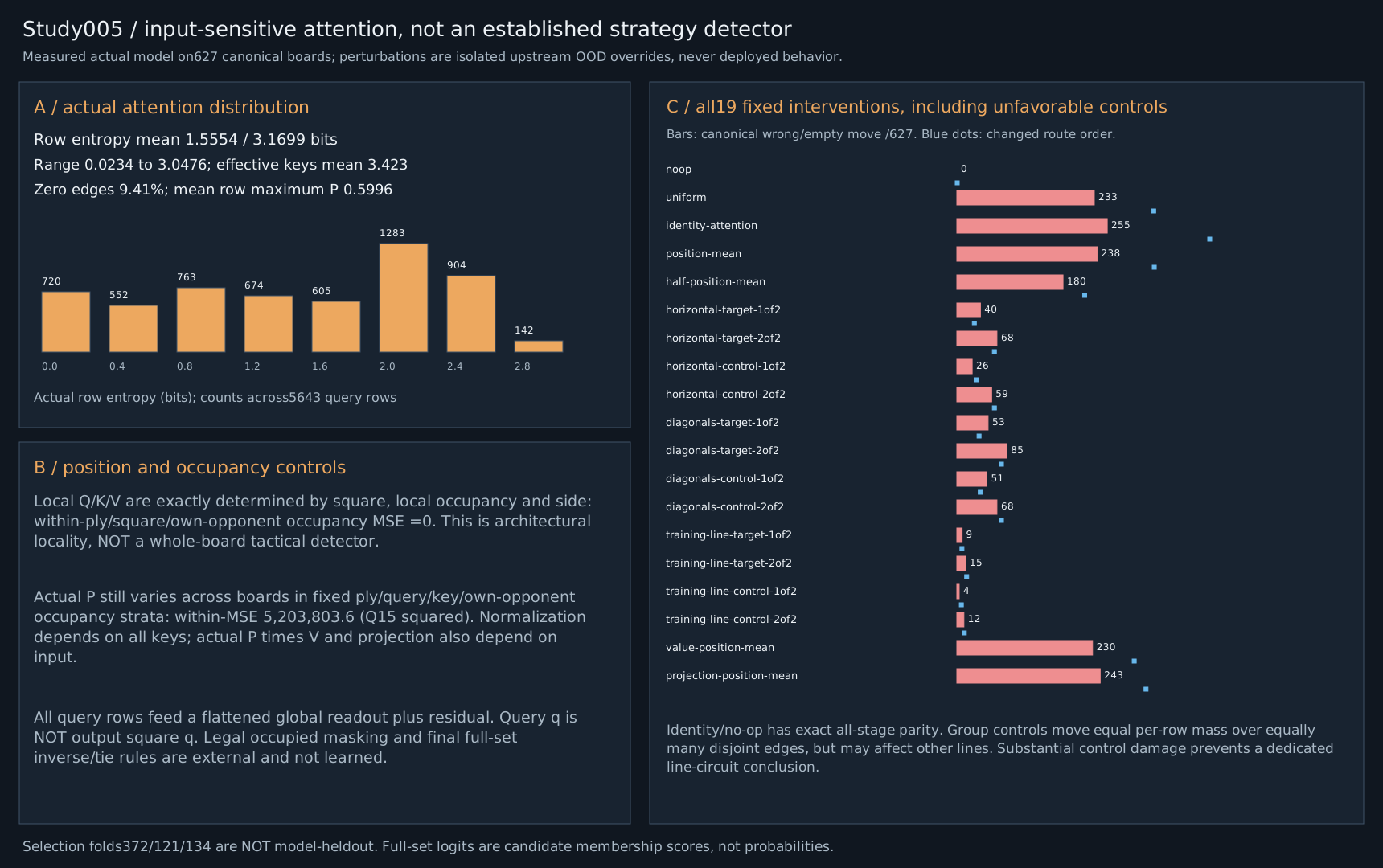
Input-sensitive attention matters to decisions, but damage from an override is not itself evidence of a selective line or threat detector.
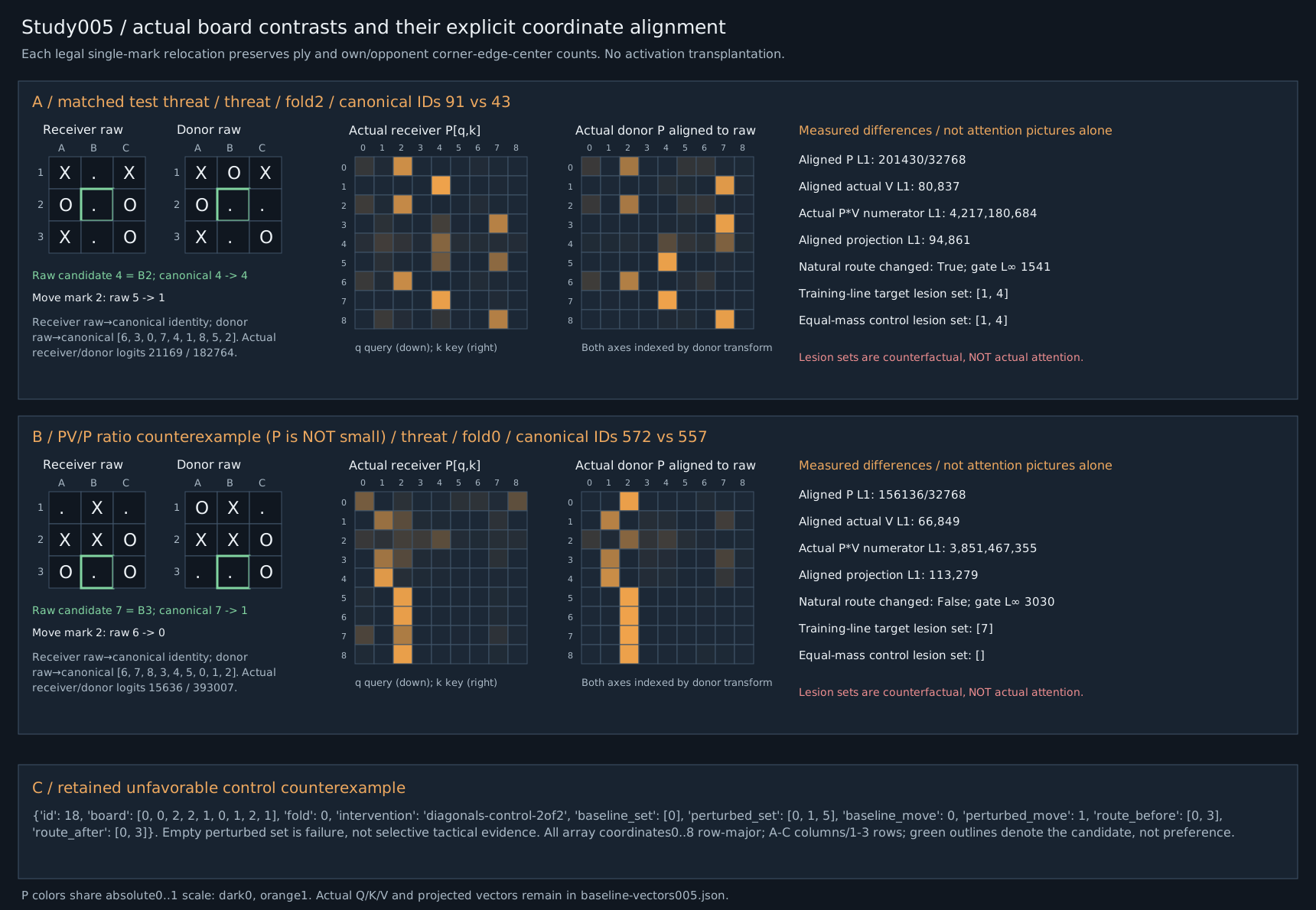
Actual probabilities, weighted values and projections are different quantities. The candidate square is not automatically the corresponding attention query row.
Router usefulness: pair membership and gate assignment are different
Study006 holds each board's expert outputs fixed while comparing six possible expert pairs under declared gate contracts. Extra outputs for normally unselected experts are evaluated offline, not claimed as deployed sparse compute. Reversing the pair and its matching gates preserves all results; reversing only the expert assignment changes which vector receives which gate and causes 291/627 selected-move failures. Replacing the actual pair's gates with equal weights causes 194/627 failures. These counts include empty sets.
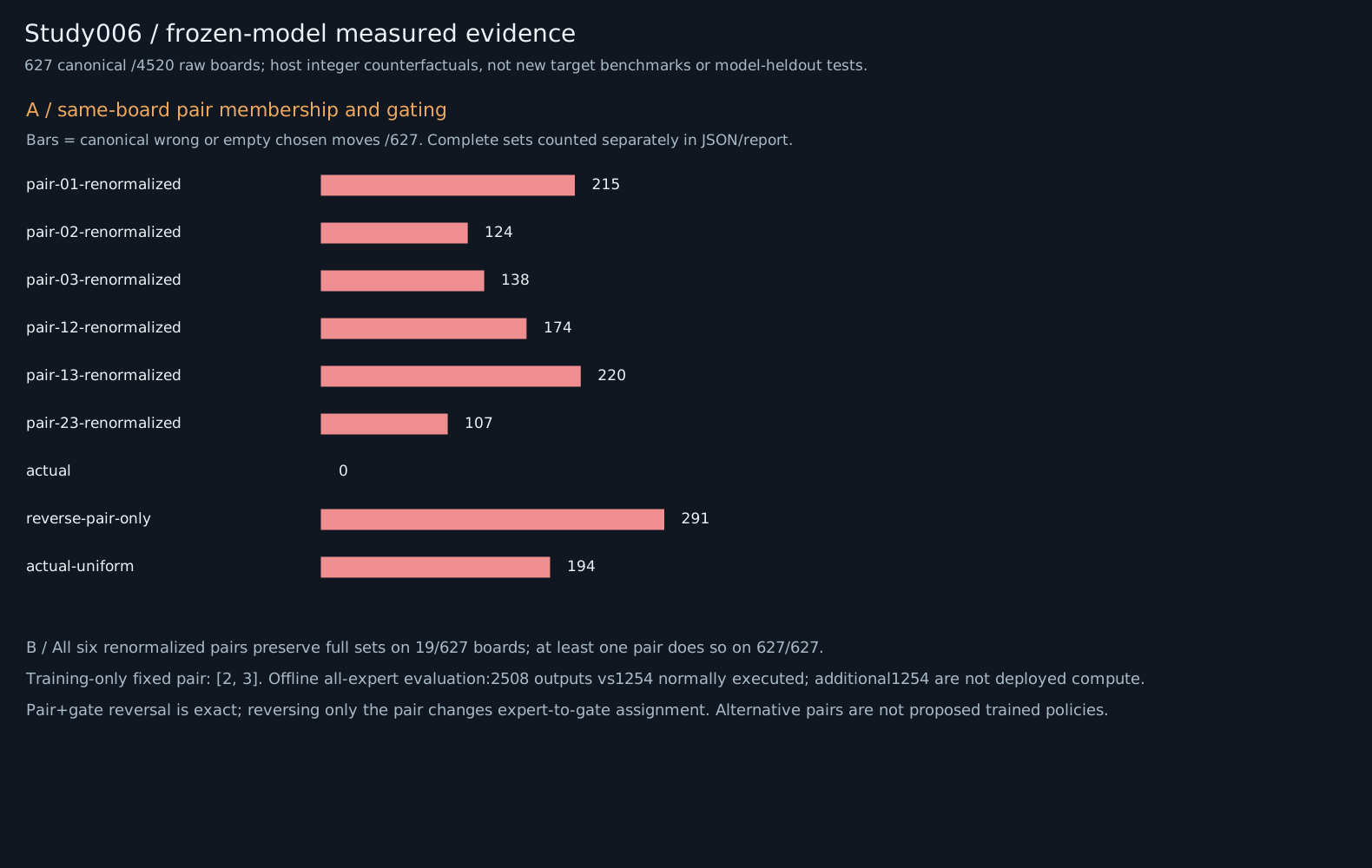
Actual routing is correct on all 627 boards. The best fixed pair, selected on training boards, still fails on 107/627 boards overall. Hindsight alternatives are diagnostic bounds, not a proposed trained policy or a deployable oracle.
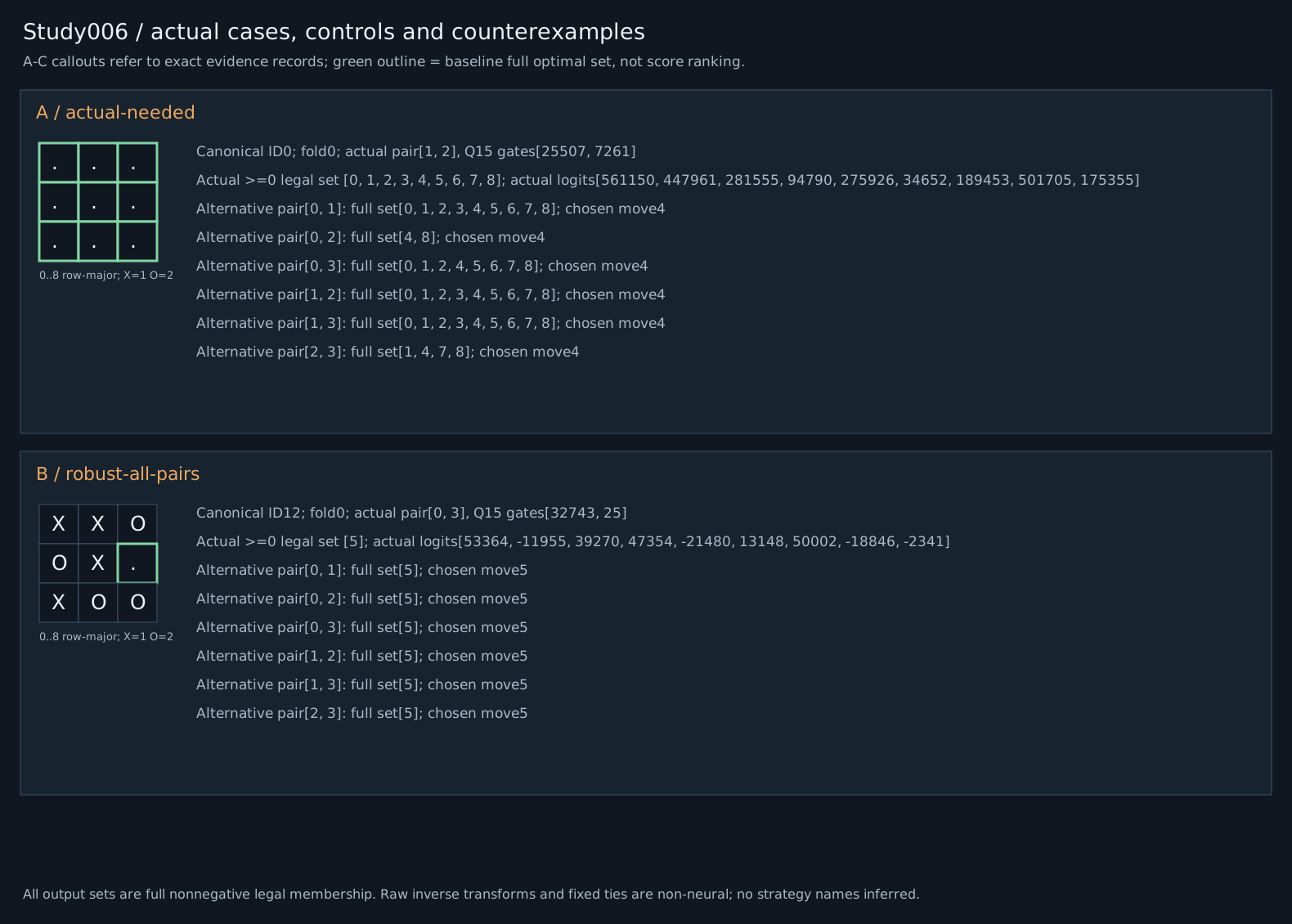
Only 19/627 boards preserve their complete legal sets under all six native renormalized pairs. This supports input-dependent routing/gating relevance, but does not identify an expert's tactical job. On test matched win/neutral records, the training-selected fixed pair fails on 2/23 win records versus 3/23 neutral records; block and fork comparisons have only 2 and 4 matched records, respectively. Sparse/reused matches do not establish selective tactical effects.
Pathway tests: local rescue does not establish sufficiency
Study007 tests whole expert output vectors after routing, retaining the receiver's readout residual, actual gates and final head. It is not a complete network circuit test. There are 354 directed task/role trials, 354 exact identity controls and 708 exact restoration equalities. Natural route-fixed and route-changing board contrasts are reported separately; their donor route changes are not interventions on the receiver's upstream router.
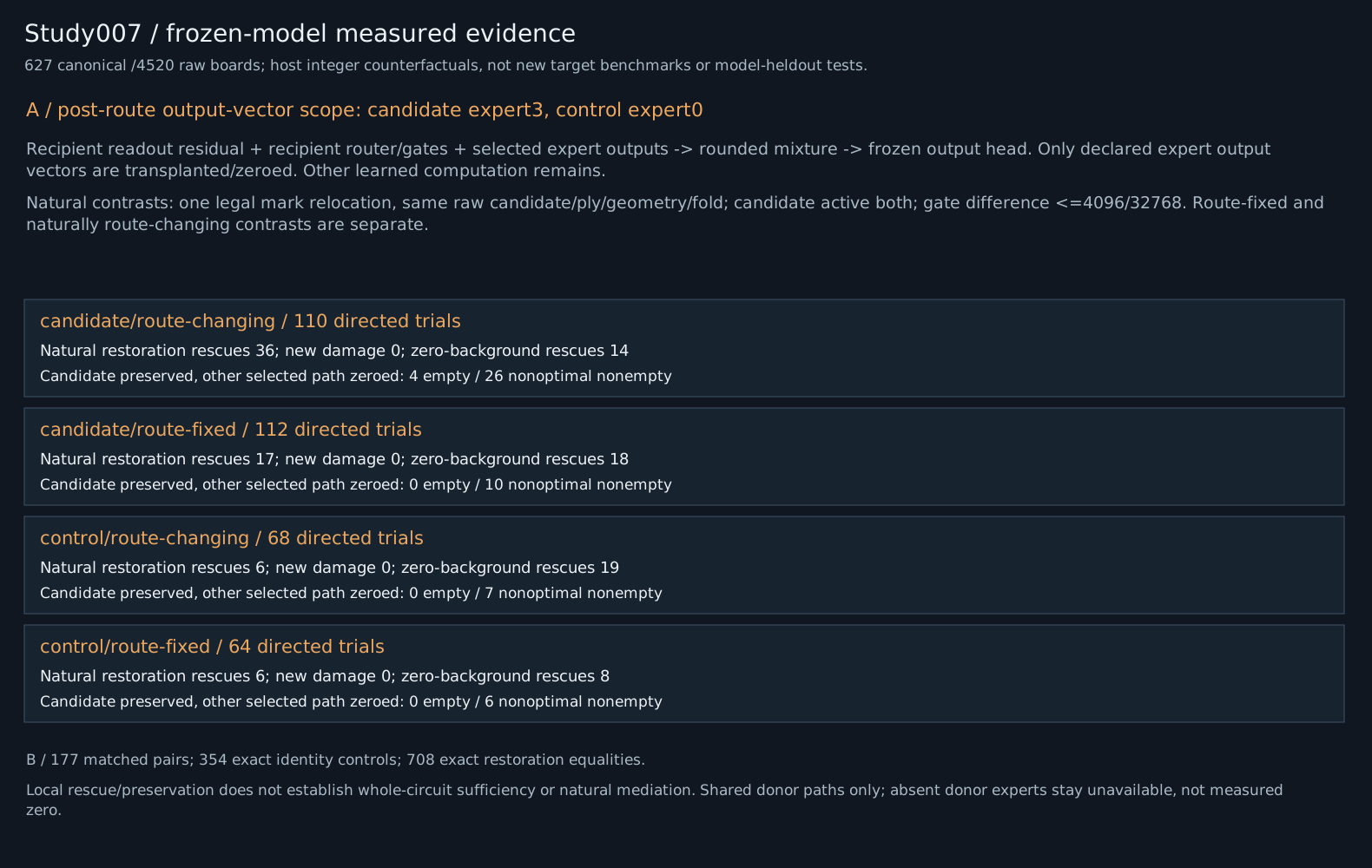
Candidate and control aggregate rows have different cohorts. Their rescue counts must not be interpreted as a head-to-head efficacy comparison.
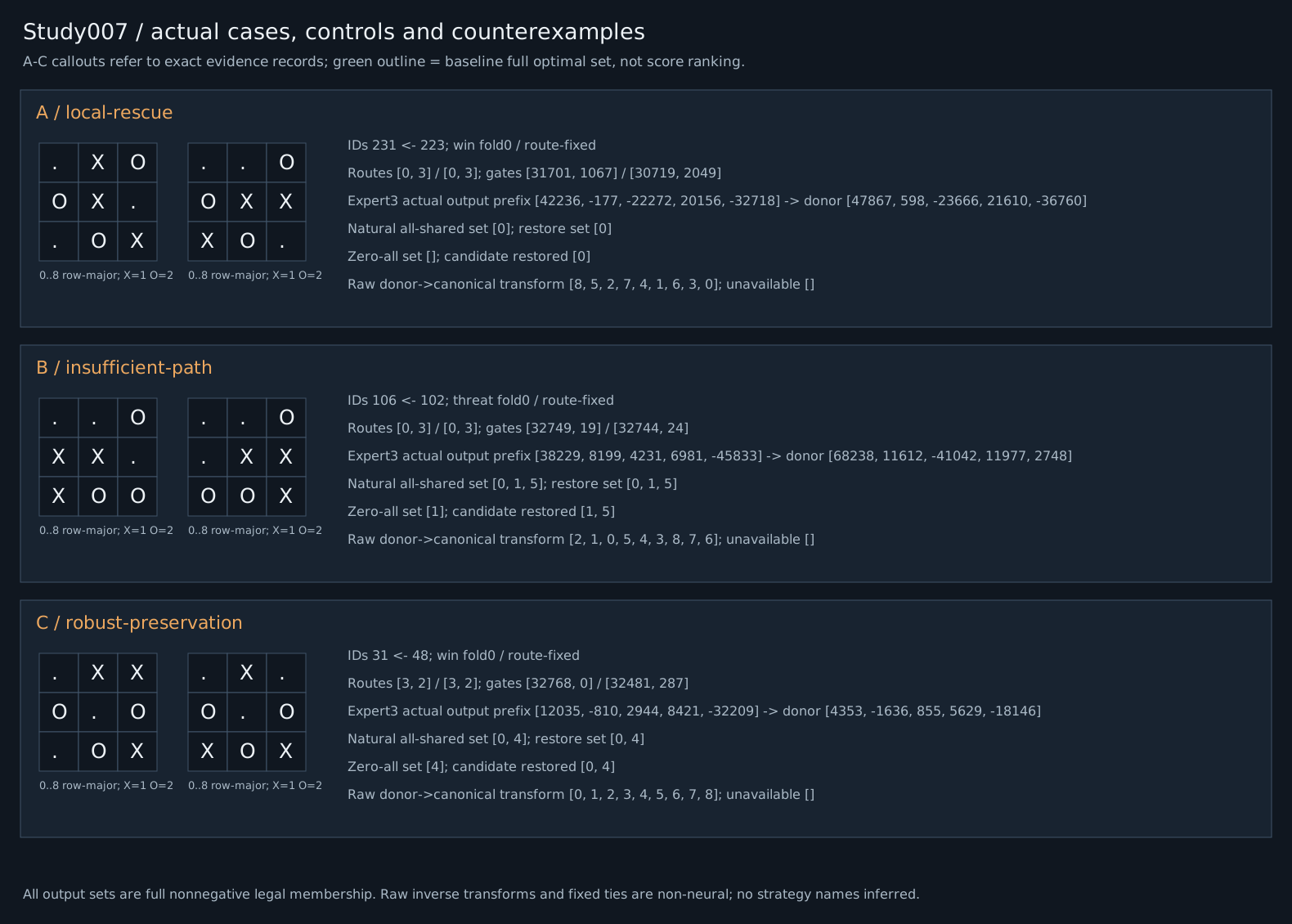
The training-selected candidate E3 sometimes rescues a damaged output, but preserving it while zeroing the other selected expert still fails on 10/112 route-fixed and 30/110 route-changing trials. This does not support sufficiency. Those trials reuse boards and tactical labels; they are not independent samples.
The exact common-support control is unfavorable to the candidate. On the same 30 directed route-fixed board-pair/task records, preserving E3 fails 5 times versus 0 for E0; natural restoration rescues 0 versus 5. Gates remain the actual receiver gates, not equalized across expert IDs, so this is also not a matched-capacity specialist comparison.
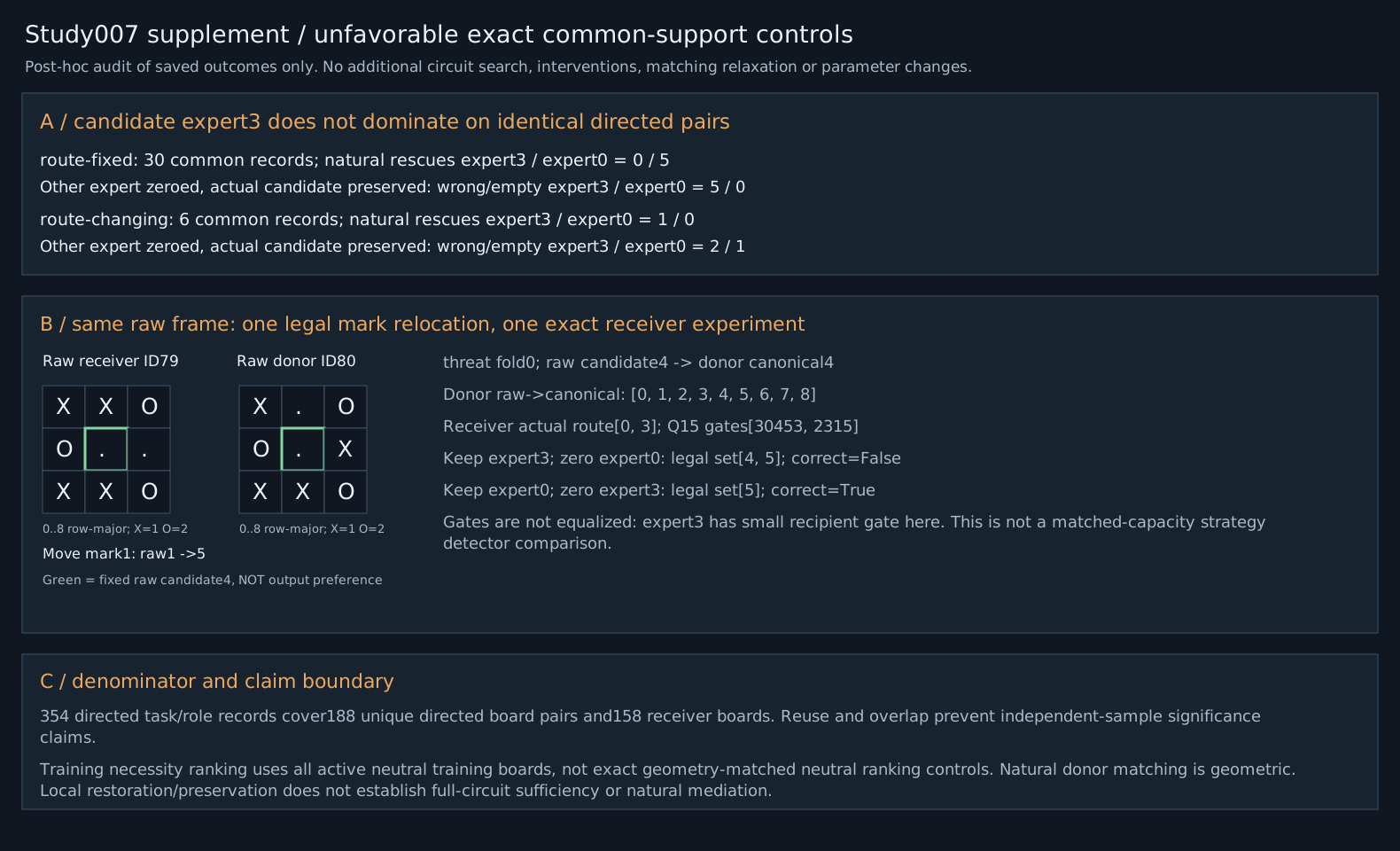
The supplement is a descriptive audit of saved outcomes, not new interventions. It corrects two potential misreadings: unequal cohorts do not demonstrate E3 superiority, and training necessity ranking used the active neutral pool—not exact geometry-matched neutrals. Natural relocation matching was geometric. Original report/figures remain unchanged; read the clarification alongside them.
Integer decision-fragility: a bounded negative result
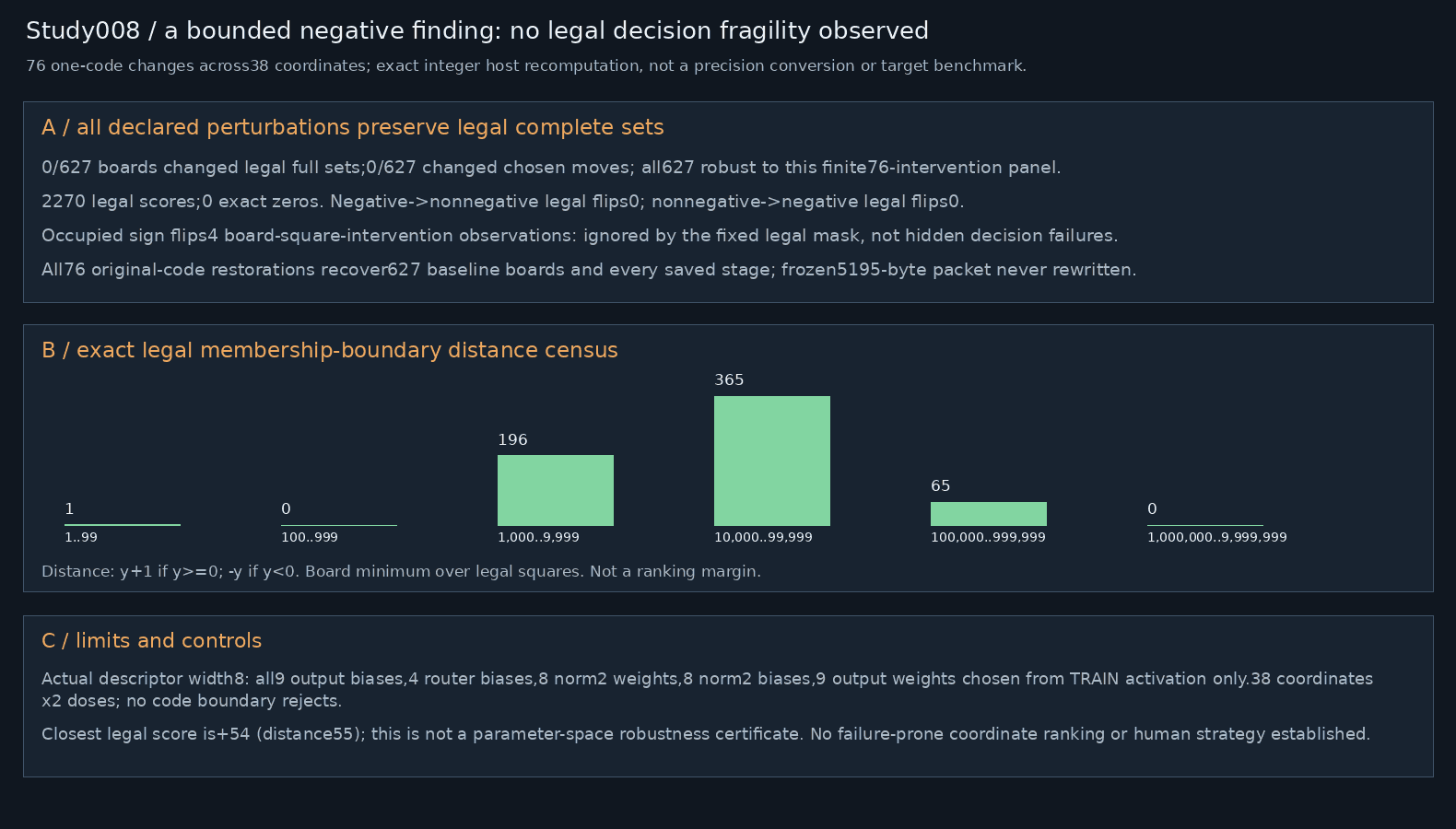
Study008 changes one stored integer code at a time by +1 or −1 across 38 declared coordinates: all nine output biases, four router biases, eight norm2 weights, eight norm2 biases, and one training-selected output-weight coordinate per row. All 76 changes are valid and each full forward is recomputed. Every original code is restored with all-stage baseline equality afterward.
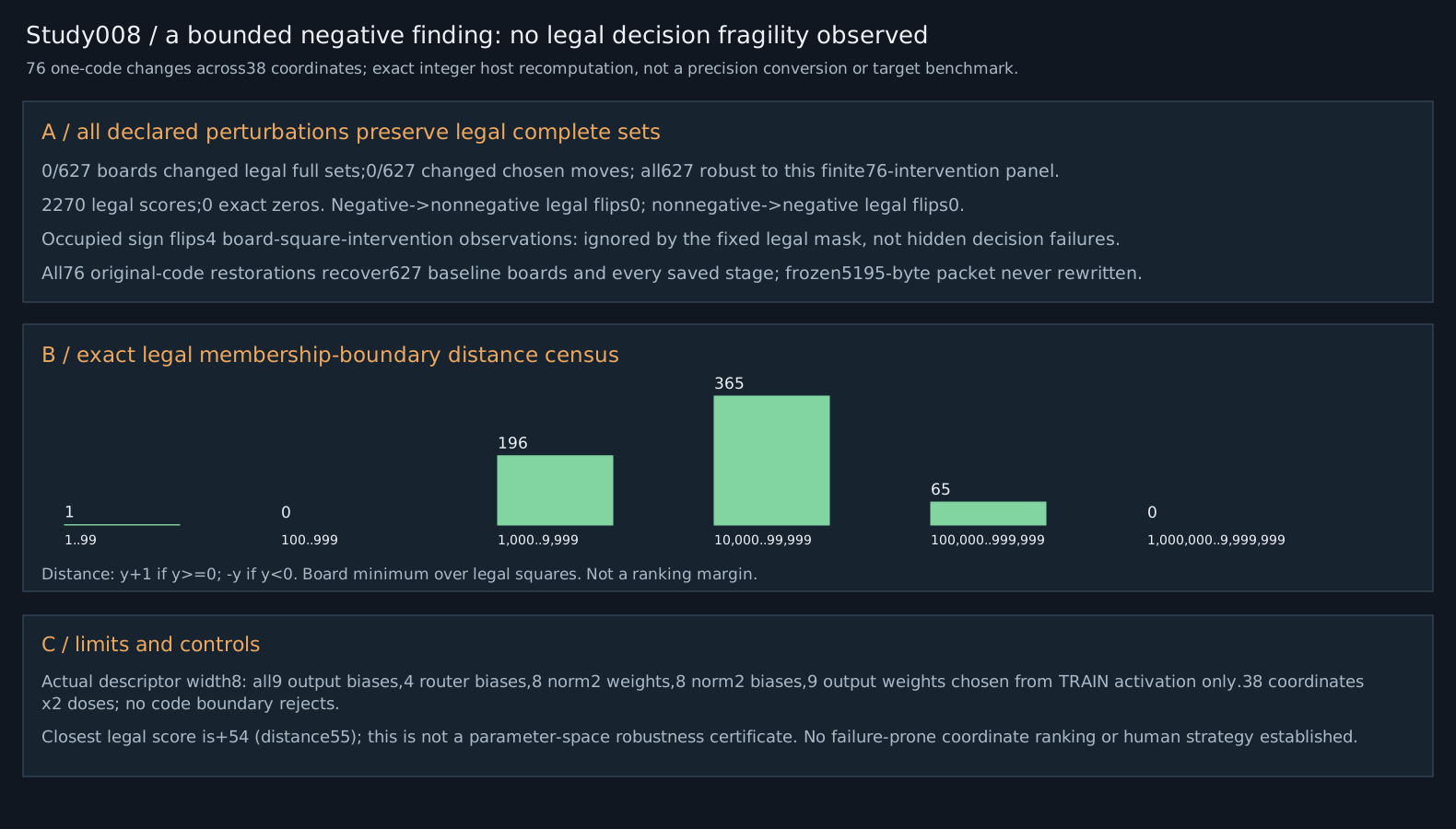
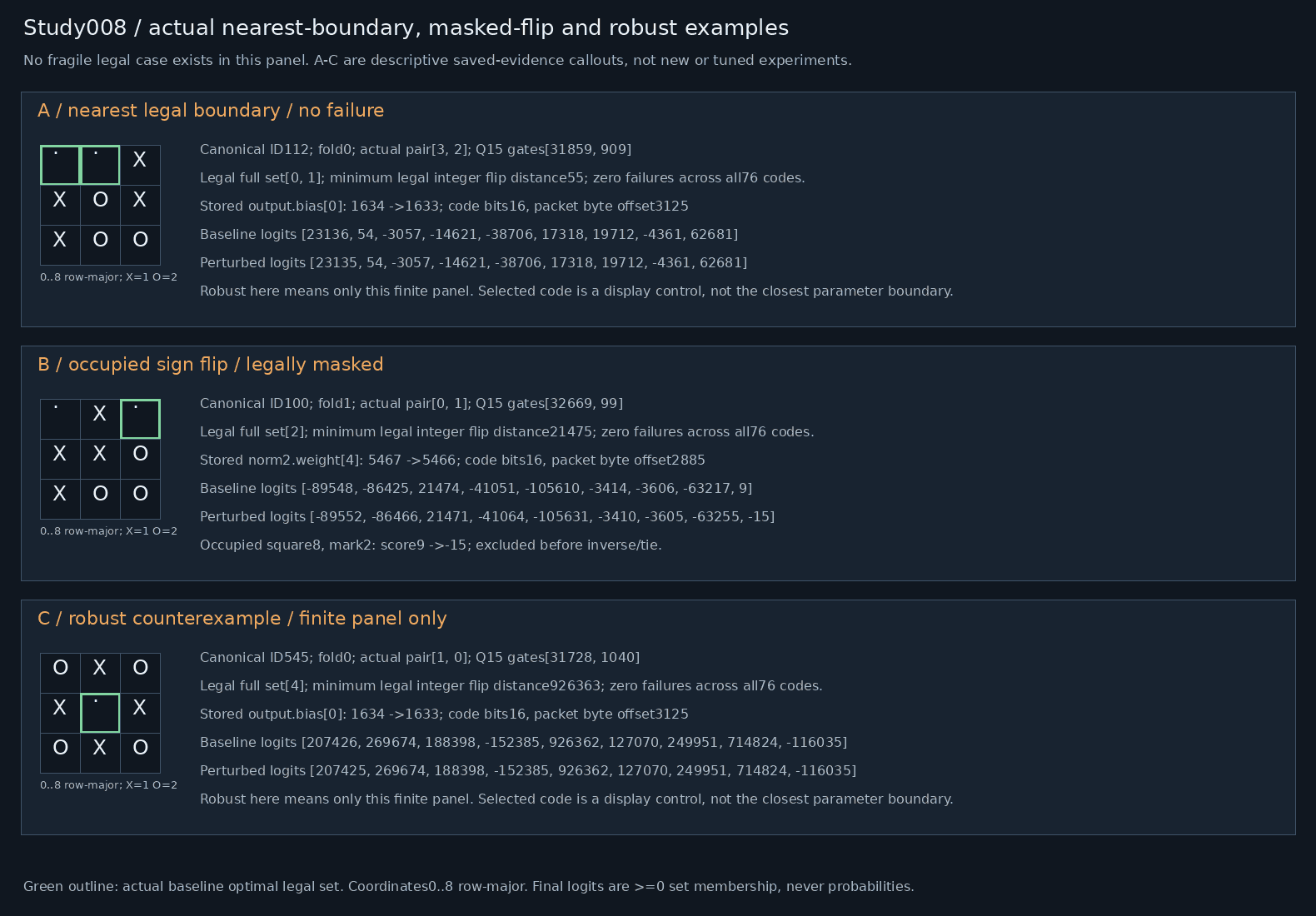
None of the 76 perturbations changes a legal full set or chosen move on the 627 canonical boards, with original-coordinate wrapper outcomes checked too. Among 2,270 legal scores there are no exact zeros; the nearest is +54, which needs a decrease of 55 score units to leave the nonnegative membership set. That is a score-space distance, not a parameter-space robustness certificate. Four occupied-square sign-flip observations are removed by the fixed legal mask and therefore are not hidden gameplay failures.
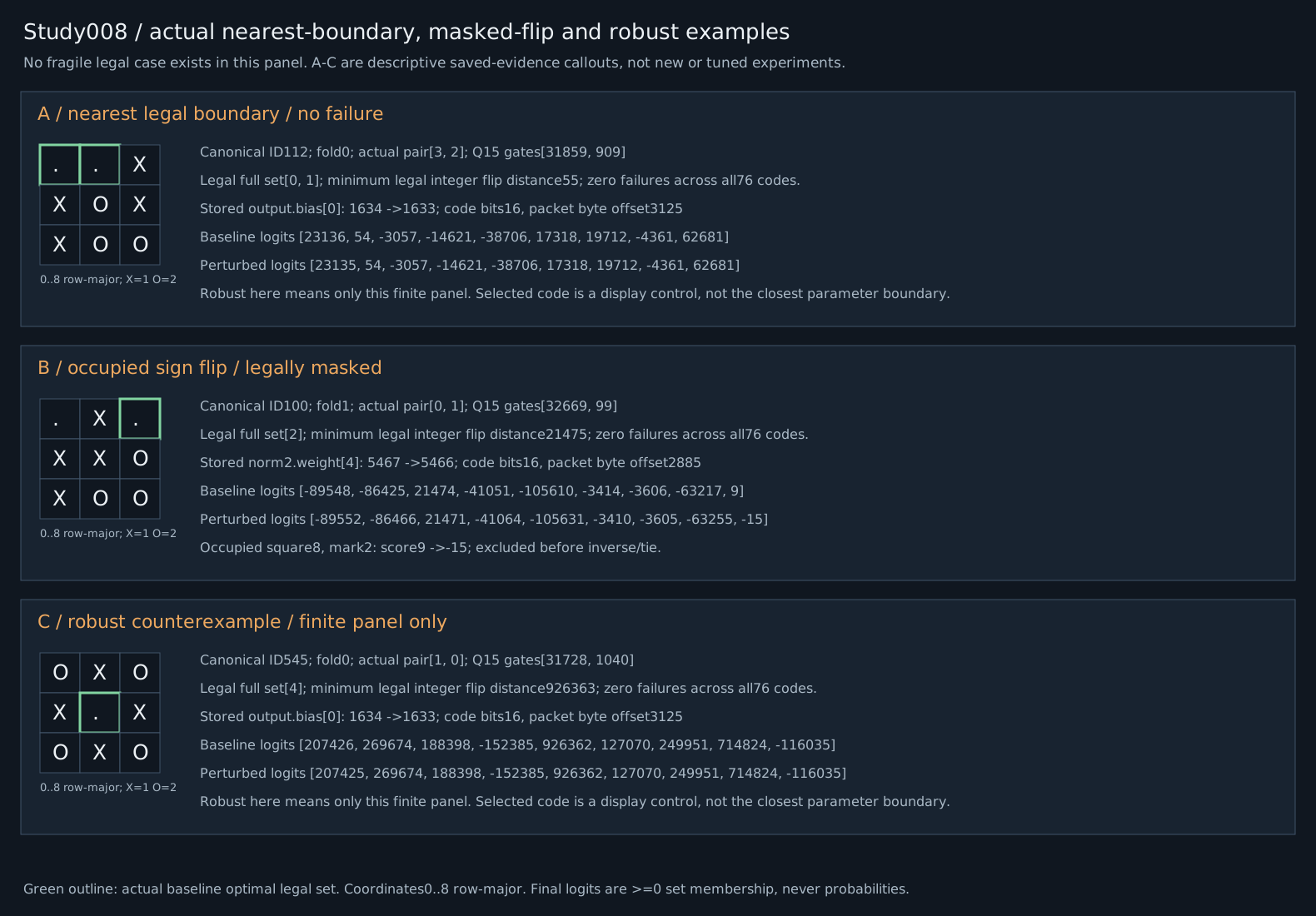
No fragile legal case was found in this panel. The corrected figures replace misleading generic preliminary labels; the original generated examples remain preserved. The actual width-8 descriptor correction was frozen before any study008 intervention. Neither correction changes the scientific design after outcomes.
This result does not establish universal robustness, minimum possible bit width or why historical reduced-precision exports failed. A componentwise precision conversion changes many effective weights/scales together; it is a separate question from a one-code perturbation.
Coarser precision: follow a numerical change all the way to a move
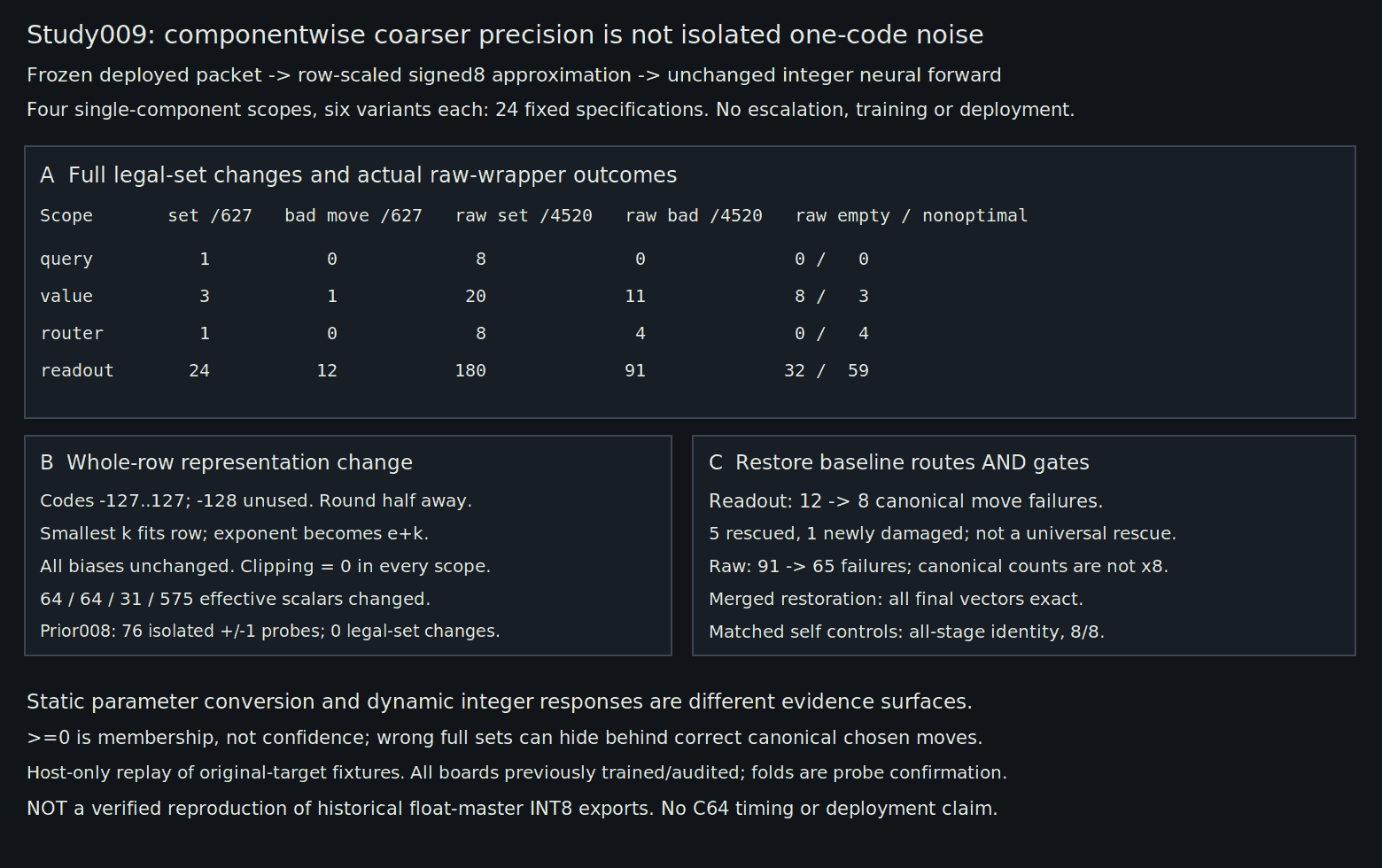
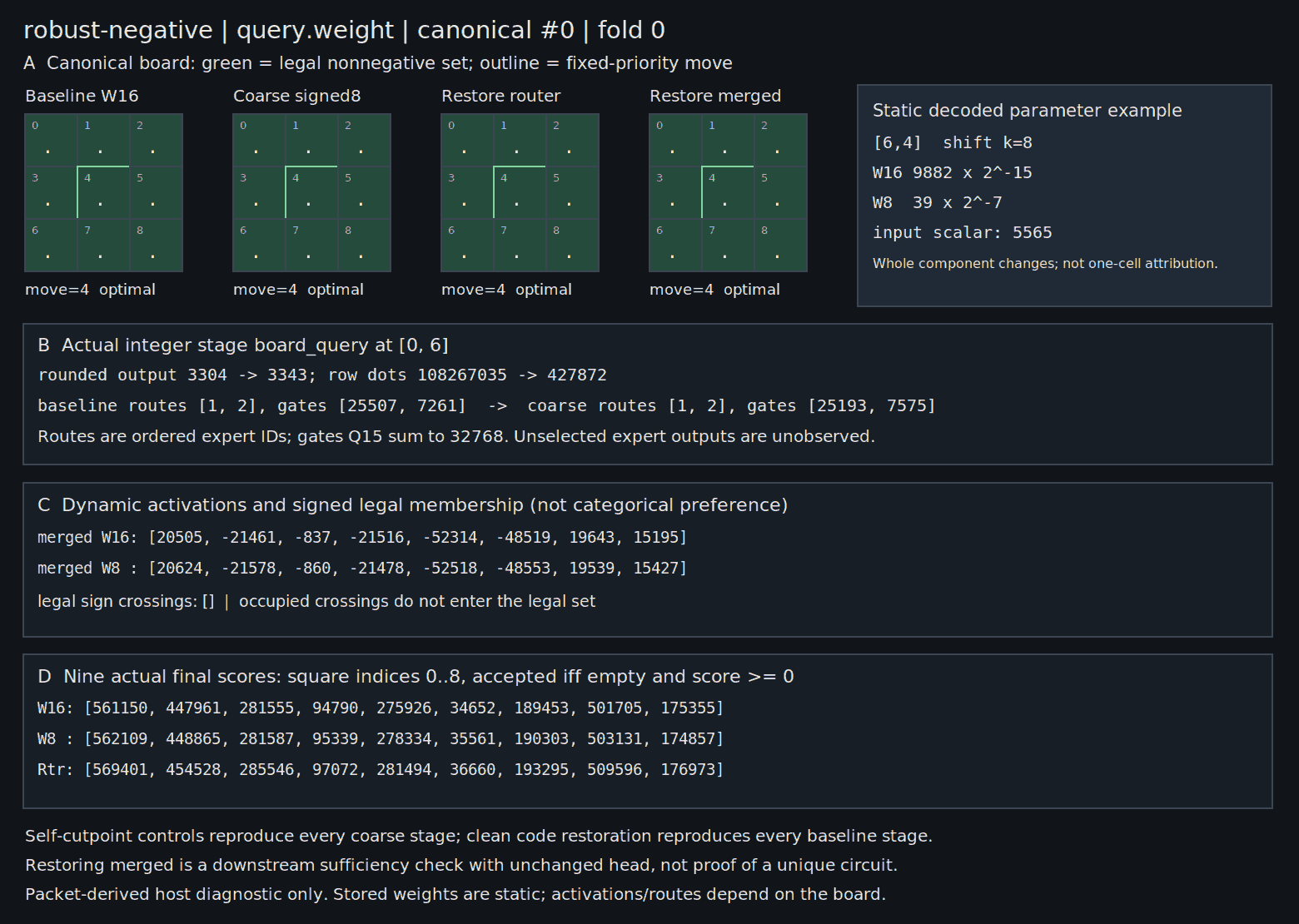
Study009 starts from the decoded deployed packet, not a float training checkpoint. It independently approximates four declared matrices—query, value, router and readout—with signed codes in −127…127. For each row, choose the smallest power-of-two right shift whose rounded codes fit that range, then increase the row exponent by the shift. Biases and all other components remain unchanged. There is zero clipping. Each scope has six fixed approximation, restoration and identity specifications, for 24 total.
This is a new packet-derived diagnostic, not a verified reproduction of the historical INT8 exports, a new deployment candidate or a C64 speed/RAM result. The study008 one-code panel used different coordinates; these two studies do not isolate multiplicity as the sole reason for their different outcomes.
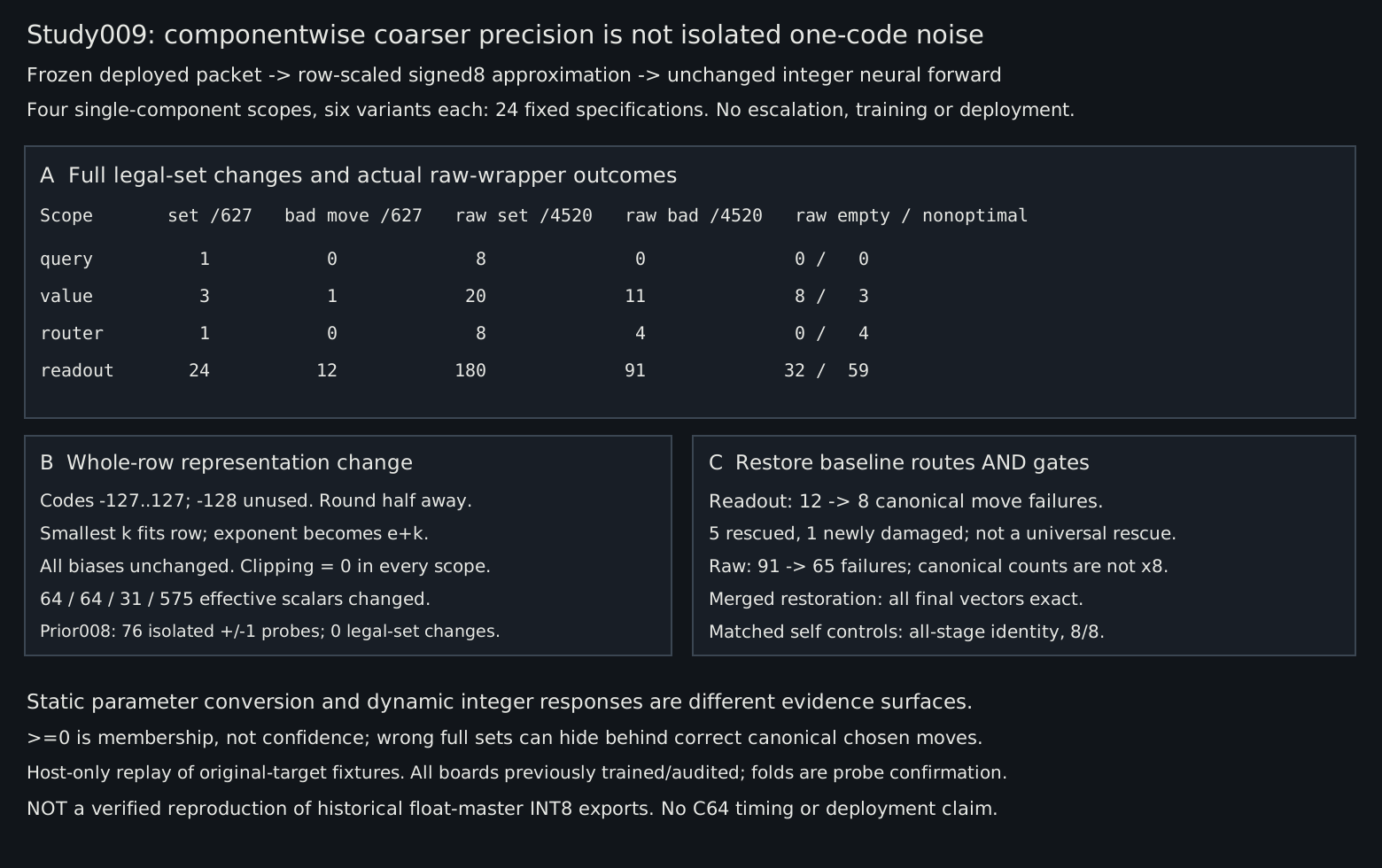
| Approximate matrix | Canonical set changes /627 | Canonical wrong-or-empty choices /627 | Raw set changes /4520 | Raw wrong-or-empty choices /4520 |
|---|---|---|---|---|
| Query | 1 | 0 | 8 | 0 |
| Value | 3 | 1 | 20 | 11 |
| Router | 1 | 0 | 8 | 4 |
| Readout | 24 | 12 | 180 | 91 |
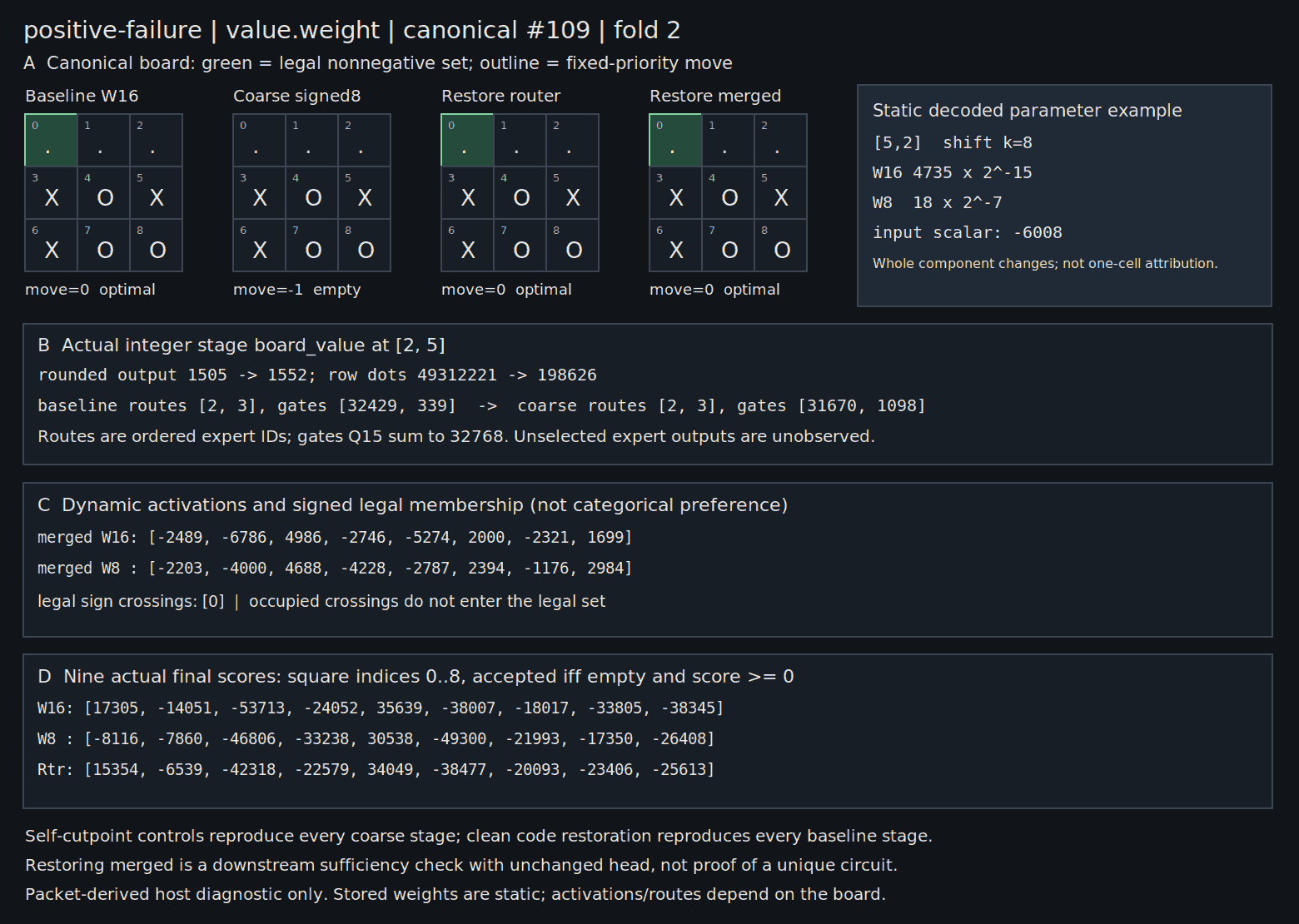
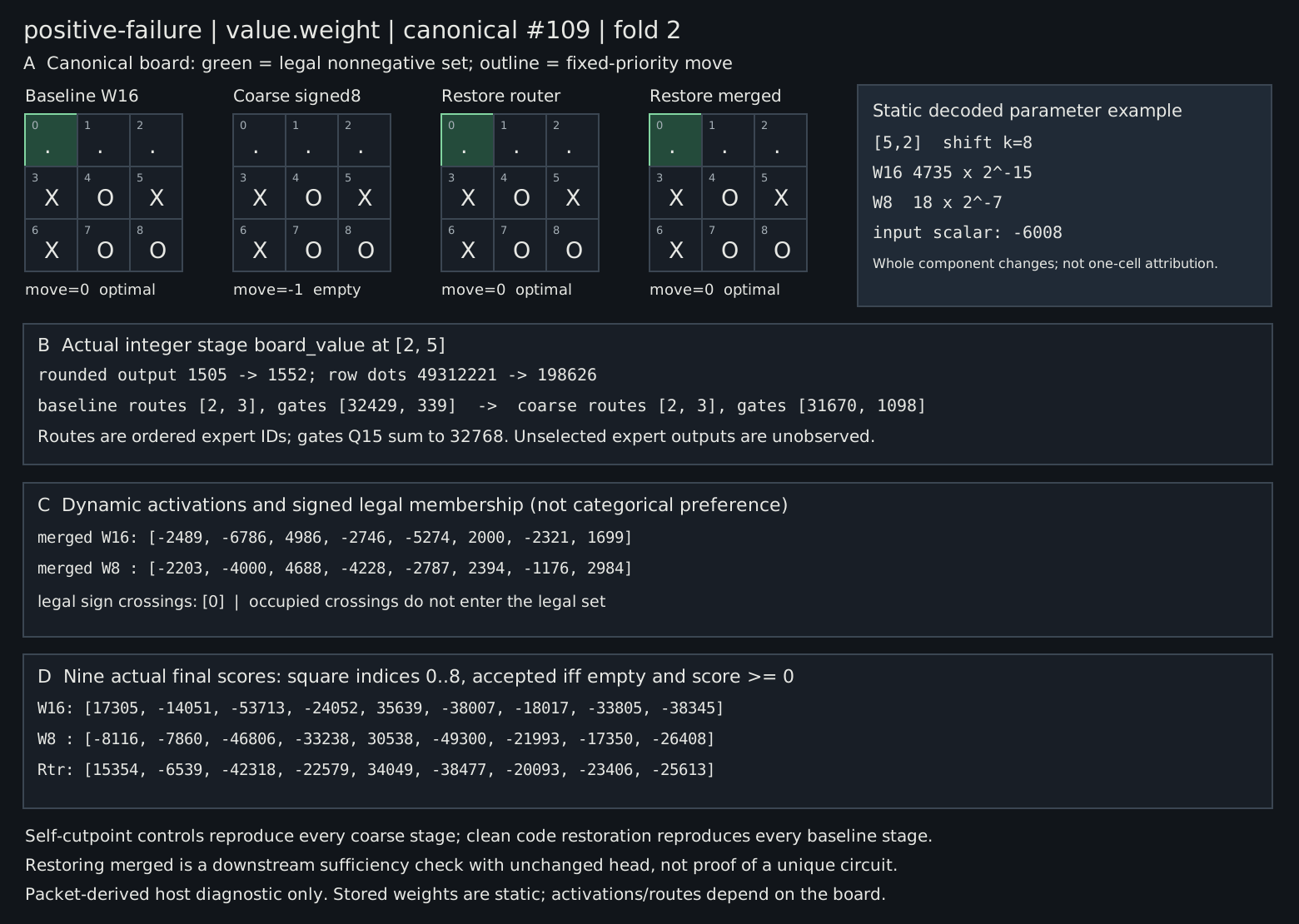
A. A small local change can propagate through gates to a sign crossing
On canonical board109, one displayed value-weight example changes from
4735 × 2^-15 to 18 × 2^-7. The whole value matrix is approximated; that
one displayed coefficient is an illustration, not isolated single-weight causal
attribution. The measured value activation changes 1505→1552, while query and
attention probabilities remain unchanged. Downstream normalization and routing
scores change; the selected expert pair stays [2,3], but its Q15 gates change
[32429,339]→[31670,1098].
The only approved legal square, internal square0, changes from +17,305 to −8,116, emptying the set. Restoring the baseline router scores at the declared cutpoint restores that square to +15,354, while the upstream approximation remains in place. This identifies a contribution of that branch to this hybrid case, not an exclusive strategic role or a natural mediation result.
B. Restoring the original gates is not a universally safe repair
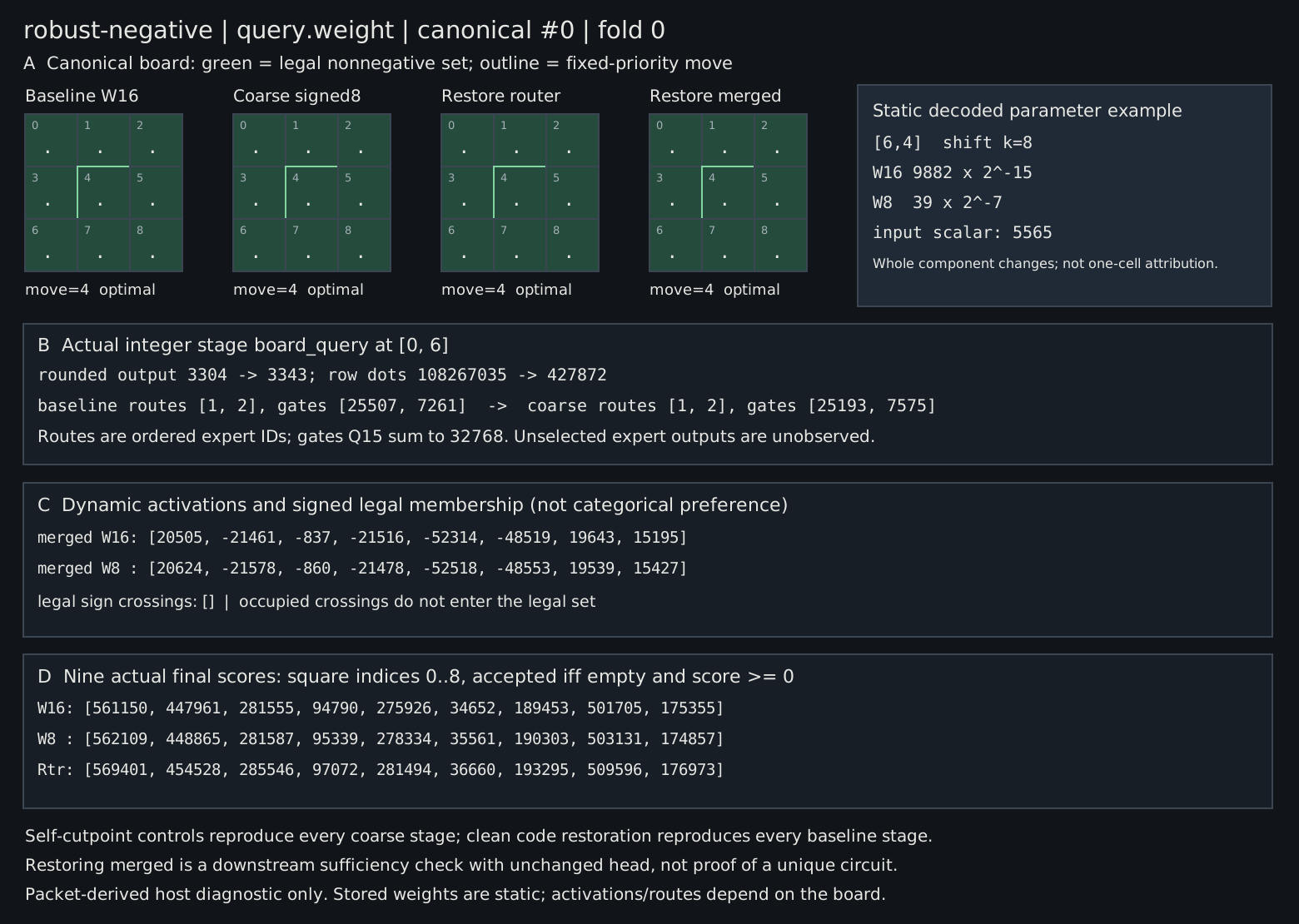
For the readout approximation, restoring baseline router scores/gates reduces canonical chosen failures 12→8, but that combines 5 rescues and 1 newly introduced failure. Raw failures change 91→65, with 34 rescues and 8 new failures. The same receiver boards are used; this is not an unequal-cohort comparison.
Board157 makes the limitation concrete: its legal square0 is accepted at
+16,341 in baseline and +9,169 after readout approximation, but becomes
−1,449 after restoring baseline router scores. The pair remains [0,3].
Original gates can be incompatible with perturbed residual/normalization/expert
activity; this is an intentionally artificial mixed-state intervention.
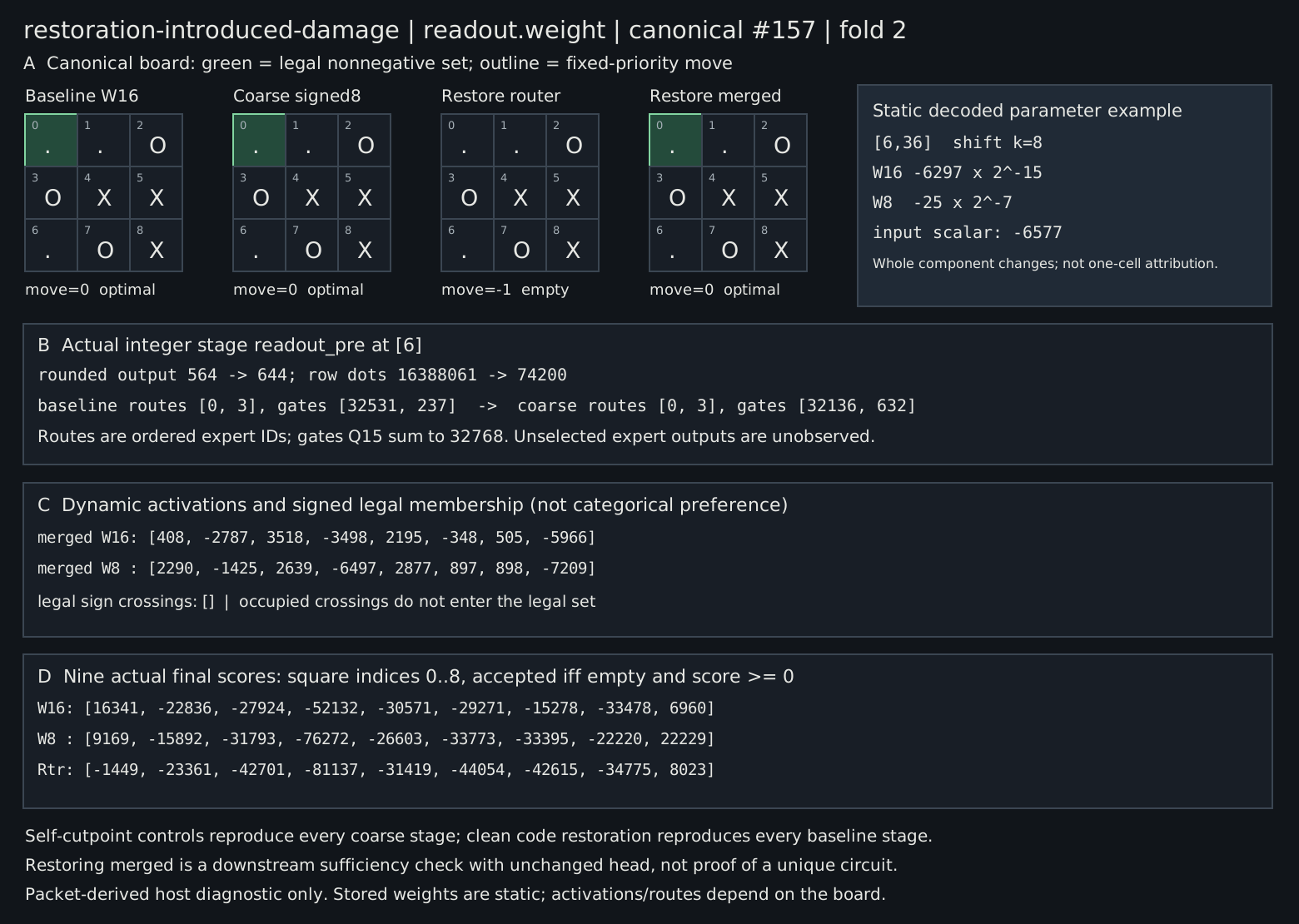
Eight self-cutpoint controls preserve every stage, and four clean-code restorations recover the full baseline. Substituting baseline merged vectors restores every final score, as expected for an unchanged deterministic final head; that mechanical sufficiency does not discover a unique strategy circuit.
C. Correct canonical choices can conceal incorrect raw choices
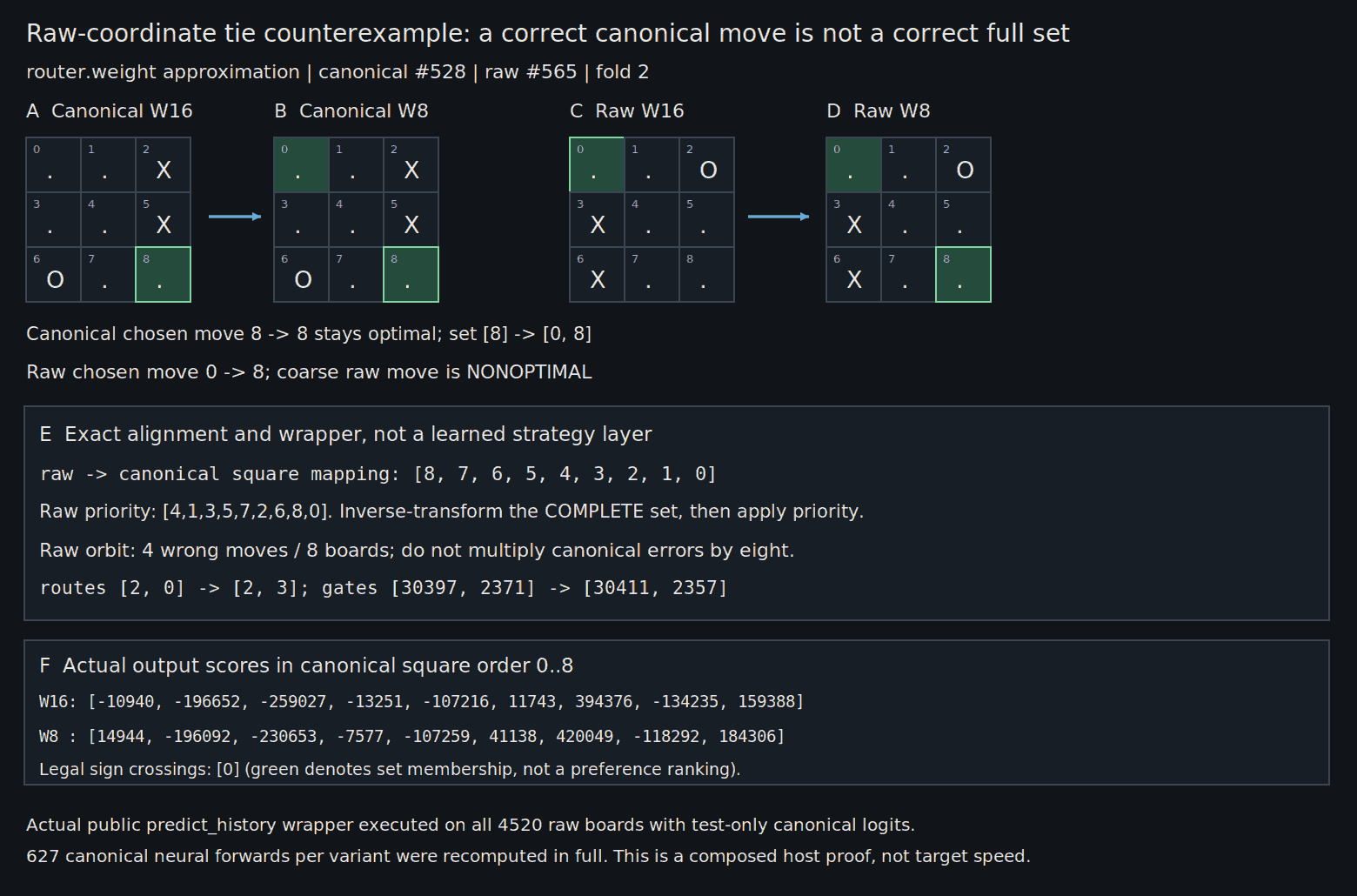
The router approximation adds internal square0 to board528's set. Its canonical chosen square8 remains correct, but an inverse-transformed raw orientation makes the fixed tie rule select the new, nonoptimal member. The orbit has 4 wrong choices out of 8 boards, despite zero wrong canonical chosen moves for this component. That is why full sets and actual raw-coordinate ties are separate gates; neither can be replaced by multiplying canonical errors by eight.
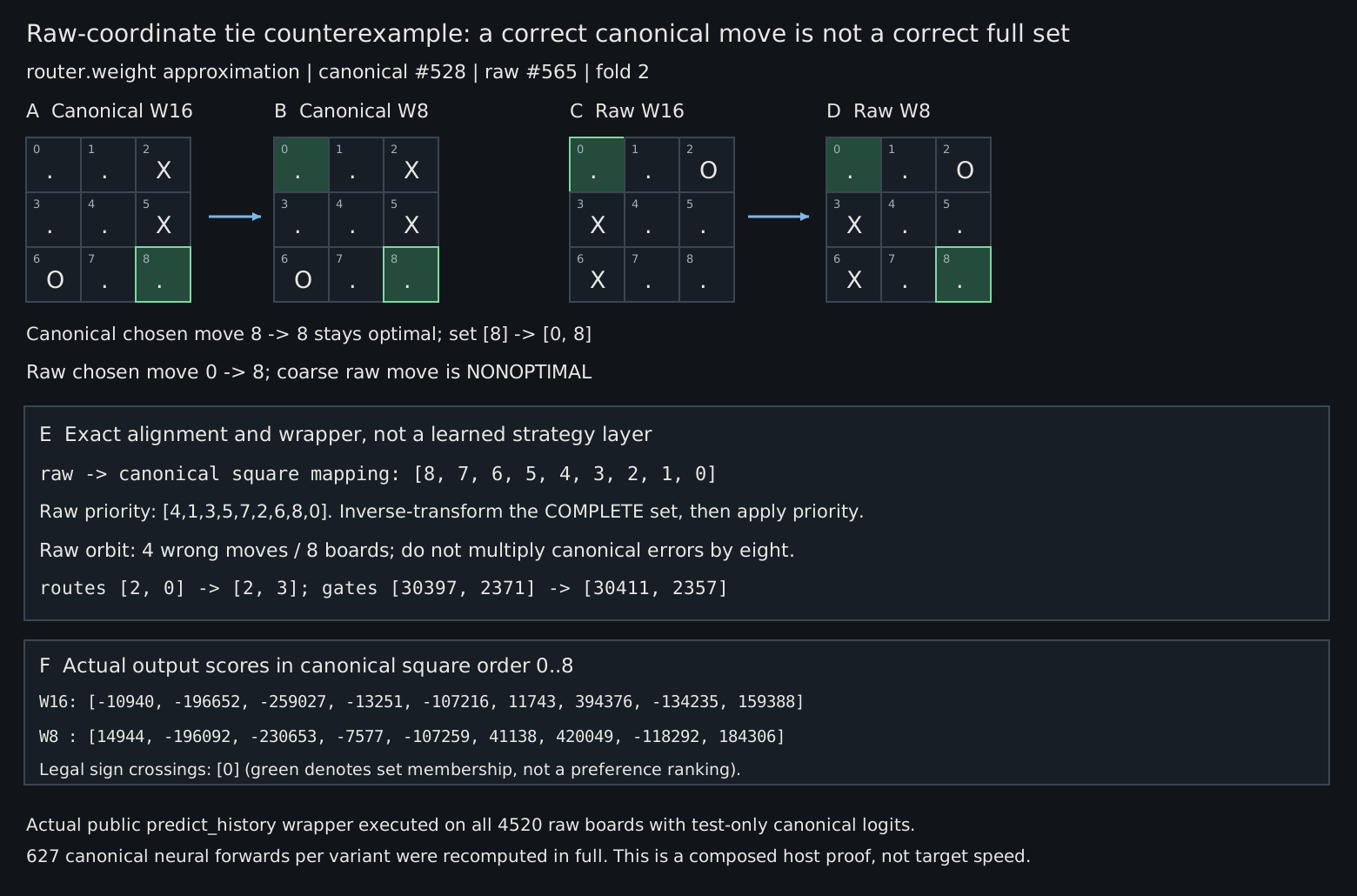
D. Changed internal activity is not automatically behavioral damage
For the empty board under query approximation, query values, attention, readout, gates, merged activations and scores change, but all nine legal scores remain nonnegative. The complete approved set and center tie-selected move remain unchanged. This counterexample belongs beside the failure cases.
A worked forward pass: from stored codes to one actual move
The following two pages follow canonical board 341 through the unchanged network. They are measured arithmetic, not a proposed strategy diagram. Read A–D first, then E–H. Lowercase a–i name squares; the eight vector lanes are latent features, not eight other squares.
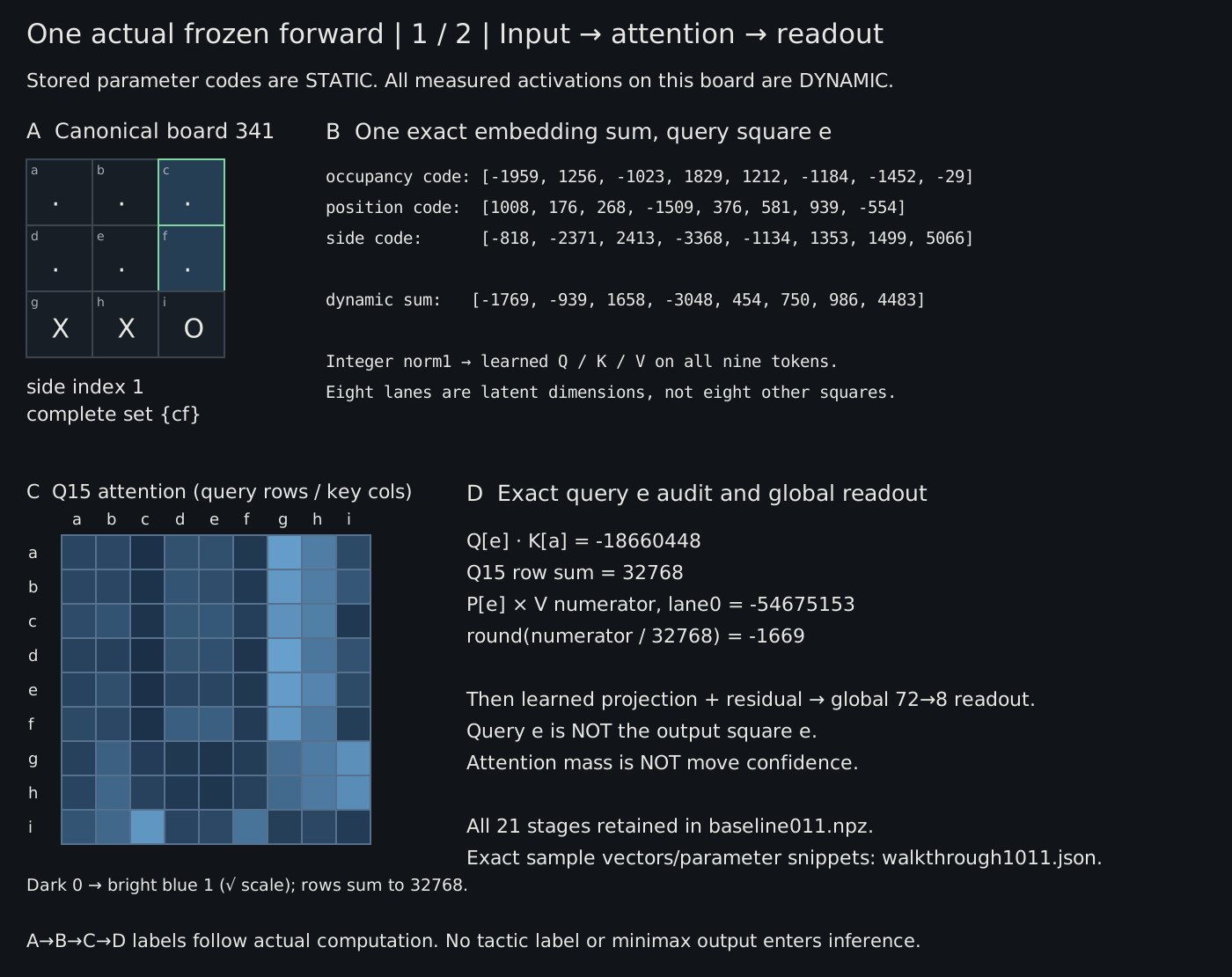
A/B — input and embeddings. Occupancy, absolute-position and side codes are stored parameters. Their sum is input-dependent. The example shows the actual eight-lane sum for query square e; the other squares are processed too.
C/D — attention. Rows are query squares and columns are key squares. Every Q15 row sums to 32768. The illustrated weighted-value numerator for lane 0 is −54,675,153, rounded to −1669. Projection and a residual lead to the global 72→8 readout. Attention on query e is not a decision to play square e, and attention mass is not move confidence.
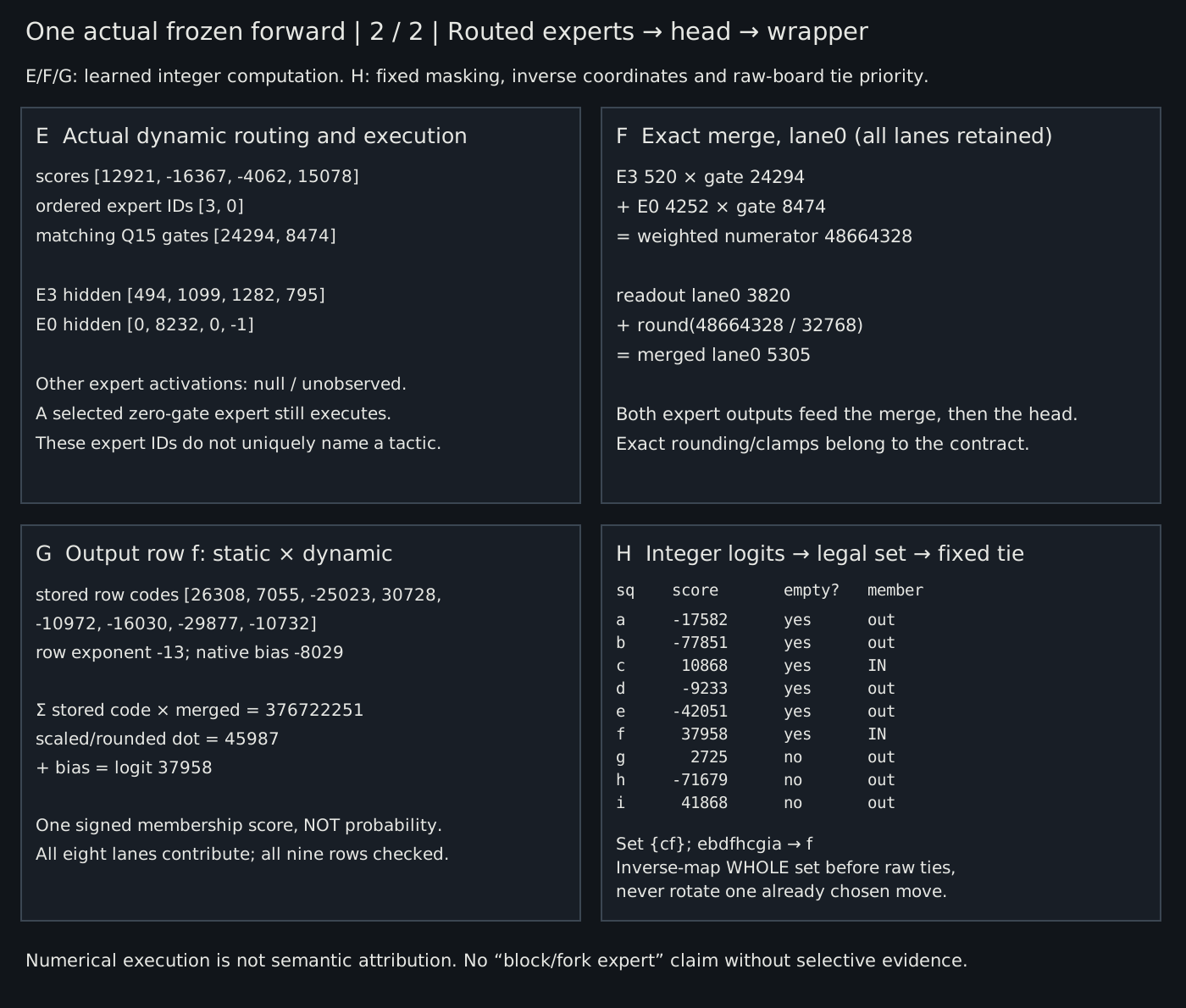
E/F — routed experts. Expert IDs [3, 0] receive matching gates [24294, 8474]. In lane 0, their outputs 520 and 4252 form weighted numerator 48,664,328. After the specified rounding and addition of readout residual 3820, merged lane 0 is 5305. Other experts are unobserved, not measured zeros.
G/H — head and wrapper. All eight merged lanes feed each output row. For square f, the actual stored-code dot product is 376,722,251; exponent −13 and native bias −8029 produce score 37958. Thresholding all nine scores and masking occupied squares gives {c, f}. The fixed priority chooses f in this frame. A larger positive score is not a preferred move: membership, not ranking, is the learned contract. The whole set must be inverse-mapped before raw-coordinate ties. Exact worked values.
Learned symmetry is different from wrapper-provided symmetry
Study010 deliberately bypasses canonicalization and feeds all 4,520 unique raw boards directly to the canonical-trained network. This is an off-contract diagnostic, not a failure of the accepted game. The direct path returns the correct complete legal set on 1,514/4,520 boards. The unchanged canonicalizing wrapper remains correct on 4,520/4,520.
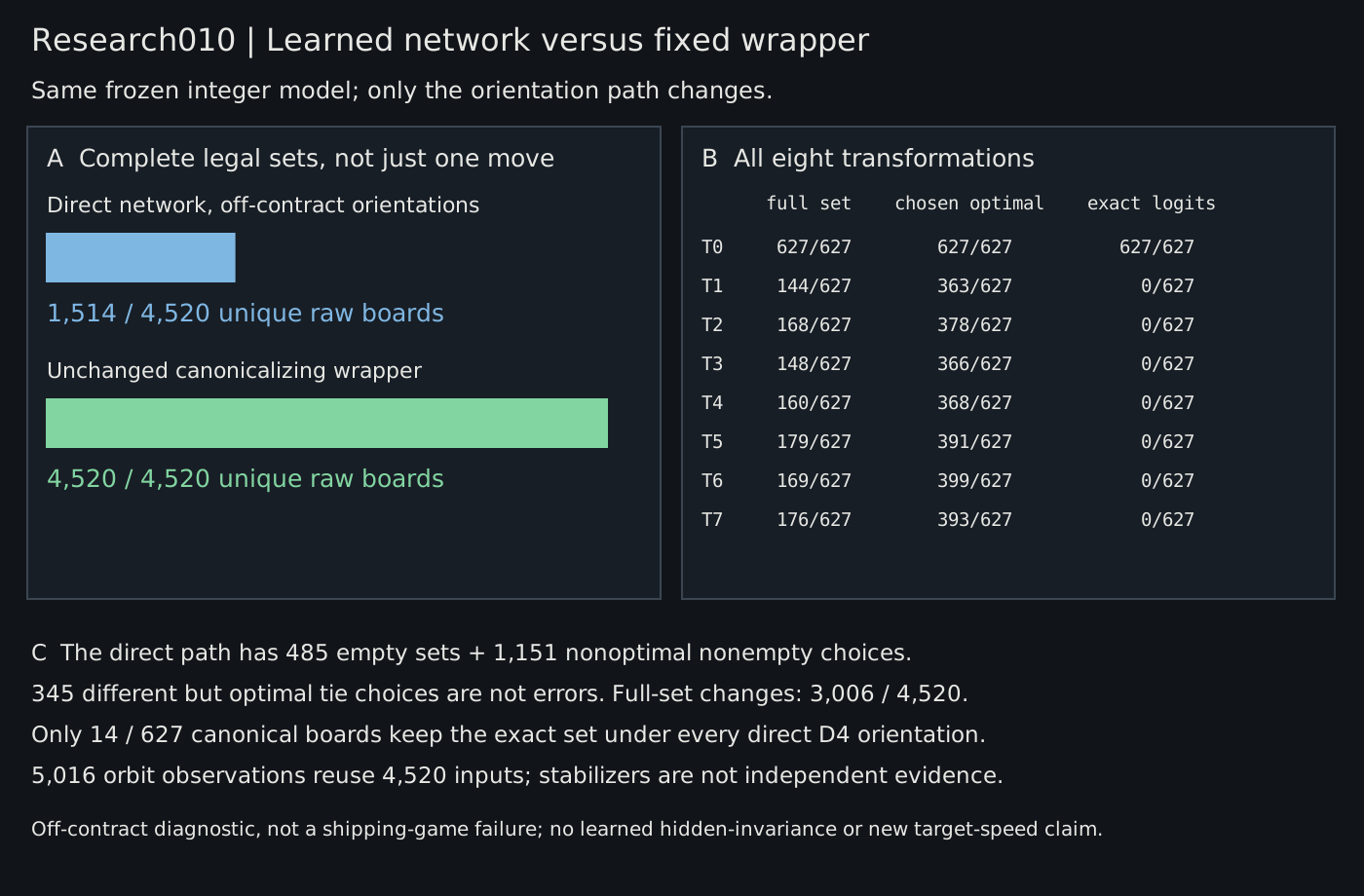
The direct path has 485 empty sets and 1,151 nonoptimal nonempty choices. Another 345 choices differ from the wrapper but are still optimal—not failures. Only 14/627 canonical boards keep the correct complete set across all eight direct orientations. The 5,016 orbit observations reuse 4,520 distinct inputs; repeated orientations of symmetric boards are not independent evidence.
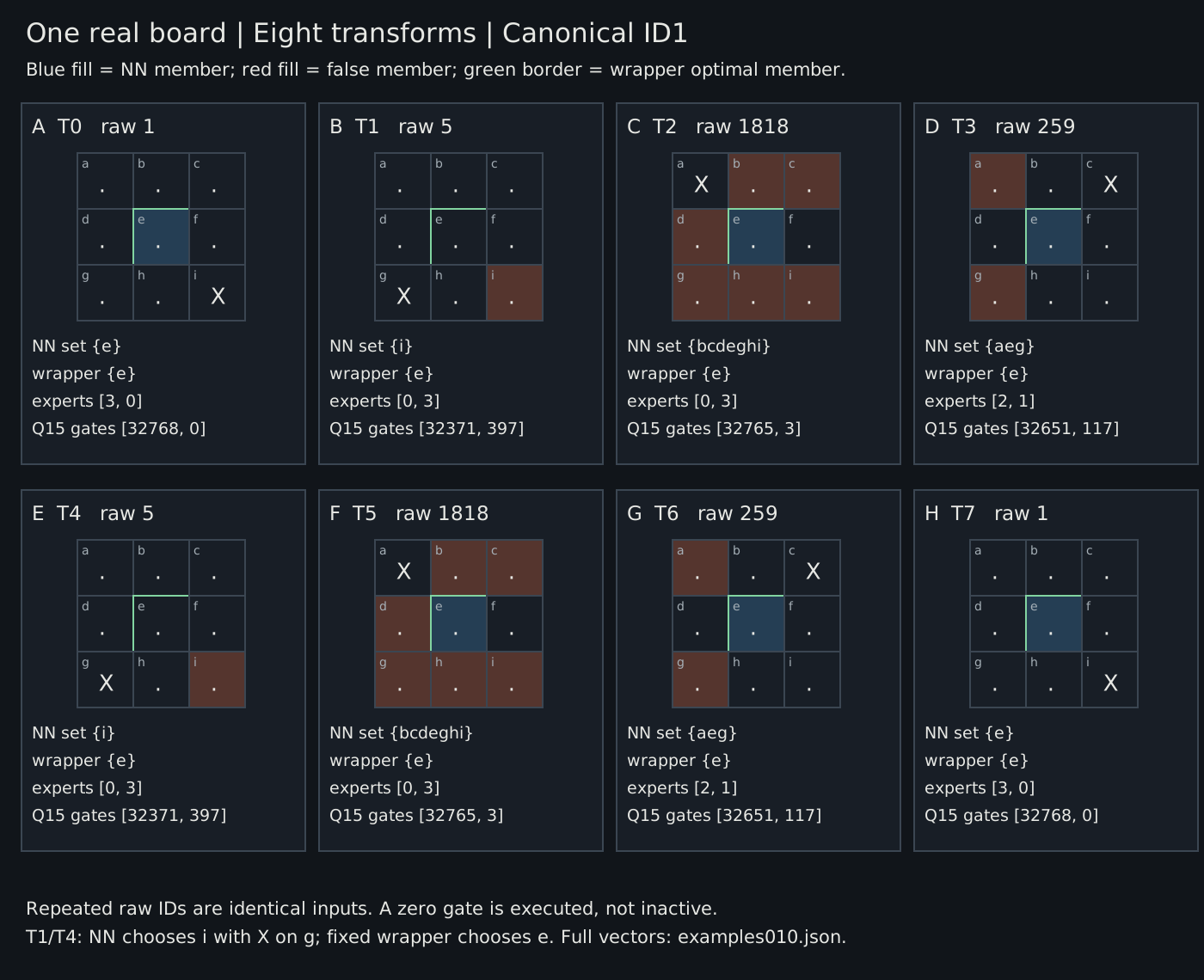
On this real example, moving X to a different corner changes direct predictions, including false members. Some panels still choose the correct center while approving other, nonoptimal squares. One correct chosen move therefore does not establish complete-set correctness. Absolute positional embeddings and a global readout allow orientation dependence, but this experiment does not isolate their individual causal contributions. Full study010.
Information survives even when routing metadata collides
Study011 compares exact full integer vectors, with shape-aware equality and an independent tuple census—not a two-dimensional projection. The full merged vectors and final logits distinguish all 627 canonical boards. Ordered routes have only 12 classes; route plus exact gates has 480.
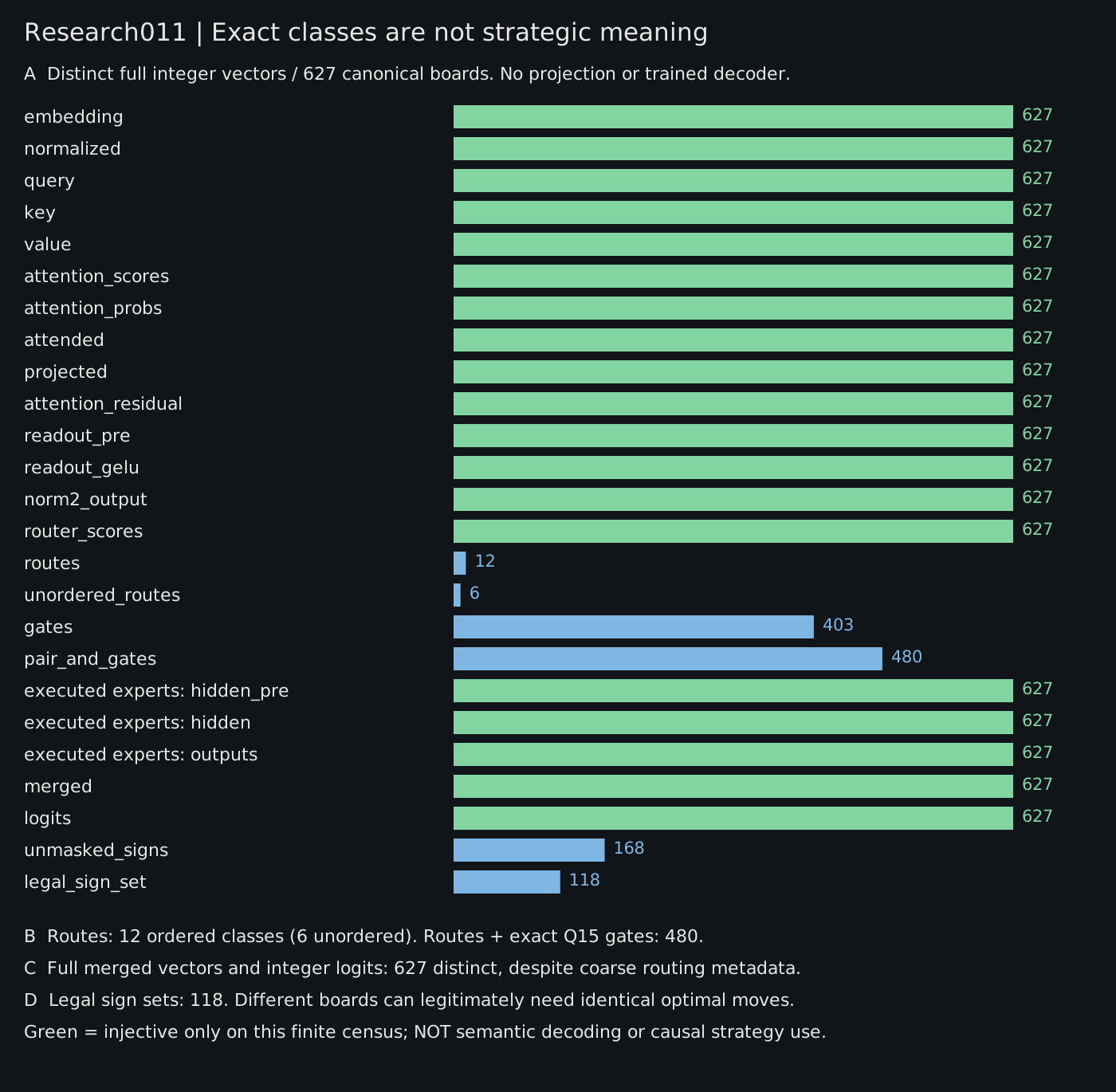
Finite uniqueness means an arbitrary lookup decoder could distinguish the audited boards. It does not establish a simple semantic decoder, generalization, causal use of every distinction, or a named strategy circuit. Top-2 out of four experts permits only 12 ordered routes by construction, so low route cardinality is not proof that routing is useless.
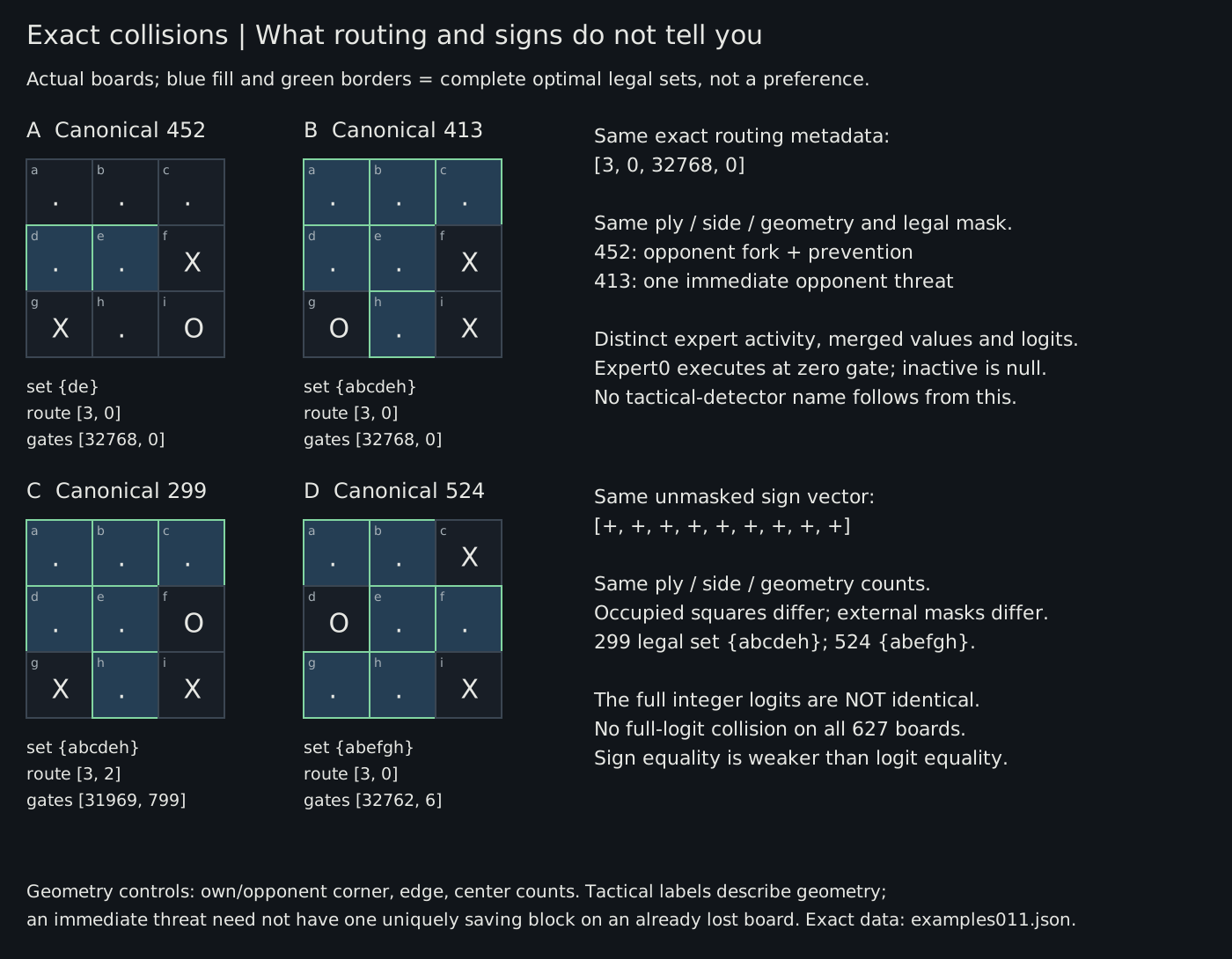
Boards 452 and 413 have identical ordered experts [3, 0], exact gates [32768, 0], ply, side, geometry counts and legal mask—yet different tactical labels and full optimal sets. Their richer expert/merged/logit vectors remain distinct. A selected zero-gate expert still executes; an unselected expert is unobserved. Separately, boards with identical signs can have different legal sets because occupied squares differ. No full-logit collision was found on these 627 boards; the sign example must not be presented as one. Full study011.
Perfect imposed symmetry still does not guarantee correct play
Study012 follows the symmetry finding with four predeclared offline output aggregations across all eight orientations. It reuses the measured direct logits and adds no neural forwards. Mean uses the sign of the exact integer sum; there is no rounding of a small negative mean to zero. Scores are not calibrated probabilities, and these are not deployed replacement policies.
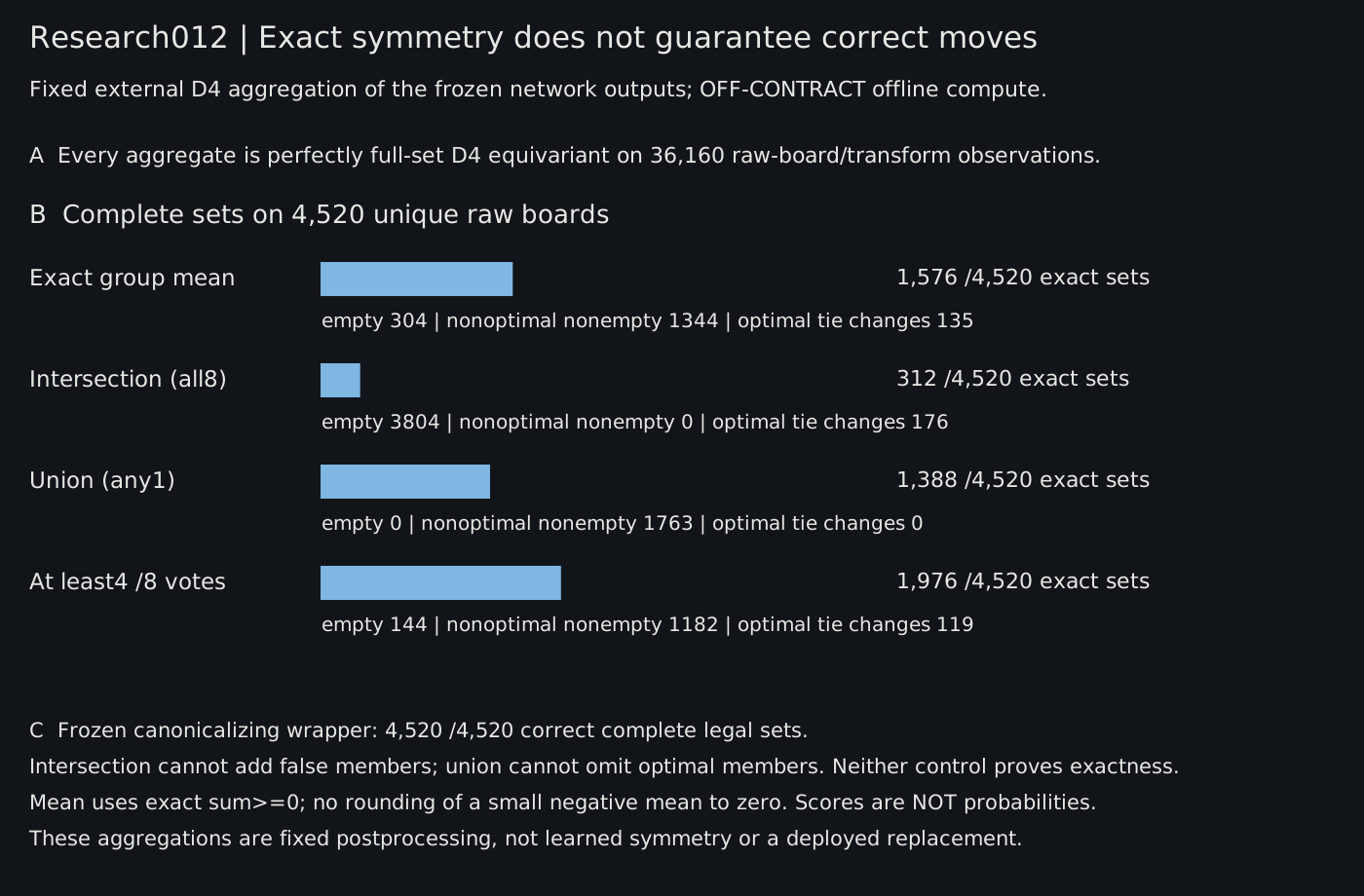
| External aggregation | Exact full sets /4520 | Empty sets | Nonoptimal nonempty choices |
|---|---|---|---|
| Exact mean sign | 1576 | 304 | 1344 |
| Intersection | 312 | 3804 | 0 |
| Union | 1388 | 0 | 1763 |
| At least 4/8 votes | 1976 | 144 | 1182 |
| Accepted canonicalizing wrapper | 4520 | 0 | 0 |
All four aggregates pass full-set equivariance on every 36,160 raw-board/transform observation per policy. That property says the set rotates consistently, not that the set contains exactly the correct moves. Fixed coordinate priority can still make selected moves non-equivariant; that is separate from set symmetry.
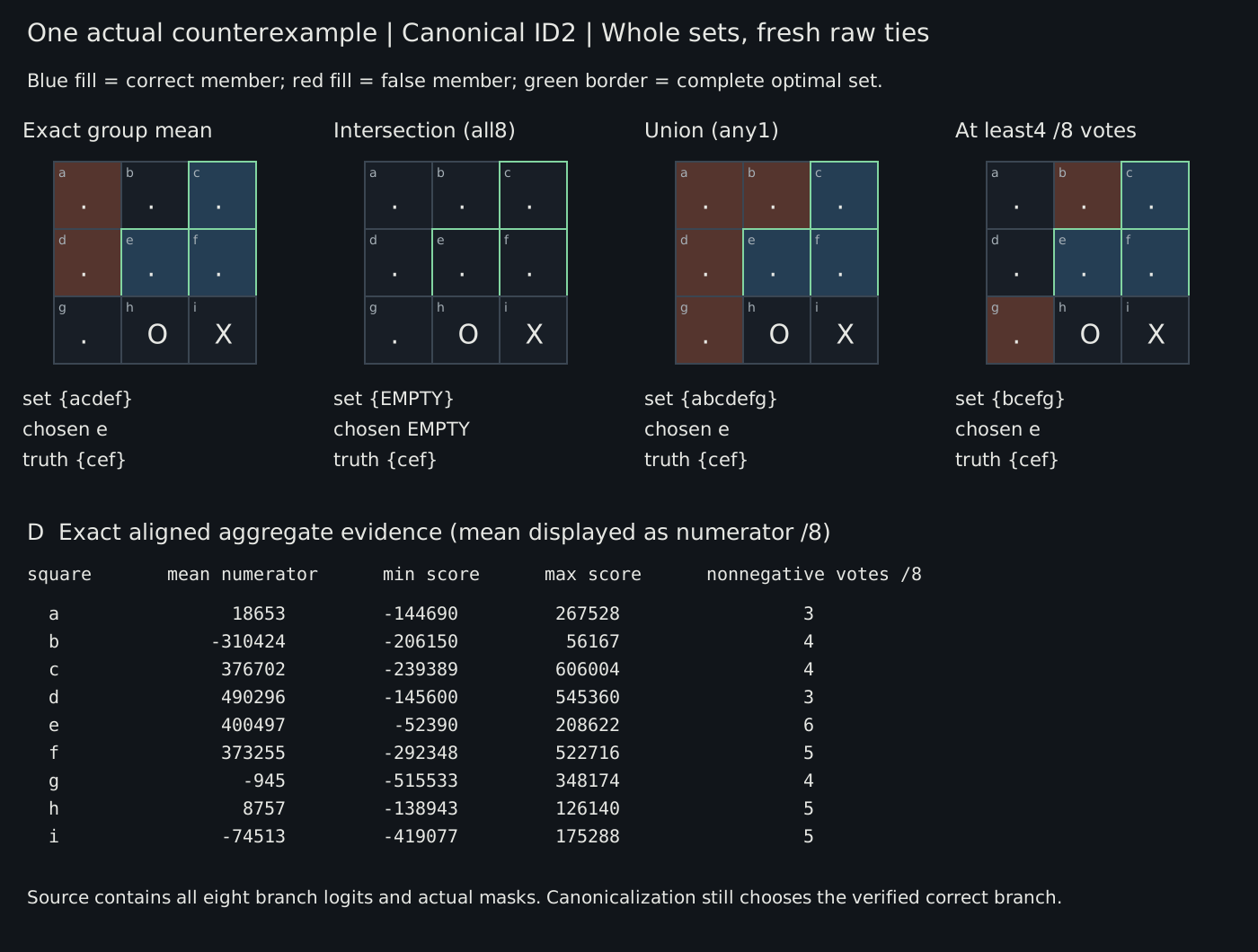
A canonical branch supplies an exactly correct set. Consequently intersection cannot add a false member, but it can discard every optimal member. Union cannot omit an optimal member, but can add a nonoptimal square selected by raw priority. Both constraints hold throughout the audit. This does not rule out every possible ensemble; it answers exactly the four frozen algorithms. Full study012.
Exact parameter intervals: beyond a handful of harmless perturbations
Study013 asks a different question from the ±1 panel: how far can one stored parameter code move before any legal membership sign changes? It fixes all nine output biases and the descriptor-first column-0 weight in each output row, for 18 coordinates. No coordinate was selected for producing an interesting failure.
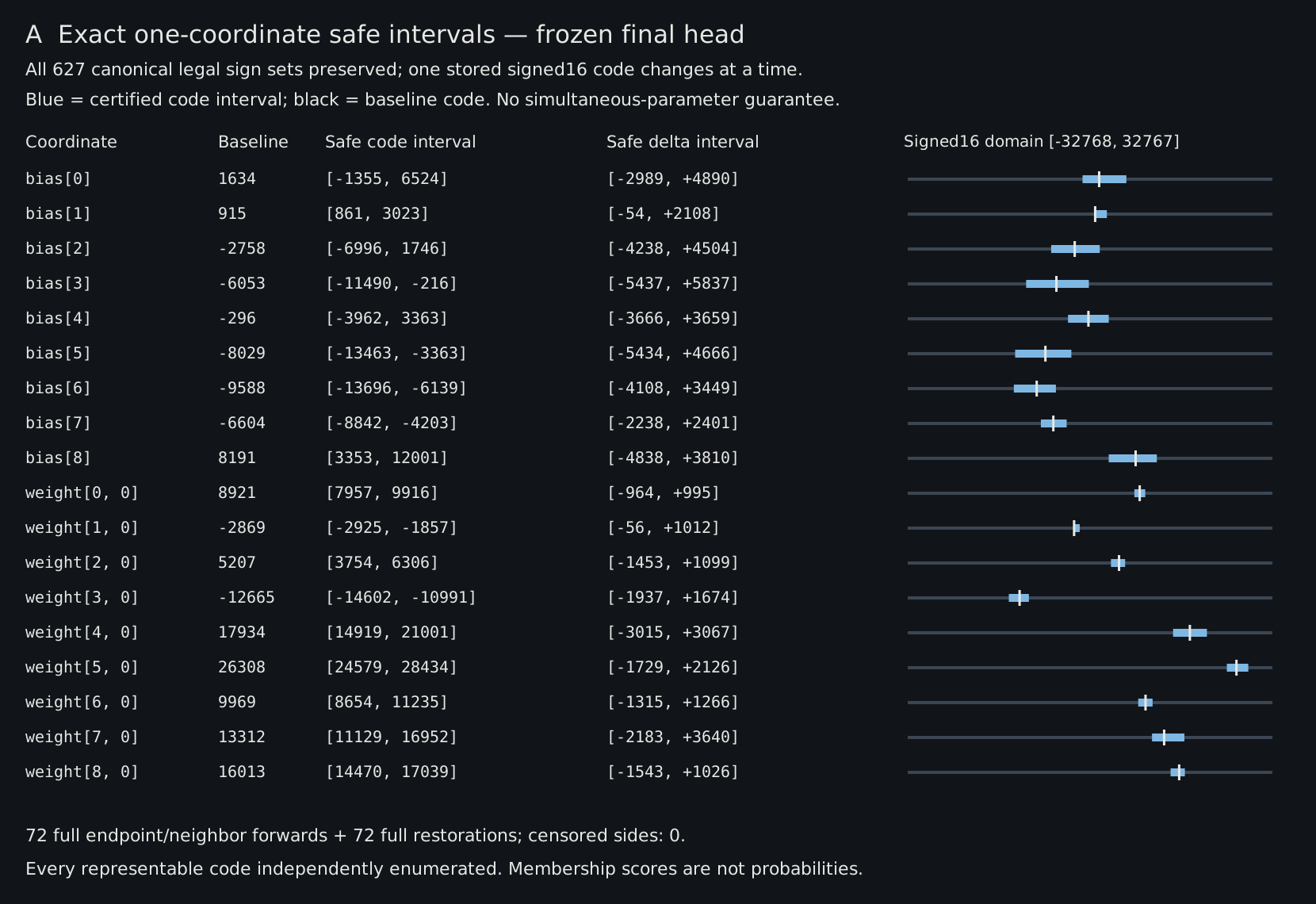
For each coordinate, exact integer inequalities are intersected over every applicable legal square on all 627 canonical boards, then clipped to signed16 code bounds. This gives a maximal one-coordinate interval, with every other parameter, exponent, lookup table and wrapper operation held fixed. An independent verifier enumerates every representable code and recovers the same intervals.
Two examples, in stored-code delta units:
| Coordinate, zero-based | Original code | Inclusive safe delta interval |
|---|---|---|
| Output bias[1] | 915 | [−54, +2108] |
| Output weight[1, 0] | −2869 | [−56, +1012] |
These units are not interchangeable. A bias-code change adds directly to the integer score after dot-product rounding; a weight-code change affects the dot through the board-specific merged activation and row scale. Bias exponents must not be applied a second time. The proof retains half-away rounding and signed32 output clamping; scores remain arbitrary membership indicators, not probabilities.
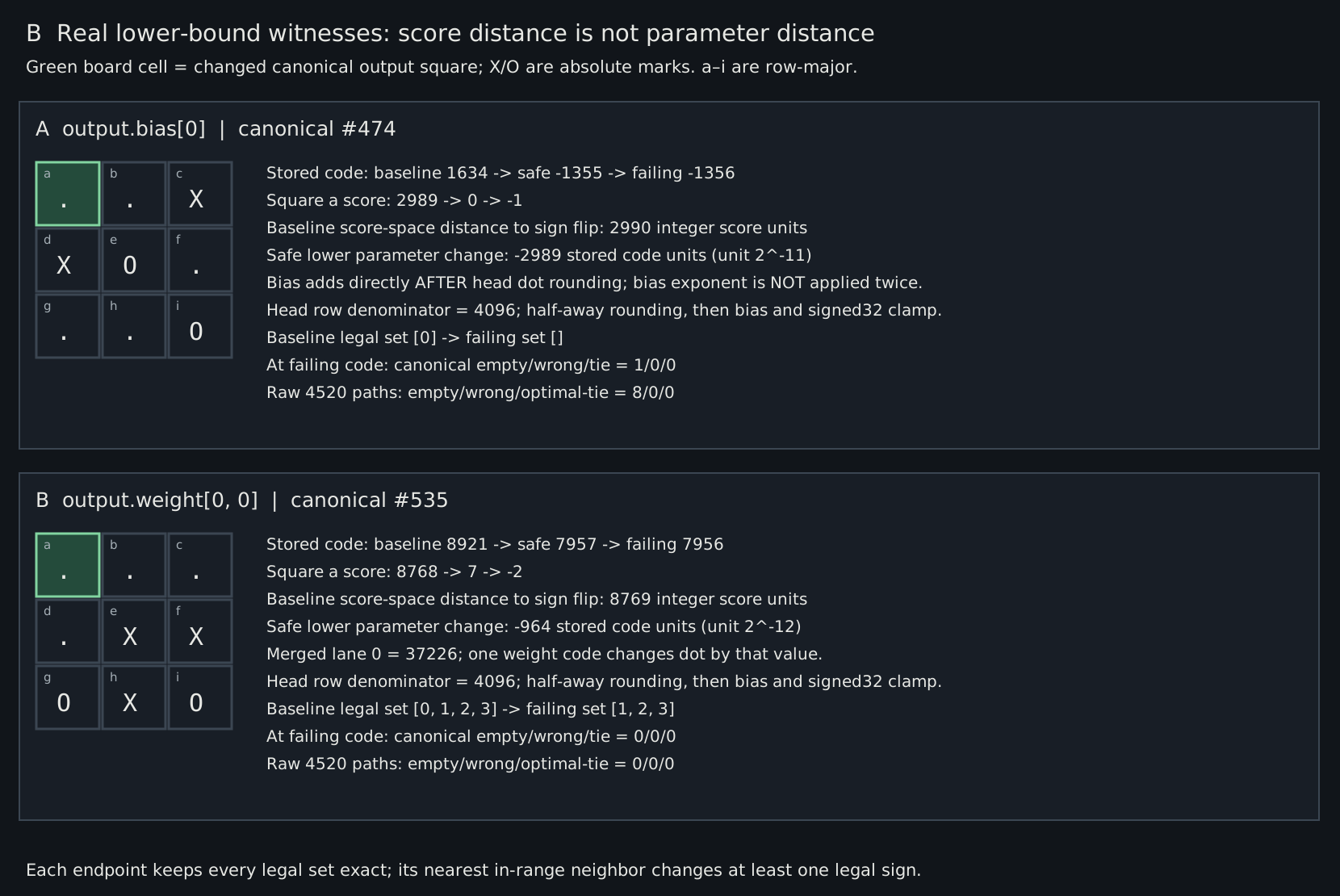
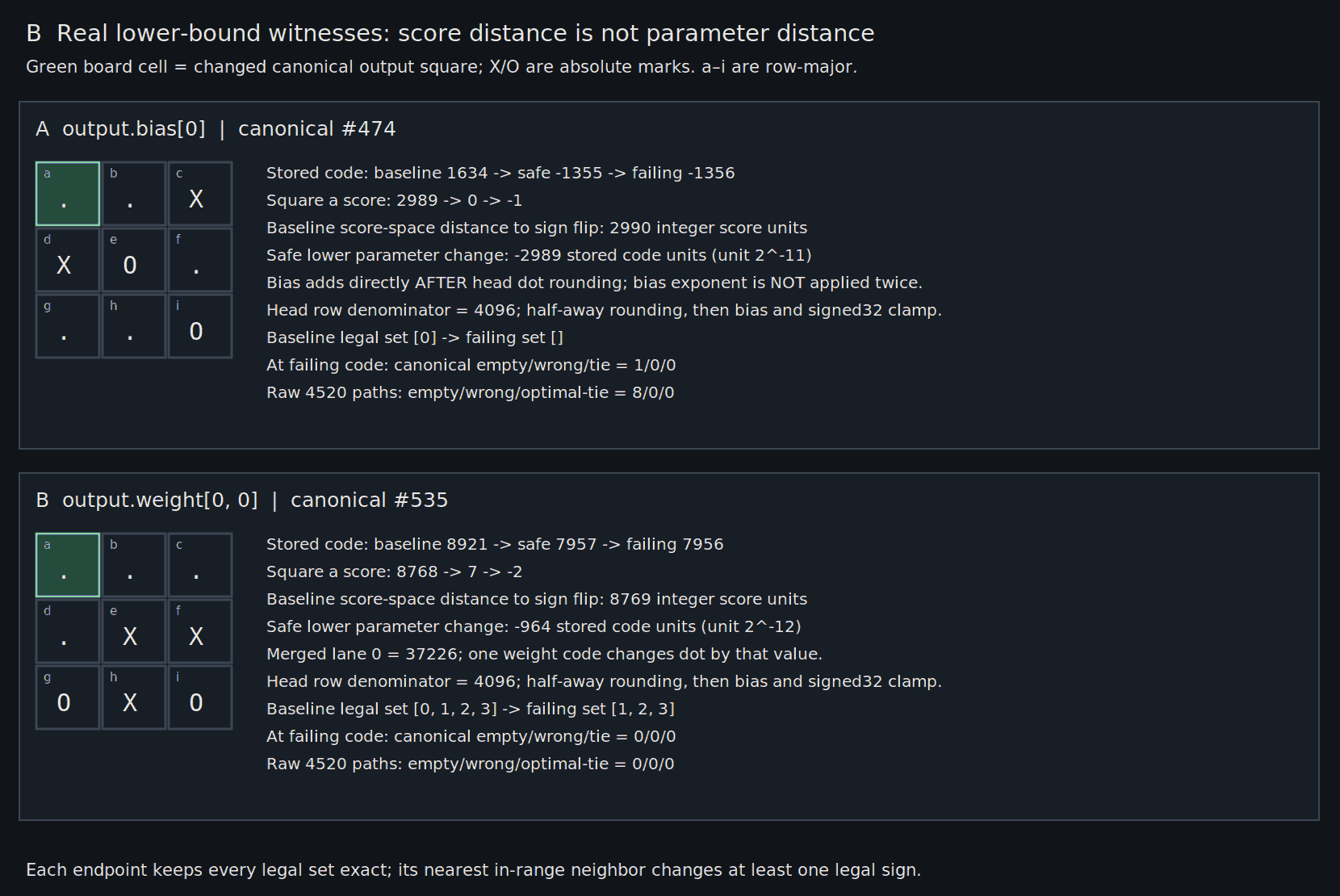
The first displayed bias witness, canonical board 474, has only square a in its approved set. Bias[0] can move from 1634 down to −1355, where its score is exactly zero and membership remains valid. The next code, −1356, gives score −1 and an empty set. The weight witness instead has multiple approved squares: removing a member changes the complete set without necessarily changing the selected move.
All 36 safe endpoints preserve every legal set. All 36 immediately adjacent in-range codes change at least one legal sign. There are no source-bound censored sides. Each endpoint/neighbor is checked with a fresh full integer-network batch over all 627 boards; another 72 full restoration batches recover all baseline stages. These are host batches, not new C64 executions.
The endpoints also produce 259 occupied-square sign-crossing observations, summed over the different candidate runs. Those squares are legally masked out; the count is not 259 distinct boards or 259 gameplay failures. Conversely, the upper failing neighbor for bias[3] has zero canonical chosen-move failures but four wrong raw-coordinate choices. Correct full-set inverse restoration and fresh raw ties remain necessary even when canonical choices look unchanged.
Parent verification reruns five tests and the independent audit: 297,533,440 code–board sign evaluations and 411,939 scalar head outputs. All 14 generated artifacts match their reproduced counterparts; the 69-entry source/evidence ZIP rebuilds identically. The original 1,492 prior-research files and 51 protected main/model/application files retain their hashes. The 655,400 public-wrapper calls reported by the study are composed checks using test-only neural-output fixtures, not that many separate neural forwards.
These intervals do not certify simultaneous changes. Nor do they establish upstream robustness, generalization to new inputs, a lower-precision deployment, or new speed/RAM results. All studied boards were already trained/audited. Full study013 · Exact certificates · Historical reproduction prerequisites.
Individually safe changes can fail together—but a smaller joint region is certified
Study014 tests the gap left explicitly open by study013. Each selected output row has two variable codes: its bias and column-0 weight. Combining the two individually safe intervals creates a rectangle; combining all rows creates an 18-coordinate box. The original independent ranges do not compose: 31 of 36 full-network row-corner candidates change legal sets, and every one of the nine original row rectangles is unsafe.
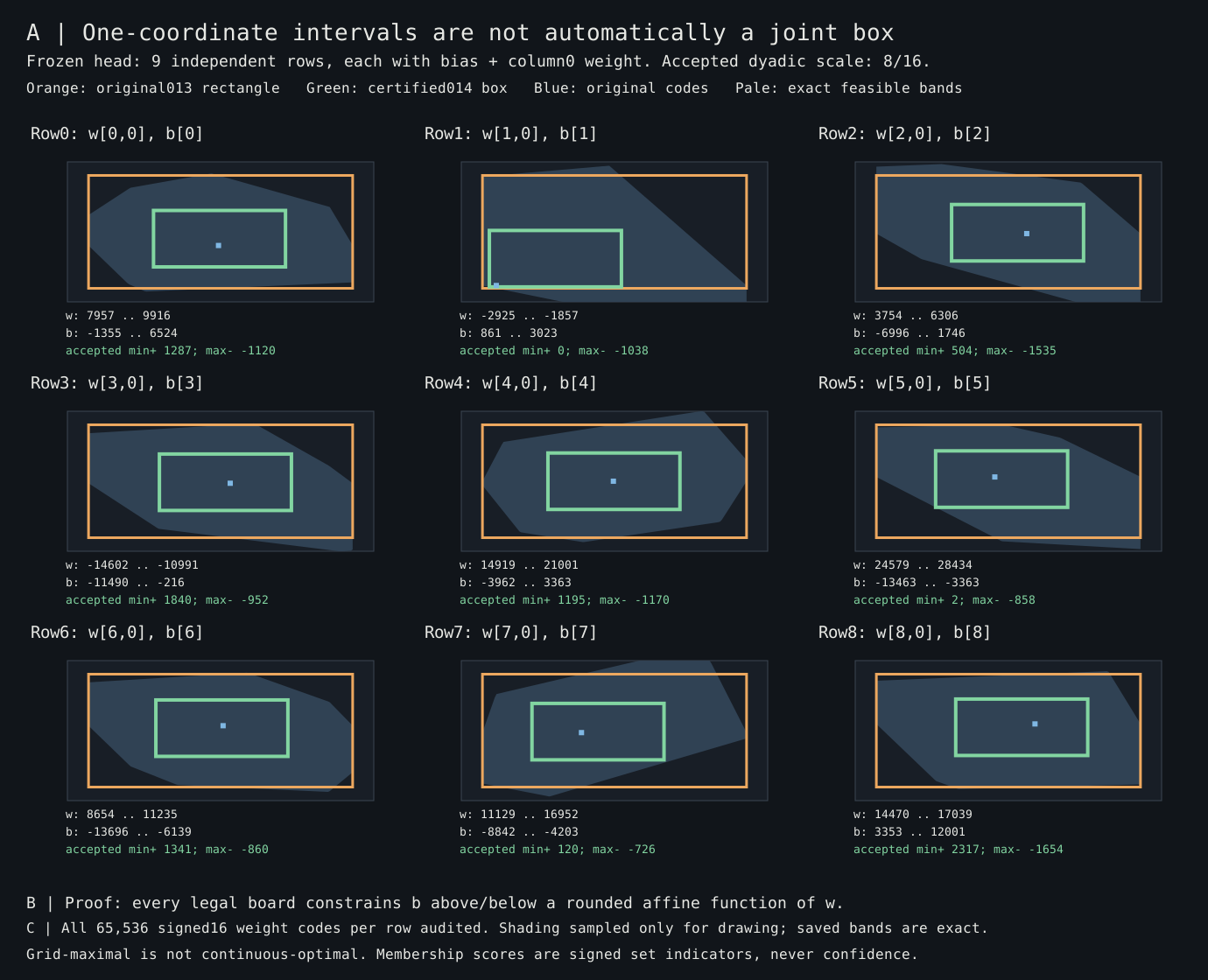
The pale region shows jointly feasible bias/weight values. Orange rectangles come from the independent study013 intervals; their corners can leave that region. Green rectangles are jointly certified. The drawn shading samples the boundary for display; the saved bands retain exact constraints for every signed16 weight code.
One actual counterexample: on canonical board 38, square 0 has score 5463. Moving only the bias to its safe endpoint gives 2474; moving only the weight gives 1460. Changing both gives −1529 and removes square 0 from the approved set. That joint value comes from a complete new neural forward. The two single-change values are independent scalar evaluations on the same saved merged vector, consistent with study013's full endpoint checks. This example changes the full set but not the selected move.
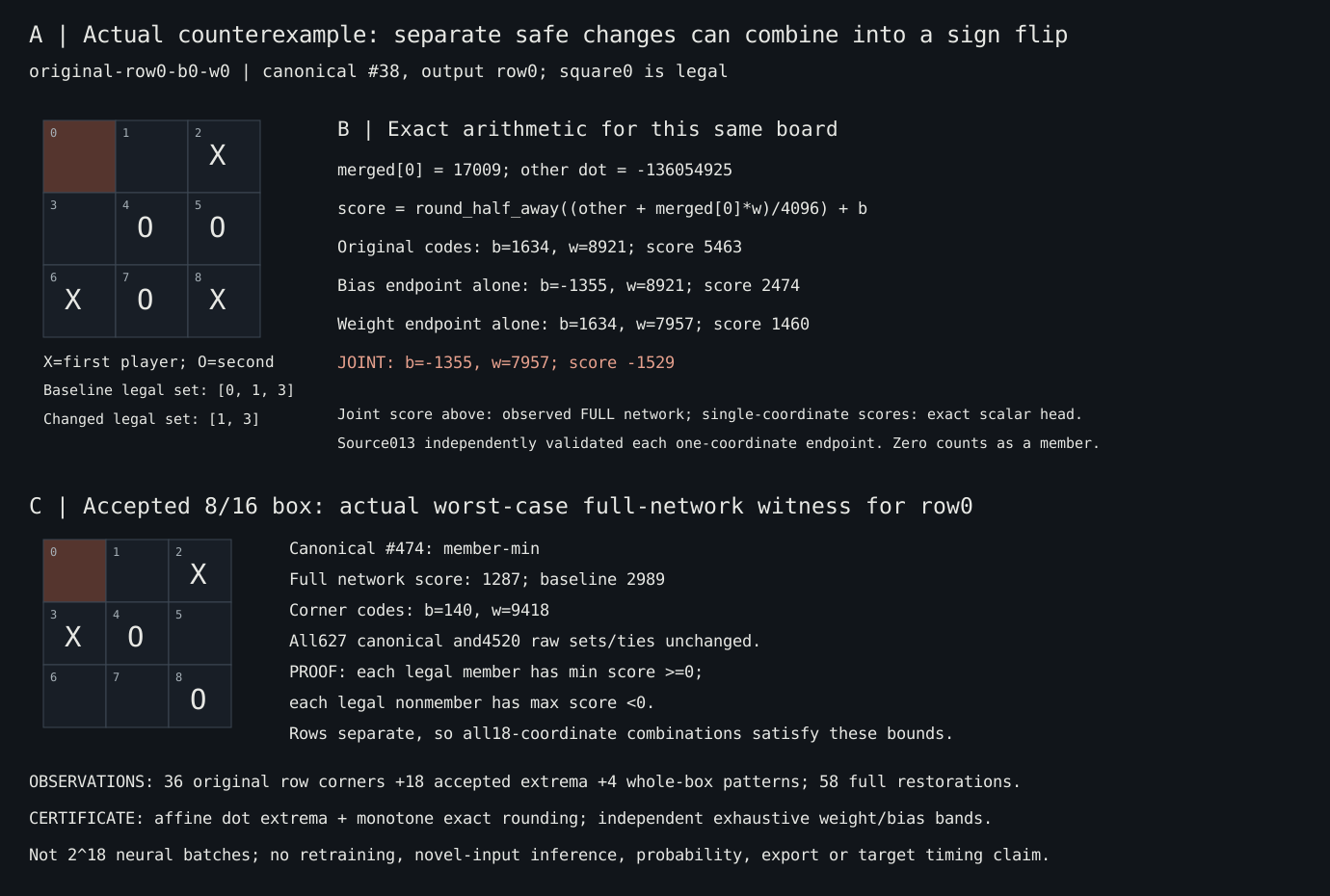
The shrink search was frozen before outcomes: scales 0/16 through 16/16, moving each endpoint toward its original code with integer truncation toward zero. 8/16 is the largest passing grid scale. Scale 9/16 and every larger declared scale fail. This is grid-maximal, not a continuously optimal or globally largest box, and does not imply that exactly half is a universal robustness rule.
The accepted box certifies every integer combination of its 18 coordinates, not merely the tested corners. For each legal member, take the exact worst-case minimum rounded score over its row rectangle and require it to remain ≥0. For each legal nonmember, require the maximum to stay <0. Final-head rows are independent and upstream merged vectors remain fixed, so these inequalities compose across rows. A separate decoder/scalar audit also checks feasible bias bands across every signed16 weight value. This is a mathematical finite-domain certificate backed by real neural witnesses—not a claim to have executed every high-dimensional corner or parameter combination.
The two recorded runs each execute 117 full neural batches: baseline, 58 candidates and 58 restorations. Parent acceptance reruns four tests with one full-study integration test explicitly skipped, then independently recalculates 589,824 row-weight codes, 148,766,720 applicable board/weight constraints and 332,937 full-head scalar outputs. It matches original and accepted extrema to saved actual network outputs, verifies 15 byte-identical reproduced files, and rebuilds the 67-entry evidence ZIP identically. No frozen evidence is rewritten. Composed wrapper calls remain distinct from actual neural forwards.
The guarantee covers the same 627 canonical / 4,520 raw audited boards and only these 18 final-head codes. Other weights, scales, lookup tables and wrapper code are fixed. It is not upstream robustness, a new-domain guarantee, compression of the deployed model, or a C64 performance result. The accepted game remains unchanged. Full study014 · Joint box certificates · Observed and constraint-only extrema.
Self-play variety is not exhaustive model coverage
Study015 follows every opening permitted by the accepted model and the game's opening-only variation policy. It executes a fresh full neural forward for every mark; the later turns use the actual fixed raw-coordinate tie order. These are host policy-emulation diagrams, not screenshots or new native C64 replays.
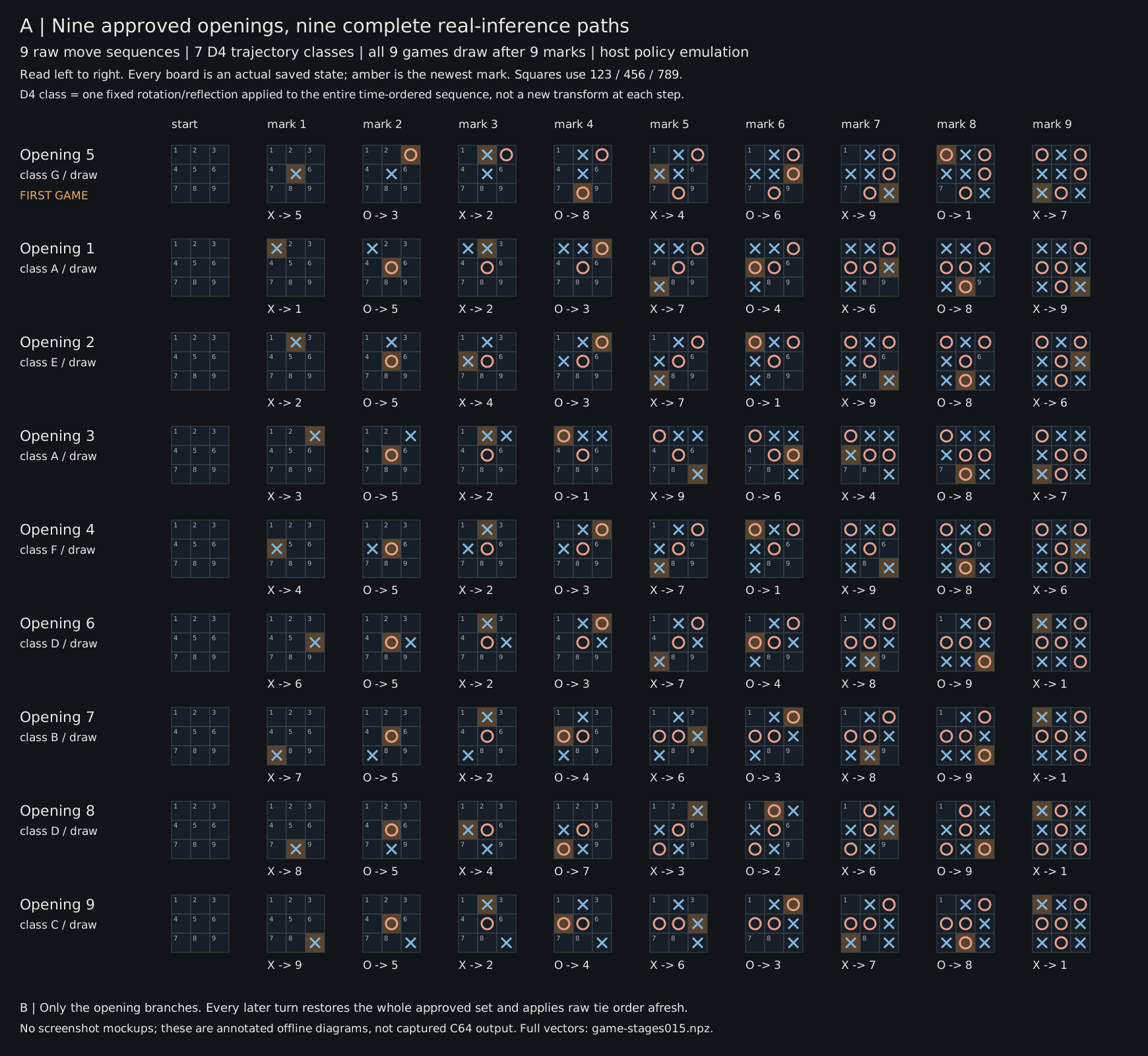
All nine openings yield nine distinct raw move sequences, seven full-trajectory rotation/reflection classes, and nine draws after nine marks. A trajectory class uses one fixed transform over the entire ordered game, not a fresh orientation at every step. The first deterministic game is 5 → 3 → 2 → 8 → 4 → 6 → 9 → 1 → 7. Every mark follows actual inference, including each empty-board opening.
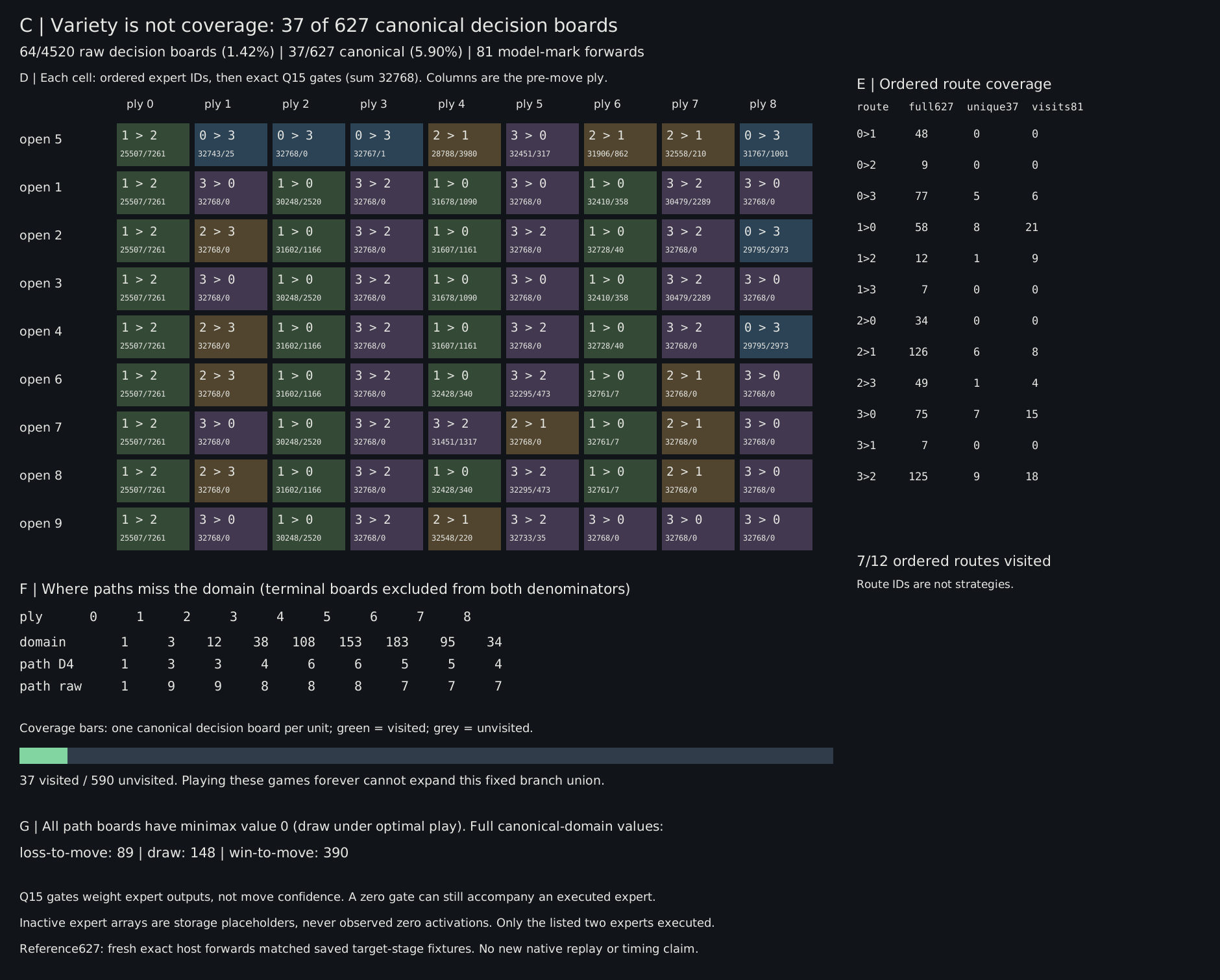
Across the nine games, 81 fresh game forwards visit only 37/627 canonical and 64/4,520 raw nonterminal boards, with seven of the twelve ordered routes. The empty board is evaluated nine times but covers one canonical position. Terminal states are excluded from those denominators. Every visited position has a draw value under optimal play, so this demonstration never exercises the already-winning or already-losing positions present elsewhere in the domain. Repeated draws cannot replace the exhaustive policy audit.
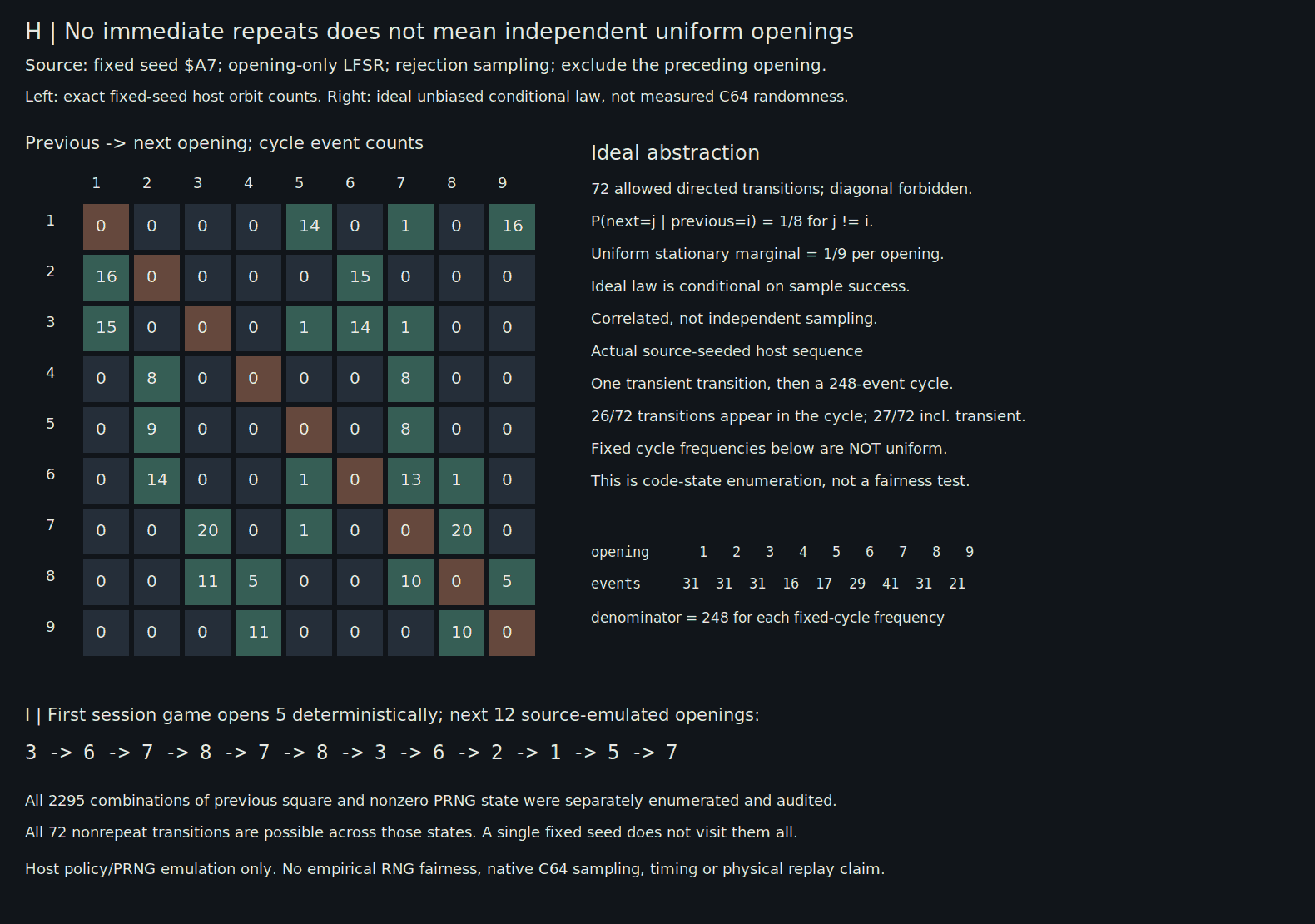
A correction to the opening-randomness description
The accepted sampler's rejection threshold and no-immediate-repeat rule do not
establish independent, uniformly distributed opening frequencies. Under an ideal
independent candidate source, the successful conditional transition would be
1/8 to each other square, with stationary marginal 1/9. The shipped source uses
a fixed-seed deterministic LFSR instead. Its state is separate from music and
animation and resets to $A7; these facts make it reproducible, not genuinely
random or automatically fair.
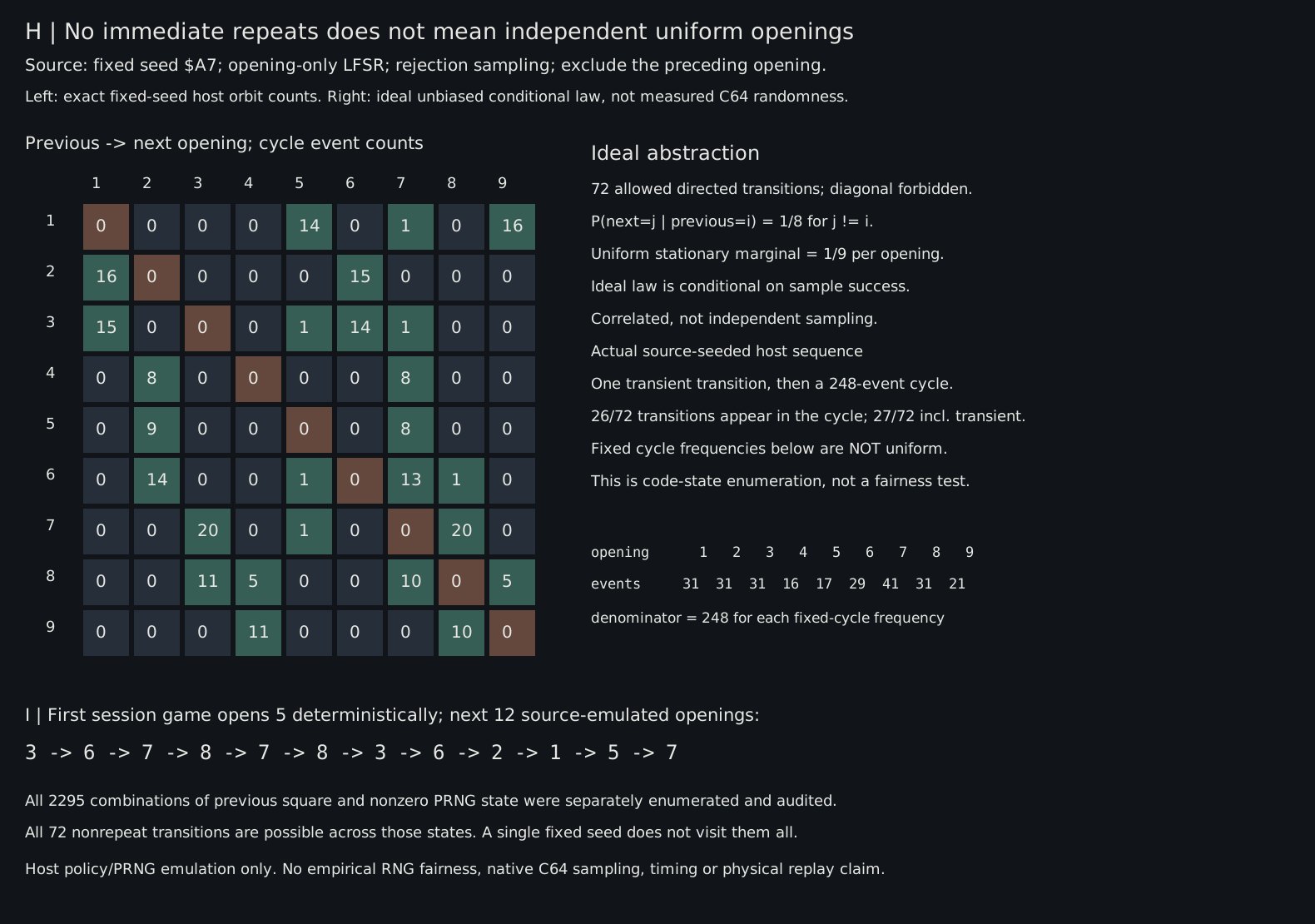
Source-bound host enumeration finds one transient transition followed by a 248-opening-event cycle. Counts for screen squares 1 through 9 within that cycle are 31, 31, 31, 16, 17, 29, 41, 31, 21. Only 26 of 72 possible directed no-repeat transitions occur in that cycle, although all 72 are possible across the separately enumerated 2,295 previous-opening/nonzero-state combinations. Immediate-repeat prevention still holds. These are exact code-state findings, not empirical native randomness measurements. A separate check executes the actual accepted PRG's sampler instructions under py65: all 2,295 states match the host census, including selected square, PRNG state and rejection attempt count. It reproduces the same transient and cycle and passes 1,067 guard/skip cases. The parent rerun reproduces the complete evidence JSON byte-for-byte. This is isolated assembled-subroutine parity in flat RAM, not full native-game replay, physical-hardware acceptance or empirical fairness. Machine-code parity evidence · Read-only harness.
The current game guide now qualifies its earlier “uniform” wording; historical reports and accepted release bytes remain unchanged. This changes no move approvals and no game behavior. Self-play is frozen inference, not learning.
Parent checks rerun five tests and the independent arbitrary-integer whole-forward audit, matching 1,701 game-stage arrays / 68,931 integer values and all 627 reference-board forwards. Eighteen artifacts reproduce byte-for-byte. The independent auditor reconstructs packet decoding, geometry, complete-set inverse mapping, raw ties, minimax membership and the sampler census. These are host proofs, not a new native or physical-hardware acceptance claim. Full study015 · Complete game records · Sampler transitions.
Worst-case safety and random-opponent wins are different objectives
Study016 fixes three tie policies and both player roles before outcomes: accepted raw priority, its reversal, and greatest raw-restored score within the legal approved set. The latter two are offline counterfactuals, not runtime changes. The human opponent is explicitly modeled as selecting uniformly among currently empty squares on every turn, with play stopping immediately at a win or full board.
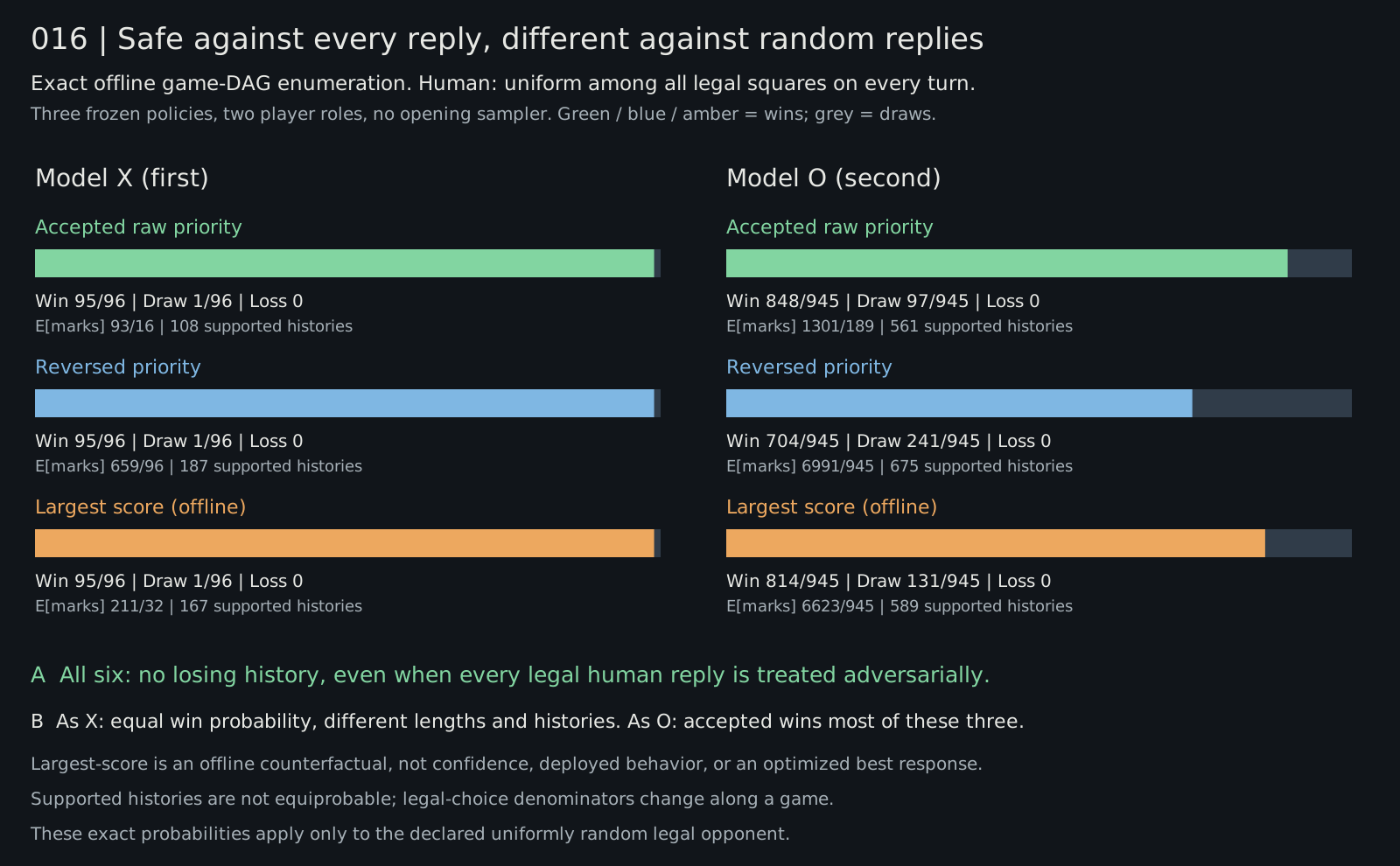
| Model role | Fixed tie policy | Exact win probability | Exact draw probability | Loss probability |
|---|---|---|---|---|
| X, first | Accepted | 95/96 | 1/96 | 0 |
| X, first | Reversed | 95/96 | 1/96 | 0 |
| X, first | Greatest approved score, offline | 95/96 | 1/96 | 0 |
| O, second | Accepted | 848/945 | 97/945 | 0 |
| O, second | Reversed | 704/945 | 241/945 | 0 |
| O, second | Greatest approved score, offline | 814/945 | 131/945 | 0 |
All three retain worst-case draw safety from the empty board: independent exhaustive traversal of every legal human reply finds no losing history in any of the six panels. That does not mean every game draws against mistakes, nor that a forced-loss position outside these reachable paths can be saved. The accepted policy has the highest O win rate among these three under the specified random opponent; this is neither a search for an optimal exploitation policy nor a claim of superiority against arbitrary human behavior.
Expected total marks and supported complete-history counts also differ even when X win probabilities agree. Histories do not have equal probability: each receives the product of reciprocal human branching counts along its path. The report retains exact rational game lengths and all reachable-state values. No sampled win rate or statistical extrapolation replaces this enumeration.
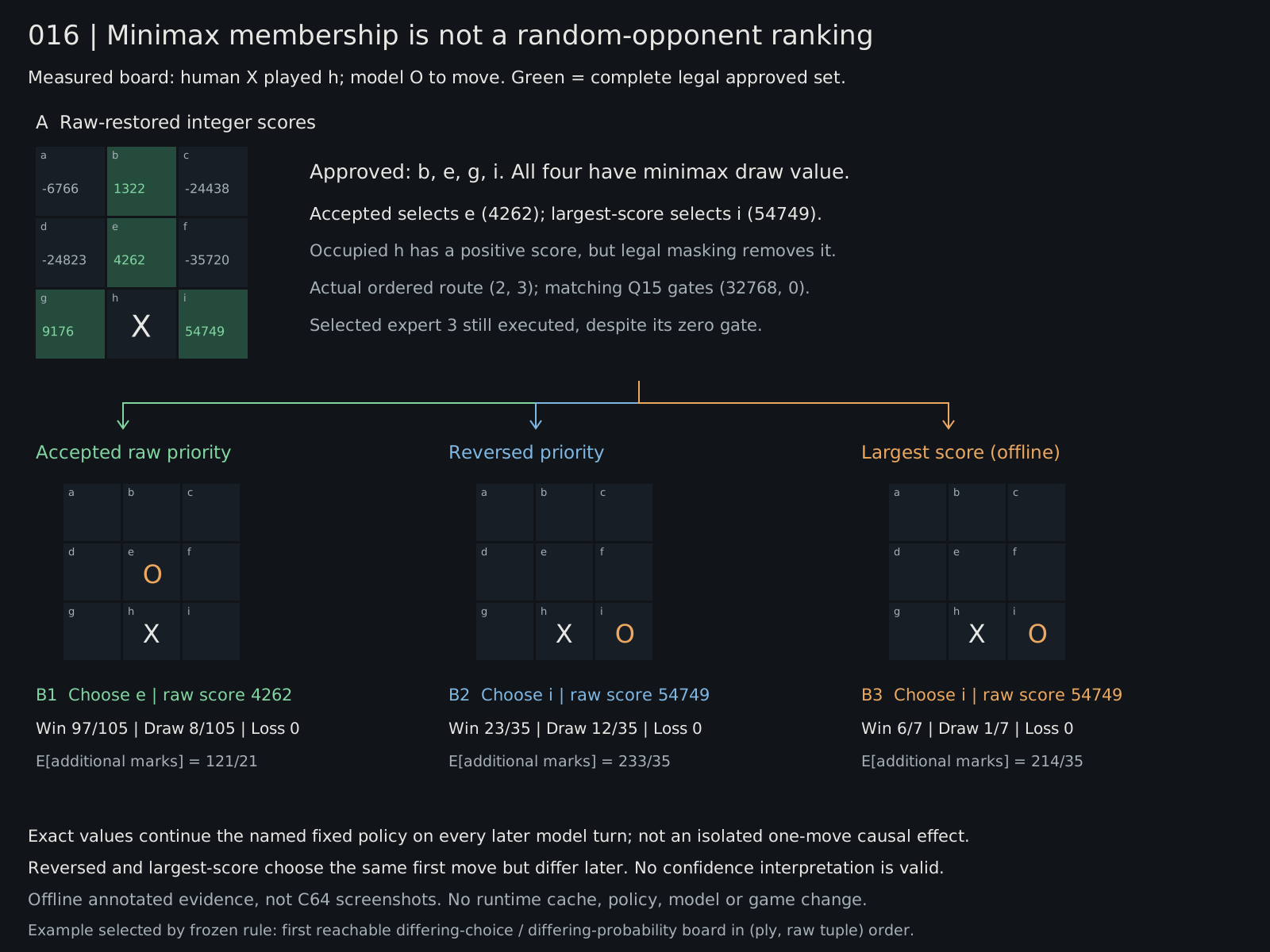
With human X at h (screen square 8), model O approves {b, e, g, i}. Accepted priority chooses e, with raw score 4262; the other two choose i, with score 54749. Continuing each whole fixed policy gives win probabilities 97/105, 23/35 and 6/7 respectively against random legal replies. Reverse-priority and greatest-score policies share that first move but differ later, so their outcome difference is not attributed solely to the first choice. The largest membership score is not the largest measured continuation win probability, and is not confidence.
Each analysis run binds all 627 canonical boards through real full-network execution once, then restores logits/sets across all 4,520 raw boards. The rational branching analysis reuses those validated outputs offline; a branch visit is not a new forward and no lookup policy is installed in the game. Parent verification reruns seven tests and the independent scalar decoder / whole-network audit, matching 13,167 stage arrays and 533,577 integer values. A separately structured bottom-up rational dynamic program and explicit complete-history traversal agree on outcomes, lengths, support and safety.
All 17 artifacts reproduce byte-for-byte, and the 84-entry evidence ZIP rebuilds identically. Historical preservation retains an explicit exception for one concurrently parent-edited verification document, with both hashes disclosed; no accepted runtime, model or old isolated-study bytes are changed. These are finite host analyses on already trained/audited boards, not new native C64, physical-hardware or general-strength evidence. Full study016 · Measured branching board · Preservation disclosure.
Evidence, preservation and reproduction boundaries
Before new interventions, each follow-up reproduced 13,167 saved stage-vector comparisons / 627 canonical boards and the composed full-set wrapper outcomes on 4,520 raw boards. Validation splits group canonical boards to prevent symmetry copies leaking between folds. These are probe selection/confirmation splits, not model-held-out generalization: the frozen model was already trained/audited on this finite domain.
Fork definitions differ between reports: studies002–004 use priority-gated board/candidate labels, while study005's independent geometric fork candidates also include positions those earlier gates exclude. Their positive counts must not be compared as if they were the same task. Strict matching sometimes leaves zero held-out tactical examples; the studies retain that absence rather than relaxing the controls after seeing results.
Studies003/004/005 respectively reproduced 23 / 28 / 25 output artifacts byte-for-byte. Their selected report, figure, frozen-experiment and verification snapshots are now in this repository, bound by the consolidation manifest:
- 003 experiment / verification
- 004 experiment / verification
- 007 experiment / verification / common-support audit
- 008 experiment / descriptor amendment / visual amendment / verification
Studies006–008 additionally reproduced 52 stage artifacts plus 5 supplementary artifacts byte-for-byte. Parent verification reran four focused tests, independently recalculated the stored expert/head/gate and raw-wrapper audits, and checked all 907 pre-existing research-file hashes. Selected report/figure copies are bound by the same consolidation manifest; no scientific source or old artifact was silently replaced.
Study009 reproduced 50 artifacts and both 152-entry source/evidence ZIPs byte-for-byte. Parent verification reran eight tests and independently recalculated the audit, including 135,432 final-affine scalar checks and 108,480 actual public-wrapper calls using explicitly test-only saved neural logits. All 1,114 earlier research files remained hash-identical. This is not a new C64 execution or a claim of 108,480 independent full neural forwards.
009 experiment · Verification · Historical reproduction prerequisites
Studies010–012 add eight measured PNG/SVG figure pairs, including a two-page worked forward. Independent parent verification passes 13 tests and checks all 51 byte-identical reproduced artifacts, both deterministic ZIP rebuilds, source hashes and the 1,258-entry initial / 1,414-entry pre012 inventories. Numerical audits recompute 13,100 exact representation classes, the worked embedding/attention/merge/head scalars, 162,720 aggregate membership scalars and 144,640 full-set equivariance checks. Audit writes were confined to fresh scratch copies; all 1,492 research-checkout files retained their hashes. These are finite host-side/composed checks, not additional native C64 runs or new model-held-out observations. Reproduction prerequisites remain external.
- 010 manifest / historical verification
- 011 manifest / historical verification
- 012 manifest / historical verification
Documentation consolidation is not a merge of the research executables. Full raw vectors, donor/pair tables, source/evidence bundles and baseline fixtures remain in the isolated research archive, not in the minimal game package. Original report commands and absolute paths describe that historical workspace; they are not portable fresh-clone instructions. The verification snapshots are historical records, not claims that those complete raw directories are shipped here. Study003 also retains broader legacy-test failures caused by uncopied old training/float fixtures; its focused new-method tests and deterministic reproduction are separate evidence. This index does not erase those limitations.
What is worth probing next?
Studies006–012 now cover routing, pathway preservation, small-code and coarse- precision diagnostics, learned versus fixed symmetry, exact representation collisions, and externally imposed equivariance. The bounded designs are complete; their conclusions and negative controls are retained above.
Study013 now supplies exact one-coordinate final-head certificates, rather than extrapolating a benign ±1 test into broad robustness.
Study014 closes that particular composition question: the original intervals fail jointly, while a smaller explicitly constrained box is certified.
Study015 now distinguishes visible game variety from full policy coverage and qualifies the fixed-seed opening sampler's fairness. The accepted PRG's actual sampler instructions now pass an exhaustive assembled-subroutine comparison; this does not turn the full neural trajectory study into native replay evidence.
Study016 completes the declared three-policy/two-role comparison: all remain worst-case safe from empty, while random-opponent outcomes differ as O. No counterfactual tie policy is deployed and no further policy search is implied.
The current bounded research pass is complete through study016. Potential future work should be separately scoped—for example native full-game checks for new claims, new explicitly authorized models, or new interventions with selective controls—not an unbounded extension of the present panels. Public publication and refreshing the frozen application010 upload package remain separate steps.
Further experiments should address a genuinely new question rather than repeat parameter ablations or enlarge a panel after seeing favorable outcomes. The accepted model and application remain frozen throughout.
For the pathway study, patch direction, comparison distribution and output metric must be declared before confirmation. Patching can test necessity and restoration differently; neither direction automatically proves a complete circuit.[1] For this membership-head model, use exact score margins plus complete legal sets and chosen-move outcomes—not a categorical output softmax borrowed from a language model.
Every new experiment should keep the deployed packet and numbered releases unchanged, cap its search before evaluation, retain controls/counterexamples and stop when the declared question has an answer—even if the answer is negative.
Sources
[1] https://arxiv.org/abs/2404.15255 — How to use and interpret activation patching